There is an odd problem hiding inside every public emergency. The experts usually know too much. They have binders, protocols, threat classifications, funding categories, maps, phone trees and acronyms nested inside other acronyms. The public has a kitchen drawer, a few minutes and a reasonable question: what am I supposed to do now?
SIDES & Associates found a business in that gap. From Lafayette, Louisiana, the firm does the recognizable work of an agency - advertising, public relations, research, media, websites and strategic planning. But its more revealing output is less glamorous: a foldout card no larger than a credit card, a hurricane checklist, a fact sheet for a public-information officer, a roomful of skeptical taxpayers who need a $90 million airport explained without varnish.
The company was founded by Larry Sides in 1976. Nearly five decades later, its distinguishing skill is not a visual style or a proprietary piece of software. It is the conversion of complexity into action. That sounds modest. In a storm, a public-health scare or a referendum, it is the whole assignment.
The trouble with having all the answers
Kathy Ashworth, the agency planner who developed its disaster specialty, described the original observation plainly: there was plenty of information in the crisis-response world, almost too much of it, and people did not know how to assemble or use it. SIDES began with a product line for bioterrorism and chemical-radiation threats in 10 states, then moved into long-term recovery work with the federal government.
“One of the things that we do is to take complicated information and put it together in ways that make it more user-friendly.”Kathy Ashworth
That sentence is the firm’s best positioning statement, whether or not anyone intended it as one. SIDES produced emergency guides with flooding information, surge maps, evacuation routes and mitigation advice. It offered first-responder cards summarizing exposure, symptoms, incubation periods and treatment. Consumer versions added supply lists, shelter instructions and space for personal details. Materials could be translated, locally branded and printed in runs from 100 to millions.
This was communication treated as a tool, not an atmosphere. A brochure had to survive contact with a refrigerator door. A carry card had to remain useful in a pocket. A recovery framework had to make different agencies understand their respective jobs. The clients were governments, utilities, airports, private companies and nonprofits. The underlying customer was often the confused citizen standing at the far end of an institutional process.
What the work cost - from an archived SIDES catalog
Historical menu prices, not current quotes. The same catalog priced first-responder carry cards from $2.99 each at 5,000 to $0.59 each at 100,000.
The one-penny argument
The cleanest demonstration came outside disaster response. In 2014, Lafayette wanted a new airport terminal. The local share would be $30 million, paid through a one-cent sales tax scheduled to last one year. This is the kind of proposition that makes a copywriter reach for adjectives. SIDES and the airport commission reached for meetings.
They made more than 70 presentations to media and community groups. One of the first audiences was the local “Taxed Enough Already” crowd. It was a sly choice: take the proposal to the people most likely to find its weak joint. If they could understand its limits, everyone else had a chance.
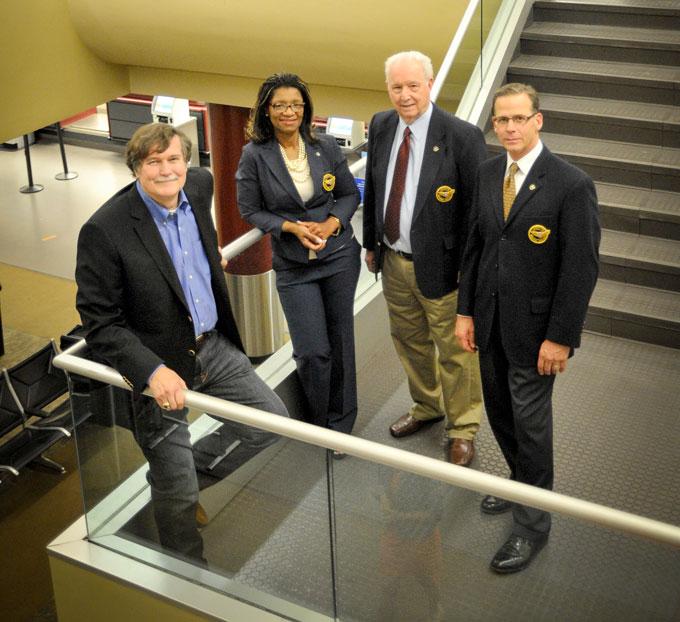
Then collections ran faster than expected. The organizers announced that the tax would shut off after about eight months, once its target had been reached. That update changed the argument. A public promise was not merely being repeated; it was being honored early. In December, 59.4 percent of voters approved the measure.
The transferable idea is almost embarrassingly simple. Put a hard boundary around the ask. Explain the mechanism. Begin with the skeptic. When circumstances improve, return the benefit instead of quietly consuming it. Advertising supplied reach, but operational restraint supplied credibility.
- Define one project, one price and one stopping condition.
- Meet the toughest audience before the friendliest one.
- Repeat the explanation until the mechanism feels ordinary.
- Report good news early, especially when it reduces the public’s cost.
What failed first
SIDES’ work for Lafayette Regional Airport offers another, smaller lesson. The original Fly Lafayette rewards program was low-tech. When it returned in 2011, the agency had started over, writing software to run registration and swipe kiosks. But the kiosks sat beyond airport security, which meant general-aviation pilots and passengers could not participate.
An Aircraft Owners and Pilots Association representative asked whether that could change. The timing mattered: SIDES was already expanding the program. A kiosk was added at the fixed-base operator, opening the club to people who used the airport without walking through the passenger terminal. By March 2014 the program counted 6,200 members, and its success was drawing inquiries from other airports.
The change of mind was not philosophical. Someone identified an excluded user at exactly the moment the system could accommodate them. That is useful product thinking dressed as public relations: observe where participation breaks, then move the interface.

A newsroom brain inside a government brief
Leadership passed to Dee Stanley in 2023, after seven years as the firm’s vice president and chief operating officer. Stanley had spent 12 years as Lafayette Consolidated Government’s chief administrative officer. Before that he was a television news director, investigative reporter, anchor and city-council clerk. It is a résumé organized around the same problem from different seats: what institutions say, what reporters ask and what residents hear.
SIDES sits in a narrow but defensible part of the market. Ordinary agencies can buy media and make campaigns. Emergency-management consultants can write plans. Large government contractors can manage programs. SIDES overlaps all three, bringing creative production into rooms where hazard mitigation, public assistance and community recovery are being discussed. Its edge is strongest when the deliverable must be technically responsible, publicly legible and actually distributed.
This approach depends on a credible institution, a bounded promise and facts that can be made plain. It is less effective when leaders hide tradeoffs, change the rules midstream or mistake more messaging for better policy. No amount of design can rescue an offer the public has good reason not to trust.
There is something pleasingly unfashionable about the SIDES portfolio. Much of it is paper. Much of it is governmental. Its cleverness appears in quantities, reading levels, distribution points and stopping conditions. The agency’s award list is long, but the better proof is behavioral: a card gets carried, a pilot finds the kiosk, a voter understands when the penny disappears.
The advertising business usually asks how to make a message memorable. SIDES’ specialty asks the harder question first: what must a person be able to do after reading it? In Lafayette, that question became a company.