On Anne Sceia Klein’s first day at Sun Oil, gas explosions forced the company into a crisis. The executives, as she later remembered it, did not know what to do or what to say. That is an unusual welcome to a new job, though it has the merit of clarifying the assignment. Years later, after Three Mile Island, Klein attended a crisis-communications seminar, returned to work and wrote a plan. She considered everything down to the vehicles people would use and the person who would speak.
The episode contains the whole AKCG philosophy in miniature. A crisis is usually described as a problem of words. In practice, it is a problem of choreography. Who gets called? Who has authority? Which audience hears first? Can the spokesperson explain what is known without filling the unknowns with wishful thinking? Klein founded Anne Klein & Associates in 1982. The firm later became Anne Klein Communications Group, then the brisker AKCG - Public Relations Counselors. The name changed. The rehearsal remained.
The first thing to fail is the clock
A communications department normally works at institutional speed. Draft, circulate, revise, approve. A crisis works at phone speed. A student posts video. A family calls a reporter. An employee forwards an internal note. By the time the third draft reaches legal, everyone outside the conference room may already have a theory.
AKCG’s response practice is built to shorten that gap. It works with senior leaders and spokespeople on objectives, internal messages, media inquiries and interviews. Before trouble, it audits vulnerabilities, imagines scenarios and assigns responsibilities. During trouble, it tries to “stabilize” the incident - the stage when an organization can still establish open channels and set the tone before events do it for them.
“The media may be the squeakiest wheel when a crisis strikes, but your most important audiences should get the grease.”AKCG’s crisis-response principle
That audience order is a genuine distinction. A senior-living fire is not merely a news event. It is a family event, a resident event, an employee event and an emergency-response event before it is a segment on television. After a deadly fire at Barclay Friends, a Kendal affiliate, AKCG helped the organization communicate through the immediate disaster and preserve trust in the facility. The company says the community later returned to strength. The language is deliberately less cinematic than the event. Reputation recovery is mostly a sequence of kept promises.
Barclay Friends
A fatal fire put residents, families and community trust ahead of ordinary publicity. The work became long-horizon recovery.
Campus protest
During a prolonged 2019 protest, an East Coast college used direct communication and a faster news cadence to limit damage to admissions and advancement.
Independent schools
More than 30 schools have used AKCG while investigating, communicating and moving forward from instances of sexual abuse.
Three verbs, one business
AKCG describes its job with three verbs: build, preserve, restore. They are also a neat map of the business. Build means media relations and thought leadership - finding a defensible position, preparing an expert, pitching stories and measuring whether coverage reaches the people who matter. Preserve means planning, training and monitoring. Restore means live crisis counsel, stakeholder communication and the patient work after attention moves elsewhere.
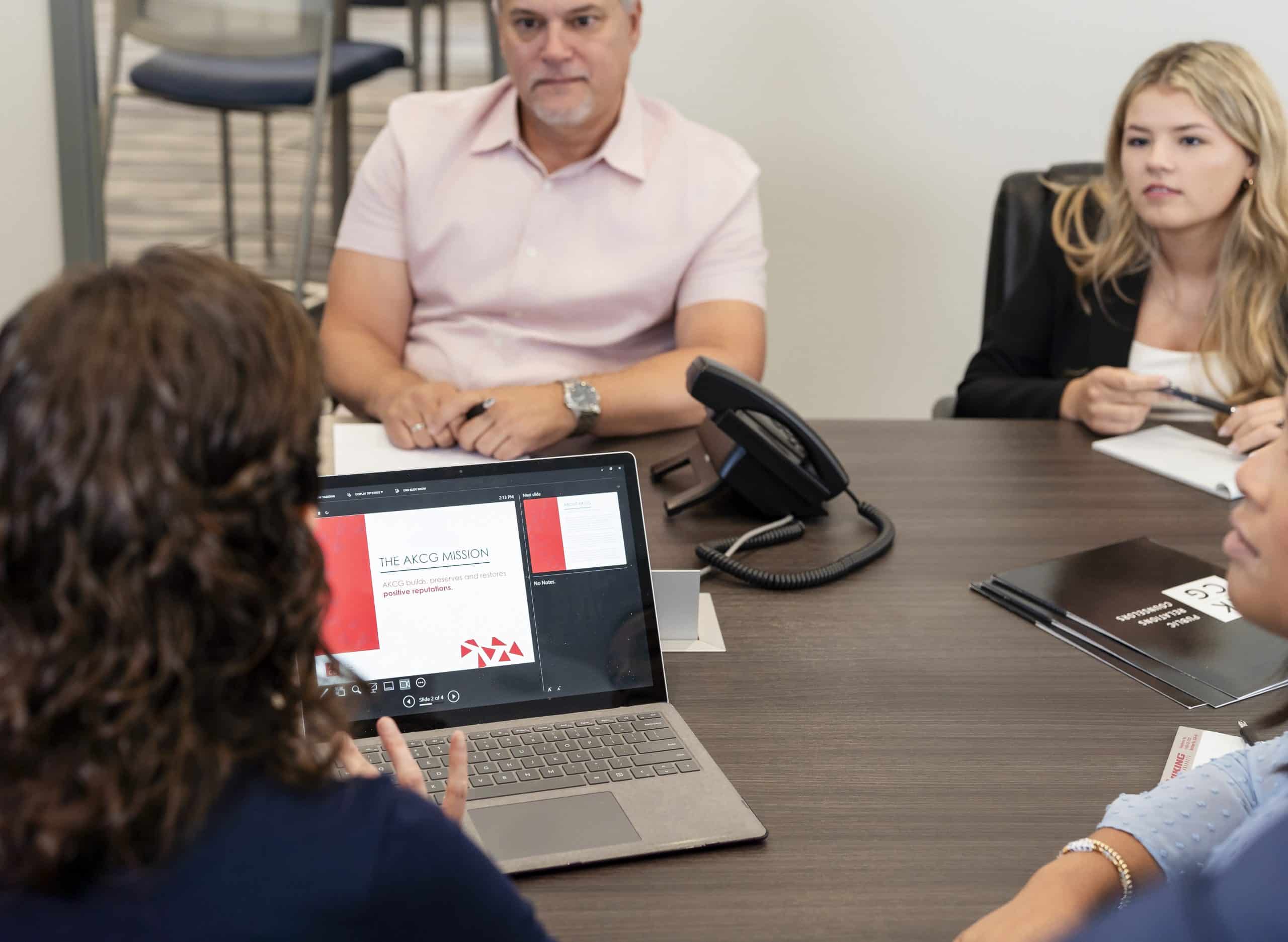
The customers tend to live where scrutiny is high and language carries operational consequences: independent schools, colleges, hospitals, senior-living communities, associations, utilities, nonprofits and other regulated organizations. In those settings, a generalist publicity shop can be the wrong tool. A school investigating past abuse needs legal coordination, empathy and a national understanding of parent and alumni dynamics. A care community needs fluency in regulation, staffing, resident dignity and worried families. Context saves time, and in a crisis time is the scarce material.
A flat bill for an unpredictable day
Consulting has an awkward habit: the meter becomes most frightening when the client is least able to think about it. AKCG On Call tries to remove that hesitation. The service is sold at a flat, projectable rate. It includes 24/7 access to a team already briefed on the organization, plus the strategy and message development required to stabilize an incident, however often the client activates it. Further execution can be scoped separately. AKCG does not post a dollar amount, so buyers still need a proposal. But the mechanism matters: calling early does not trigger a fresh strategy bill.
flat-rate model
What the retainer changes: leaders can call while an issue is still containable. The published offer includes stabilization strategy and message development; implementation beyond that stage is separately defined.
The newer CODE Score Leadership Trust Baseline pushes the firm further upstream. It asks stakeholders to assess leadership through four qualities - caring, openness, dedication and expertise - then uses the gaps to shape a communications plan. It is a simple but useful correction to the vanity of clip counting. Coverage can be plentiful while trust is falling. A baseline makes the argument testable.
The narrow firm gets wider
Specialization has not prevented growth. AKCG reached No. 2,567 on the 2025 Inc. 5000 after reporting 164 percent revenue growth over three years. In May 2026 it acquired Cleveland-based Hennes Communications, founded by Bruce Hennes in 1989. Hennes brought additional depth in crisis and litigation communications, executive training and reputation management, along with experience advising law firms, public utilities, universities, manufacturers and major healthcare organizations.
2025 Inc. 5000
The acquisition is less a pivot than a doubling down. Large global advisory firms can supply vast networks; local agencies can supply familiarity; in-house teams know the institution from the inside. AKCG’s place between them is senior specialist counsel with national reach and vertical experience. It works when leaders are willing to expose operational weaknesses before they become headlines, give counselors access to decision-makers and align communications with actual behavior. It works poorly when management wants a clever sentence to substitute for an honest fix.
What to copy before Monday
Most organizations do not need a crisis firm to borrow the discipline. They need a table, a clock and the nerve to ask uncomfortable questions while nothing is burning.
- Name the first five calls. Employees, families, regulators and partners may deserve direct contact before a public post.
- Write roles, not just messages. A polished holding statement is useless if nobody knows who can approve it.
- Practice with friction. Use mock interviews, playback and hostile questions. Confidence assembled in private tends to survive public pressure.
- Change the medium. Chris Lukach’s advice to schools is wonderfully ordinary: do not always answer a tense letter with a letter. Pick up the phone and disrupt the cycle.
- Measure trust before volume. Establish what stakeholders believe, then test whether awareness, understanding and behavior move - not merely the number of mentions.
There is one more lesson in Klein’s first day among the gas explosions. The executives were not foolish; they were unrehearsed. Under pressure, an organization does not rise to the eloquence of its mission statement. It falls to the quality of its preparation. AKCG has spent four decades turning that mildly terrifying fact into a business.