A snake, an impala, an anteater and a narwhal. Put their initials together and you get SIAN. Years before artificial intelligence became a conference topic for Sian Morley-Smith, an illustration exercise offered her a rather more zoological way to introduce herself. Her design blog records the assignment with an explanation that makes the choice sound inevitable: animals were the obvious material.
It is a pleasing introduction to someone whose working life is usually described in software terms. Morley-Smith is the co-founder and co-CEO of ToucanTech, which brings databases, websites, communications, events and fundraising into one system. The job involves records and processes. Her older creative work involves whales, sloths and names assembled from creatures. Somewhere between those two worlds sits an interest in making things that people can understand and enjoy.
There is no need to turn the narwhal into a business parable. It is more interesting as a detail: the person helping institutions organise their relationships has also spent time drawing animals into letters. A company biography tells you what someone does. An anteater occasionally improves the picture.
A biologist takes the operational route
Morley-Smith studied at Imperial College London from 2003 to 2006, completing a BSc in Biology. She also served as vice-president of the Royal College of Science Union in 2005-06. The combination places scientific study beside the work of a student organisation: one part of university life concerns the subject, another concerns the people sharing it.
Her interest in community fundraising began at Imperial. A later career in IT consulting at Accenture supplied a different kind of preparation, with technology and operations becoming the recurring subjects of her professional life. The route to running a software company passed through biology, student representation and consulting. It was an education with several departments.
That background matters because ToucanTech deals with work that straddles disciplines. An alumni officer may need to write a newsletter, maintain accurate records, arrange an event and keep track of donations. The human relationship continues through all of those jobs, even when the software treats each as a separate destination.
The first community had a business-school question
Before ToucanTech came BusinessBecause, the business-school platform associated with Morley-Smith, Kate Jillings and Maria Ahmed. Launched in 2009, it connected prospective applicants with the experiences of students and the institutions they were considering. Stories about studying and working gave a specialised audience reasons to return.
There was a straightforward human problem underneath the publishing business. Choosing a business school can mean choosing a country, a financial commitment and a possible new career. Other people’s accounts help make that decision less abstract. BusinessBecause brought candidates, schools, students and employers into the same conversation.
On 10 April 2018, the Graduate Management Admission Council completed its acquisition of the company. The agreement provided for BusinessBecause to retain editorial and creative independence as a separate subsidiary. For Morley-Smith, it marked a concrete achievement in building a business around a defined community.
Jillings later recalled Ahmed’s vision for the platform’s more human and humorous coverage, alongside Morley-Smith’s contribution to making the day-to-day work happen. That is a useful distinction in a founder story. Ideas have authors; operating businesses also need people who keep the activity moving after the initial enthusiasm has worn off.
Building the machinery for staying in touch
ToucanTech’s development overlapped with the BusinessBecause years. The company was incorporated in November 2013; Jillings describes establishing the venture in 2014; the product launched in 2016 after 18 months of development. Those dates describe different stages of the same undertaking. The software did not arrive fully formed on the day the company paperwork was filed.
The product gave schools, charities and other organisations a shared place for community administration. A database could connect to the website, email communications and fundraising activity. For small teams, the appeal was practical: fewer disconnected tasks between an institution and the people who cared about it.
The earlier business had operated a community of its own. ToucanTech offered other organisations the tools to run theirs. Morley-Smith and Jillings carried their working partnership into a different business model, supplying software to the people responsible for keeping networks active.
There is an unglamorous amount of coordination in that proposition. Sending an invitation involves choosing the right people, having their details and recording what happens next. Joining those steps together gives the community team a better chance of following through. For Morley-Smith, the work extends the operational interests that preceded ToucanTech: helping a group’s intentions survive the business of getting things done.
In 2020, Pembroke VCT invested £1 million. Its newsletter at the time described more than 160 clients and over £250 million in donations tracked through the database. That last figure belongs to customer activity recorded on the platform. It is a measure of the work passing through the software, rather than the company’s own income.
Ten new colleagues, and a question about trust
Growing the company brought its own community problem: how should new colleagues join a team working online? In August 2020, Morley-Smith described hiring ten people and expanding the commercial operation. She personally conducted initial screening calls without video, then brought promising candidates into further conversations with their prospective teams.
Her description of onboarding was agreeably plain: “Onboarding is difficult and can be dull!” Getting the technology ready before day one let a new hire begin useful work sooner. Managers needed to explain the projects and priorities, then allow the person they had chosen to get on with them.
“You hired someone great, right? Then you trust them to deliver.”
Sian Morley-Smith, 2020
She also recognised the comedy of online communication: a dry joke can look remarkably like irritation when it arrives as text. Informal conversations and emojis helped colleagues interpret one another. The managerial lesson was small and practical. A functioning team needs enough everyday contact for people to understand how the others sound.
Her old school becomes part of the story
The work has circled back to institutions from her own education. St Mary’s School, Cambridge, identifies Morley-Smith as an alumna, under her former name Fleming-Jones. Its Pastonians Connect network runs on ToucanTech. When the school introduced its Empower mentoring initiative, the platform provided the setting for former pupils to offer advice and support.
Mentoring gives this connection a purpose beyond remembering school days. The Empower programme invites former pupils to help with CVs, mock interviews, introductions and decisions about what comes next. A network becomes useful through those individual exchanges. A young person needs advice; someone further along has experience to share. The platform supplies a place for the introduction.
In the school’s 2024 anniversary magazine, Morley-Smith described building a team of 60 and operating offices across three continents. Set beside the school connection, the scale has a particular intimacy. A former pupil helped build the system through which other former pupils could remain involved.
Hills Road Sixth Form College supplies another return journey. Morley-Smith attended the college, which relaunched its alumni website at the end of October 2025 using an existing ToucanTech database. The decision preserved records accumulated earlier, rather than requiring the development team to begin again.
The college’s experience also gives the software story a useful dose of realism. Its earlier network had faded without someone to look after it. A dedicated development role, created in February 2025, changed the circumstances. Technology could retain the information; people still had to make the invitations and keep the conversation going.
For the small team rebuilding that engagement, newsletters and a leavers survey became recurring ways to bring people back. The familiar institution, the old records and a new programme of contact belonged together. Morley-Smith’s personal connection made the choice warmer, while the existing data made it practical.
CommunicationsMeet again
EventsOffer support
Giving
A schematic of the connected work ToucanTech supports.
From the newsletter to the dataset
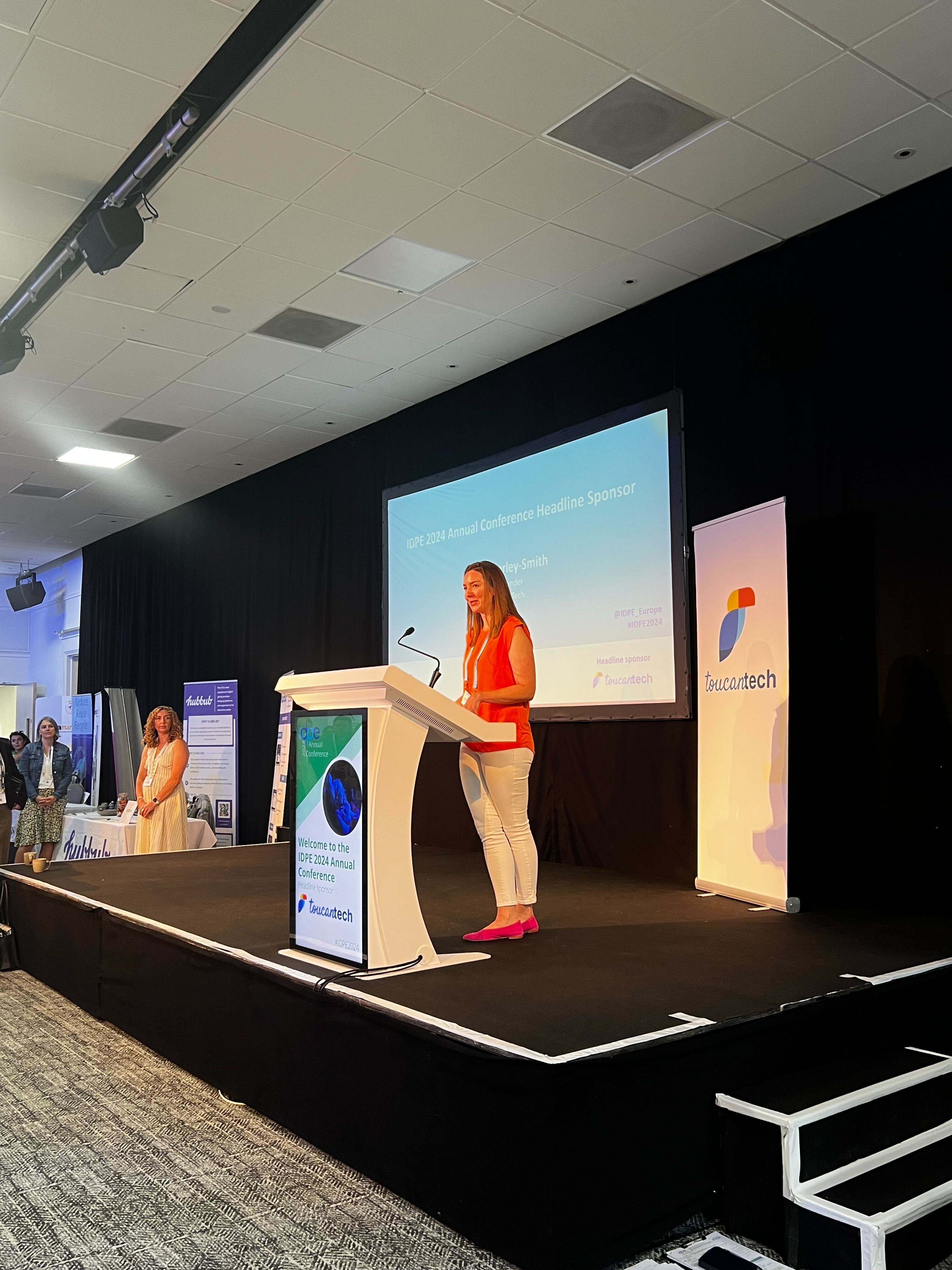
Morley-Smith’s conference work shows how the questions have changed. In 2016, she was listed on the IDPE programme leading a roundtable about online content that gets results. The subject was the usefulness of emails, newsletters and stories, with examples and measures to help development professionals understand their effects.
A later ToucanTech networking programme offered her practical design tips for non-designers. The subject fits someone with an illustration portfolio as well as an operational role: a message has to look coherent before anyone can be expected to act on it. Her portfolio ranges through animal names and London scenes, reminders of the visual interests alongside the software career.
For the IDPE conference on 18-19 May 2026, the advertised topic was preparing schools for AI, from organisational mindset to the structure of a dataset. Her workshop included database preparation, record summaries, note-taking tools and turning notes into material that could be imported into a system. The emphasis was on jobs a development team could recognise.
That practical interest comes with questions about trust. Reflecting on London Tech Week in 2025, she wrote about the value of originality and human connection amid the growth of generated content. Her workshops and that reflection sit comfortably together. A useful new tool still needs someone to decide what deserves attention.
The continuing ambition is to use technology to strengthen support networks. Her career has approached that task through publishing, operations, design and software. It remains grounded in ordinary acts: reading another person’s experience, finding a former classmate, answering an invitation, giving someone time. The snake and the narwhal can stay in the sketchbook. There are plenty of people to connect.