Sherrese Clarke learned dealmaking from a man who drove a taxi. Her father, Desmond, a Jamaican immigrant, went on to build a real estate brokerage and invest in property. At the kitchen table, he walked his daughter through transactions and debt financing. Before she had a finance degree, she had a practical demonstration of what money could make possible.
There is a useful intimacy to that beginning. A transaction can look bloodless when reduced to a spreadsheet. At a family table, the people attached to it are harder to miss. Clarke’s early education joined the mechanics of financing to the reasons someone might need it. Her later work would put those two concerns in the same room again, with musicians and filmmakers occupying the seats.
She grew up in Queens, in a household where culture was part of ordinary life. She studied piano and acted as a child. The future investor had experience on the other side of an audience. That gives her eventual choice of industry a certain logic: she had already spent time with the things that would later appear in a portfolio.
Her favorite album is Stevie Wonder’s Songs in the Key of Life. She ran a theater group in college. For her Harvard Business School application, she wrote about building an investment platform for content. An admissions essay is usually a temporary exercise in presenting a plausible future. Clarke appears to have treated hers as a set of working instructions.
“I believed content could change the world.”
Sherrese Clarke, on her business-school ambition
A long apprenticeship in other people’s money
Georgetown supplied the finance degree; Harvard supplied the MBA. Between and around those credentials came the institutional work. Clarke’s career took her through Morgan Stanley and CIT, into the details of lending, capital commitments and entertainment finance. The route to buying songs passed through years of learning how to evaluate businesses and arrange their funding.
At CIT, she helped develop the entertainment practice as one of three founding senior leaders, overseeing a $1 billion portfolio. At Morgan Stanley, she eventually led its Entertainment, Media & Sports Structured Solutions platform. Her biography also credits her with managing the origination and execution of more than $85 billion in loan commitments. Those were bank commitments, a different measure from the assets her own firm would later manage.
Credit work asks particular questions. What supports repayment? What persists after the excitement fades? How much confidence belongs in a forecast? For an entertainment investor, these questions follow a song beyond opening week and a film beyond its first weekend. An audience may applaud once. A lender wants to understand what happens afterward.
Tempo Music gave Clarke a chance to put a music-rights platform into practice. The venture launched in 2019 with Providence Equity Partners and Warner Music Group, backed by $650 million in equity and debt capacity. Warner’s responsibilities included publishing administration and recorded-music distribution. Behind the agreeable word “music” sat a collection of distinct rights and administrative jobs.
Clarke served as Tempo’s founding CEO, chaired its investment committee and sat on its board. In January 2021, she left to establish her own venture. Her farewell described an idea that had begun with a blank page and a call from colleague Drew Hawkins in 2015. The polished company had a considerably less polished first draft. Most worthwhile things do.
The chorus has another job
HarbourView Equity Partners officially launched on October 7, 2021, with Apollo clients and funds as lead investors. Its remit covered media and entertainment. Clarke wanted the people making valuable content to participate in its economics as well as its creation. A good seat at the table, in this formulation, includes a say in the deal.
Her shorthand is “Content is queen.” The phrase is memorable enough to survive a conference badge, but the investment premise requires more patient explanation. Songs can generate income through repeated use. Owning an interest in those rights gives an investor exposure to that continuing activity. The purchase concerns a defined asset or income stream, rather than an artist’s entire career.
That distinction matters when famous names enter the conversation. Buying a publishing catalog, selected recordings or a royalty interest involves different things. An investor may acquire part of the economics associated with an artist without owning every recording or composition. The headline-sized version of a transaction often travels faster than its contractual fine print.
HarbourView’s portfolio crosses genres and generations. Its early acquisition of Luis Fonsi’s catalog brought the firm into the orbit of Despacito. Other transactions have involved country, hip-hop, R&B and rock. The range reflects a willingness to examine audiences outside one familiar musical neighborhood. Personal taste may open a conversation; it cannot finish an investment decision.
Clarke has described a firm built around data and portfolio construction. The team uses its own platform to examine audiences, assess potential investments and manage the mix of existing assets. The unromantic work continues after a deal closes: bring the rights aboard, collect income and look for opportunities to support their value. Someone has to mind the paperwork while everyone else sings along.
A song needn’t be old to become someone’s classic
In a later Trapital conversation, HarbourView’s approach included a notably contemporary repertoire. The songs in its portfolio averaged twelve years old at the time of that interview. The premise was that younger listeners would develop durable favorites of their own. A classic does not arrive with an age certificate. It becomes one through people returning to it.
That is an appealing idea with an exacting financial consequence. Continued listening has to be assessed rather than wished into existence. A song can have a large moment and a short afterlife. Another can keep finding new listeners after its original campaign has vanished. The important question is how a particular catalog behaves over time, including how quickly its income might decline.
Clarke’s emphasis on audiences makes that distinction central to her work. A familiar name provides context; patterns of consumption supply another kind of evidence. Investors still have to choose a price and live with the uncertainty in their assumptions. Affection for a chorus is a fine human response. It is insufficient preparation for writing a large check.
The portfolio’s breadth also changes how to think about the enterprise. A collection of music rights spreads exposure across works, creators and audiences. It does not make each work equally durable. It does allow the firm to construct a business around many listening habits, rather than ask a single performer to carry every expectation placed on the fund.
Capital arrives; the work gets larger
In June 2025, HarbourView announced an additional $500 million in debt financing through a private securitization backed by its music portfolio. KKR-managed insurance vehicles participated. The transaction followed nearly $500 million in financing secured in 2024 from KKR-managed vehicles and accounts and other investors. Here, the accumulated rights supported a further financing step.
The announcement put HarbourView’s regulatory assets under management at approximately $2.67 billion, measured as of December 31, 2024. That number describes managed assets under the regulatory calculation. It is separate from Clarke’s personal wealth, annual revenue or money distributed to investors. Large numbers are rather sociable: unless carefully introduced, they tend to borrow one another’s identities.
The financing also made visible the relationship between creative assets and institutional capital. The music that people replay can sit beneath a transaction involving insurance vehicles and structured finance. Clarke’s earlier banking experience belongs in this picture. The firm needs people who understand both the continuing appeal of the work and the obligations attached to its financing.
Her career has drawn recognition from different rooms. Billboard gave her its Trailblazer Award in 2023. Inc. included her on its Female Founders list that year. By 2026, her official biography recorded further Billboard recognition and inclusion in the ForbesBLK 50 Money Masters. The audience for her work includes musicians, entertainment executives and the people allocating investment capital.
HarbourView regulatory assets under management as of December 31, 2024, reported in June 2025.
From a playlist to a production slate
The content ambitions in Clarke’s business-school essay extended beyond music. HarbourView has invested in media companies including MACRO and Mucho Mas Media. It also backed Usher’s 2024 concert film, Rendezvous in Paris, and a proposed slate of hip-hop biopics with Westbrook Studios, Flavor Unit and Jesse Collins Entertainment, beginning with Queen Latifah. These are partnerships around creating and financing screen work.
In September 2025, HarbourView and the Steward Family led a $30 million investment round in Lion Forge Entertainment. HarbourView took a minority investment; the Steward Family and Polarity remained majority owners. The studio planned to expand its intellectual-property portfolio and franchise pipeline. The ownership detail helps explain the relationship: Clarke’s firm joined an existing enterprise with its own leadership and creative plans.
Lion Forge’s family entertainment business adds another kind of audience to the story. A song catalog arrives with an established history of use. A studio’s future projects require choices about development and production. Both concern intellectual property, but their daily demands differ. Expanding across them calls for more than using the same financial vocabulary on a different poster.
Clarke’s public connections run through those creative and financial worlds. In May 2023, she joined Issa Rae for a Milken Institute conversation moderated by Ari Melber about storytelling and underrepresented communities. She is also a Carnegie Hall trustee. The recurring subject is who gets to make culture, who helps it reach people and who participates in the value it creates.
The next listener is part of the deal
In March 2026, HarbourView announced an acquisition of selected music and non-music assets from the Quincy Jones estate. The assets included recorded music, publishing and Jones’s participation in The Fresh Prince of Bel-Air. The agreement also set out collaboration with the estate on future initiatives involving his name, image and likeness.
The family and HarbourView identified preservation, education and protection as shared priorities, including safeguards against unauthorized or exploitative uses of AI. This introduces a responsibility that outlasts the announcement. A celebrated body of work comes with people who care about how it is presented. Future uses have to answer to the terms of the agreement and the legacy behind it.
Clarke’s stated ambition is to build across the wider media and entertainment business. The sequence of investments gives that ambition substance: music rights, production companies, concert film, animation and an estate whose work crosses several forms. Her job is to connect capital with those opportunities while keeping the distinctions between them clear.
The kitchen-table lessons remain a useful way into the career. Financing was something her father could explain through an actual transaction. Culture was something she could play, perform and enjoy. HarbourView brings those experiences into a demanding professional setting. The song keeps moving through people’s lives; Clarke works on the agreements that follow it.
Follow the work. Hear the conversations.
- HarbourView: Clarke’s official biography ↗
- Sherrese Clarke on LinkedIn ↗
- Sherrese Clarke on Instagram ↗
- The kitchen table and the catalog strategy ↗
- The business-school essay and early ambition ↗
- Tempo’s launch with Warner and Providence ↗
- Leaving Tempo to build her own venture ↗
- The 2021 HarbourView launch ↗
- The 2025 financing announcement ↗
- Music Rights Investing: the Trapital conversation ↗
- Lion Forge’s investment announcement ↗
- The Quincy Jones estate partnership ↗
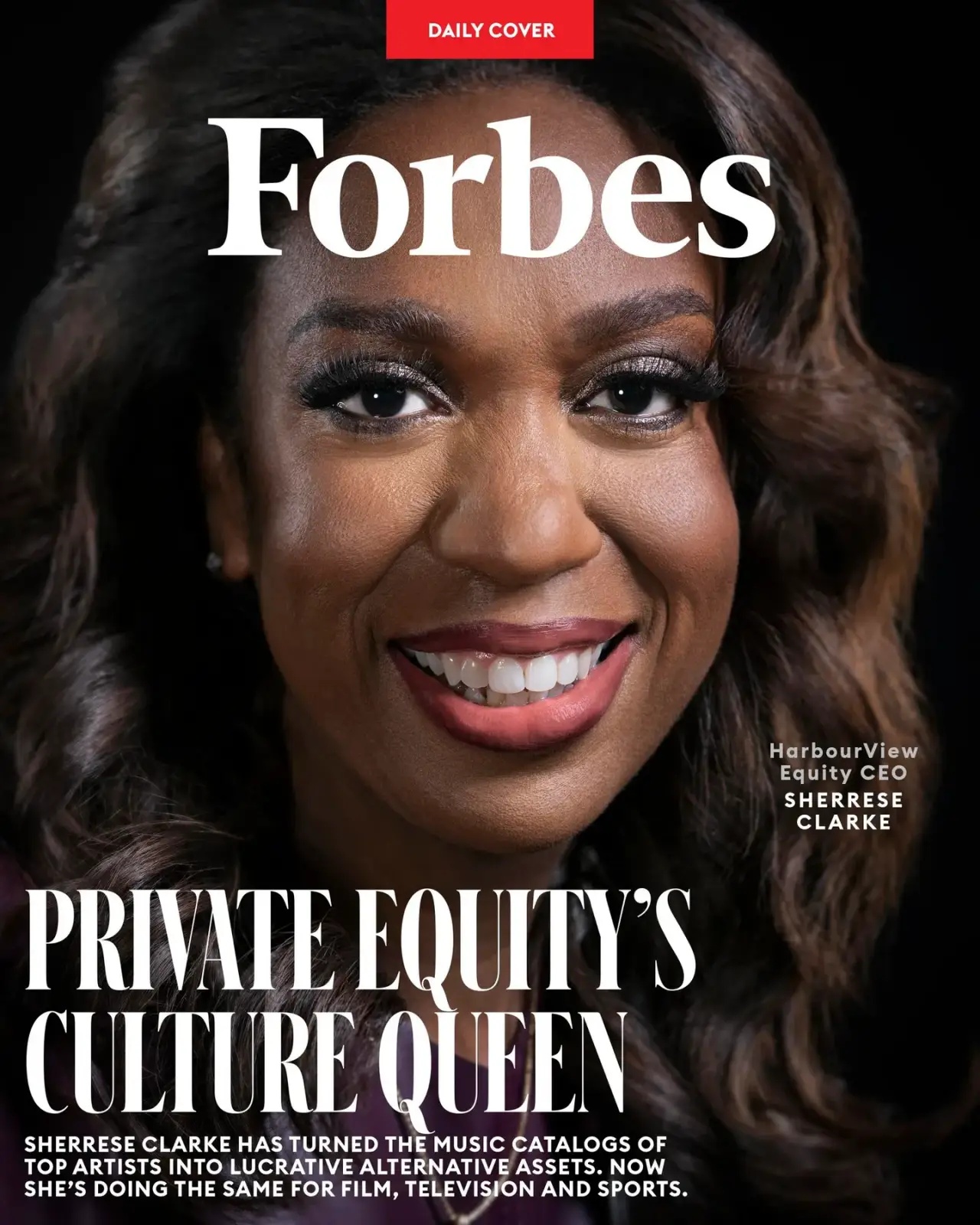
- The 2026 Forbes profile ↗
- Watch: Billboard’s Trailblazer Award acceptance ↗
- Watch: the Issa Rae conversation at Milken ↗
- World Music Views interviews on YouTube ↗