A photograph of a castle usually ends up in an album. Giuseppe Ottaiano’s photographs found another destination. In Casalbore, rooms beside a Norman tower house the Museo dei Castelli, whose core came from his exhibition of Irpinia’s castles and fortifications. The images became part of a place people could visit. Then came the teaching, the workshops, the walks through the village.
It is a useful way into SEMA, the communications agency Ottaiano co-founded with journalist and educator Maddalena Venuso. A collection of pictures can do several jobs. It can record a landscape, introduce an unfamiliar town, supply an exhibition, and give a teacher a reason to organize a trip. The subject stays recognizable while the way people encounter it changes.
SEMA works in that space between having something worth showing and arranging for someone to notice. Its portfolio contains websites, packaging, exhibition work, and printed publications. Its particular interest is Campania: the foods, buildings, customs, and landscapes that give a regional identity something concrete to rest on.
An agency with an egg theory
There is an egg running through SEMA’s self-portrait. Eggs appear in its website imagery, and its agency story compares communication to an ingredient that works in many forms. Boiled, fried, or folded into something else, the egg changes its role according to the dish. It is an unusually domestic explanation of a professional service.
“La comunicazione è come l’uovo!”
SEMA’s agency story
“Communication is like an egg!”
The comparison carries a serious proposition. A message has to suit the circumstances in which someone encounters it. A printed object and a website impose different demands. An event adds bodies, rooms, timing, and the possibility that somebody needs a chair.
SEMA’s own account says the increasing complexity and variety of media prompted it to broaden its services. The result is six areas spanning design, websites, marketing, media planning, events, and press work. Its evolution is described as an expansion of what it could deliver as communication became more complicated.
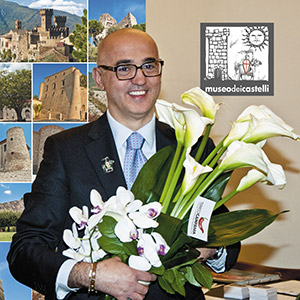
The town supplies the material
Ottaiano’s professional biography describes years spent documenting and promoting Campania. His work includes regional forest guides, a forest information point at Cuma, and books about local food and fortified places. In 2015, he presented Irpinia Terra di Castelli at Expo with the Avellino Chamber of Commerce.
These are tangible ways of organizing knowledge. A guide gives a reader a route through a subject. An information point puts that knowledge where a visitor can use it. A book lets the photographs travel. The creative choice lies partly in deciding which form gives the material a useful next life.
At Casalbore, the museum’s educational offer includes a village walk, a workshop about local bread and oil, an exhibition visit, and interactive games. Its published contribution is €10 per pupil. The castle photographs belong to a larger experience that a school can understand, schedule, and book. That makes the cultural proposition wonderfully specific: here is what your class will actually do.
Water gets a website
The same interest in regional knowledge appears around MUMAC, the Museo Multimediale delle Acque Campane in Sant’Anastasia. In March 2024, Rai reported on the museum’s mapping of Campania’s water heritage, from springs to waterfalls. Its television piece interviewed Ottaiano as the project’s originator with the association Terre di Campania.
SEMA’s portfolio documents a distinct professional contribution: the museum’s logo, in an entry dated December 6, 2023, and its website, dated January 4, 2024. The website mockup shows the work across desktop, tablet, and phone. Blue water imagery and the museum’s identity carry across those different screens.
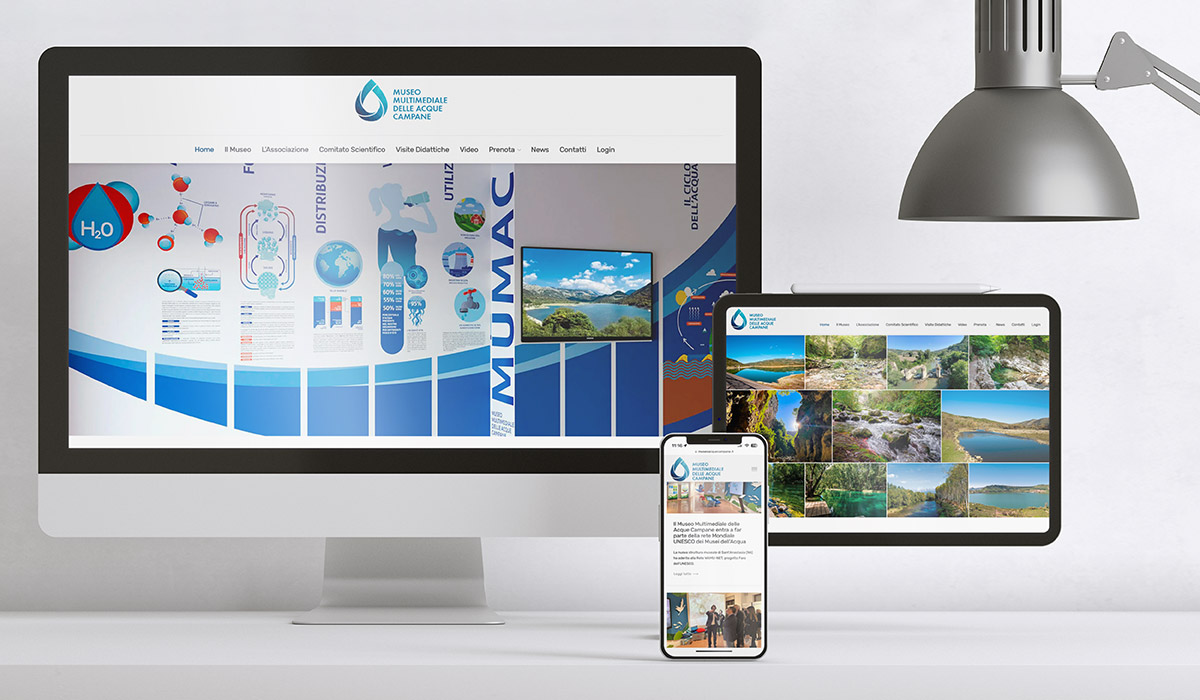
The relationship also has a later public trace. A June 2025 report about a MUMAC meeting on cooperation among regional water museums carries SEMA’s press-office credit. The association, museum, and agency have distinguishable roles here. Together, these records show design and publicity appearing at different stages of a cultural project.
Yes, somebody has to supply the chairs
There is a pleasingly unromantic document in SEMA’s public record. On May 10, 2023, the Naples nursing professions order approved an award to the company for one gazebo, two folding tables, and four folding chairs. The resolution set a maximum expenditure of €2,700, excluding VAT and other statutory charges.
Maximum authorized expenditure, excluding VAT and statutory charges.
That is a spending ceiling for a particular supply, not a price list for creative work. But it reveals an aspect of the business that a portfolio image cannot: delivery can include ordinary physical equipment. A client’s project has requirements all the way down to the furniture.
A later conference programme supplies another practical example. For Cristiani in cammino... costruttori di pace, held in Assisi on December 5–7, 2025, SEMA is named as the organizing secretariat, with Ottaiano as the contact. The agency’s work extends into the arrangements that allow people to gather around an idea.
A bulletin belongs beside a browser
SEMA’s customers also include commercial organizations. Its client gallery spans food producers, energy businesses, pharmacies, and cultural institutions. Named examples include wine producer Salvatore Molettieri and the Stazione Zoologica Anton Dohrn. This breadth places its regional work within a wider agency practice.
The portfolio makes that mixture easy to see. A Thoma24 website entry is dated June 3, 2024. A November 2023 entry presents the Madonna dell’Arco sanctuary’s bulletin. The bulletin requires someone to make a publication coherent and readable; the website offers a different setting for communicating an organization’s presence.
For a buyer, the appeal of that range is coordination. One agency can work across the identity, publication, digital presence, and publicity around a project. SEMA sells professional services and delivered work to businesses and institutions. Public procurement is one documented route through which that work is commissioned.
Begin with something people can point to
The lesson I take from this collection of work is to start smaller than “our brand story.” Start with a building, an object, a practice, or a person who remembers something. Decide what another person could learn or do with it. Then choose the form that makes that encounter possible.
SEMA’s published programme for the 2023–2024 nativity celebrations at San Vito in Marigliano offers a particularly human example. It proposed interviewing grandparents and assembling their memories into a documentary. Alongside that were craft workshops, exhibitions, music, and food. A familiar celebration supplied several ways to participate.
That approach depends on material worth sharing and people willing to help share it. A beautiful account of a place cannot, by itself, arrange access to the building or run the workshop. The practical question for anyone borrowing the idea is what happens when the audience arrives. In Casalbore, the answer includes a walk, bread and oil, and photographs of castles. It is a rather good place to begin.