Every company has one person who knows where the numbers live. Their calendar is a crime scene. Sales wants a cohort cut, finance wants a clean total, product wants to know what changed, and somebody has typed “quick question” in Slack. Seek AI was built for that person, and for everyone waiting on them. It put a plain-language box in front of structured company data, generated the query, showed its work, and left room for an analyst to approve the answer. That final clause is the whole story.
Seek is most useful to organizations with a real data warehouse, a busy analytics team, and a long tail of questions too specific for a dashboard. It is less compelling for a small business living happily in spreadsheets, or for a team that wants a free chatbot to explore a CSV on Friday afternoon. Public pricing never appeared. Deployment involved a Snowflake Native App, a managed service, or an embedded arrangement. This was enterprise software, paperwork and all.
The question-to-answer relay
Who should have wanted this?
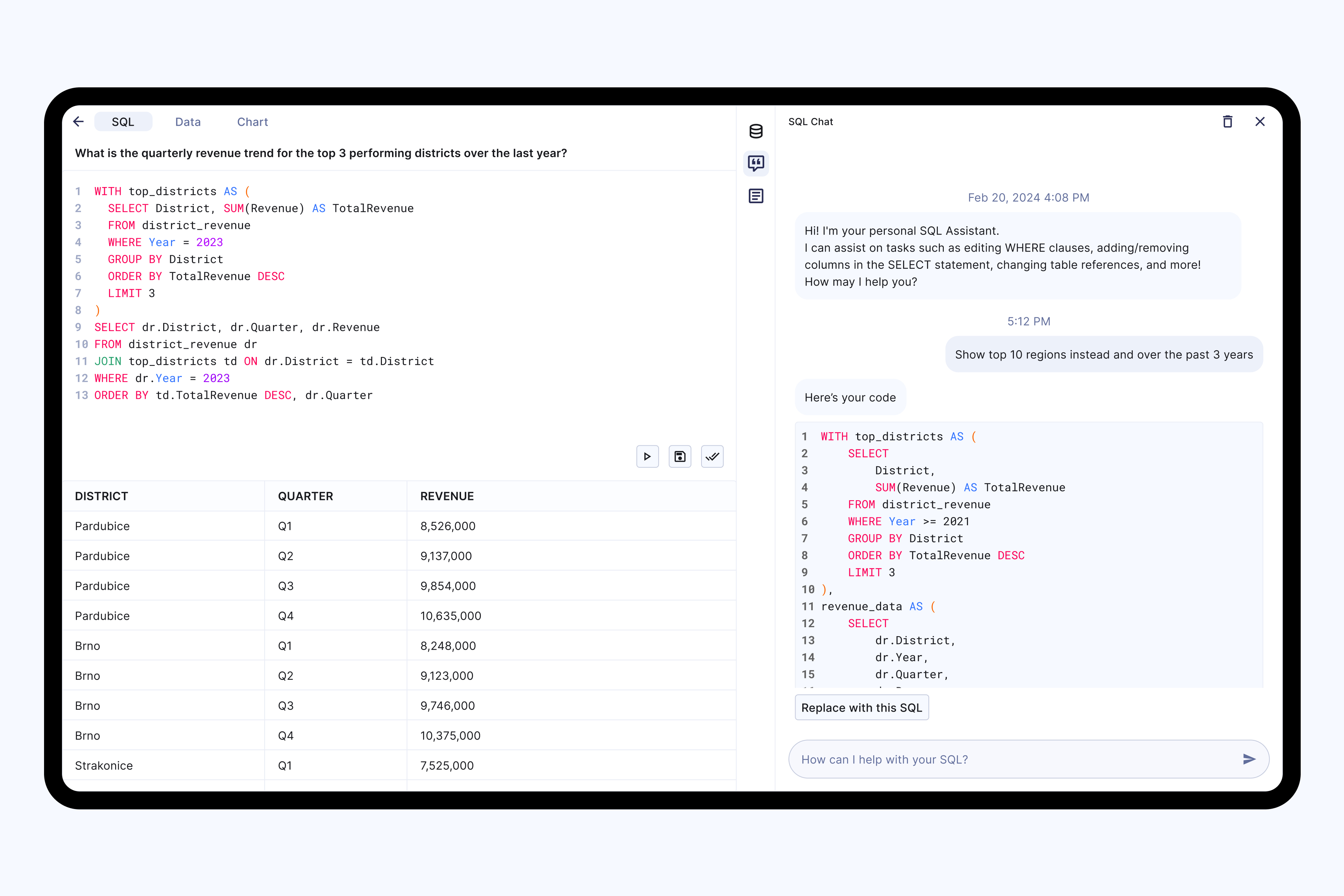
The obvious buyer was the head of data who could recite the backlog in days. Seek offered business colleagues a front door that felt like chat, while analysts kept the grown-up controls: schemas, generated code, tables, charts, saved insights, and a SQL editor. The same workflow could sit inside another software product through Powered by Seek, letting that product’s customers ask ad hoc questions without opening a support ticket.
Customer-success teams were another natural fit. They field questions with a peculiar half-life: urgent for the customer, small enough to lose against a strategic analytics project, and likely to return next month in slightly different clothing. One anonymized Seek case study reported that representatives went from waiting as long as two months to getting most answers in under a day. New-rep onboarding reportedly shrank from as long as a year to under two weeks because useful questions and approved answers could circulate instead of staying inside one veteran’s head.
Retail and consumer brands made particularly tidy examples. Welles, a medical-workwear label, said Seek helped it segment dormant customers, inspect returns, and make inventory decisions. In one month, the company reported re-engaging 4,000 dormant customers, reducing returns by more than half, and replacing five Shopify apps. Storelli, a soccer-equipment company, said the tool got its team “80% of the way there” when surfacing product bundles. BattleFin cited access across more than 2,400 datasets. These are company case studies rather than controlled trials, but they show the right shape of job: many data sources, recurring questions, and decisions that cannot wait for next week’s dashboard refresh.
The chat box was the decoy
By 2025, every analytics product had learned to draw a chat box. Seek’s more interesting work happened after the user pressed send. Its Dialogue Agent interpreted intent. A Semantic Parsing Agent converted that intent into database code. An Explanation Agent turned the output back into readable language. An Exploration Agent proposed follow-ups. Previous questions could enter an insights catalog, so answers became shared institutional memory instead of another disposable DM.
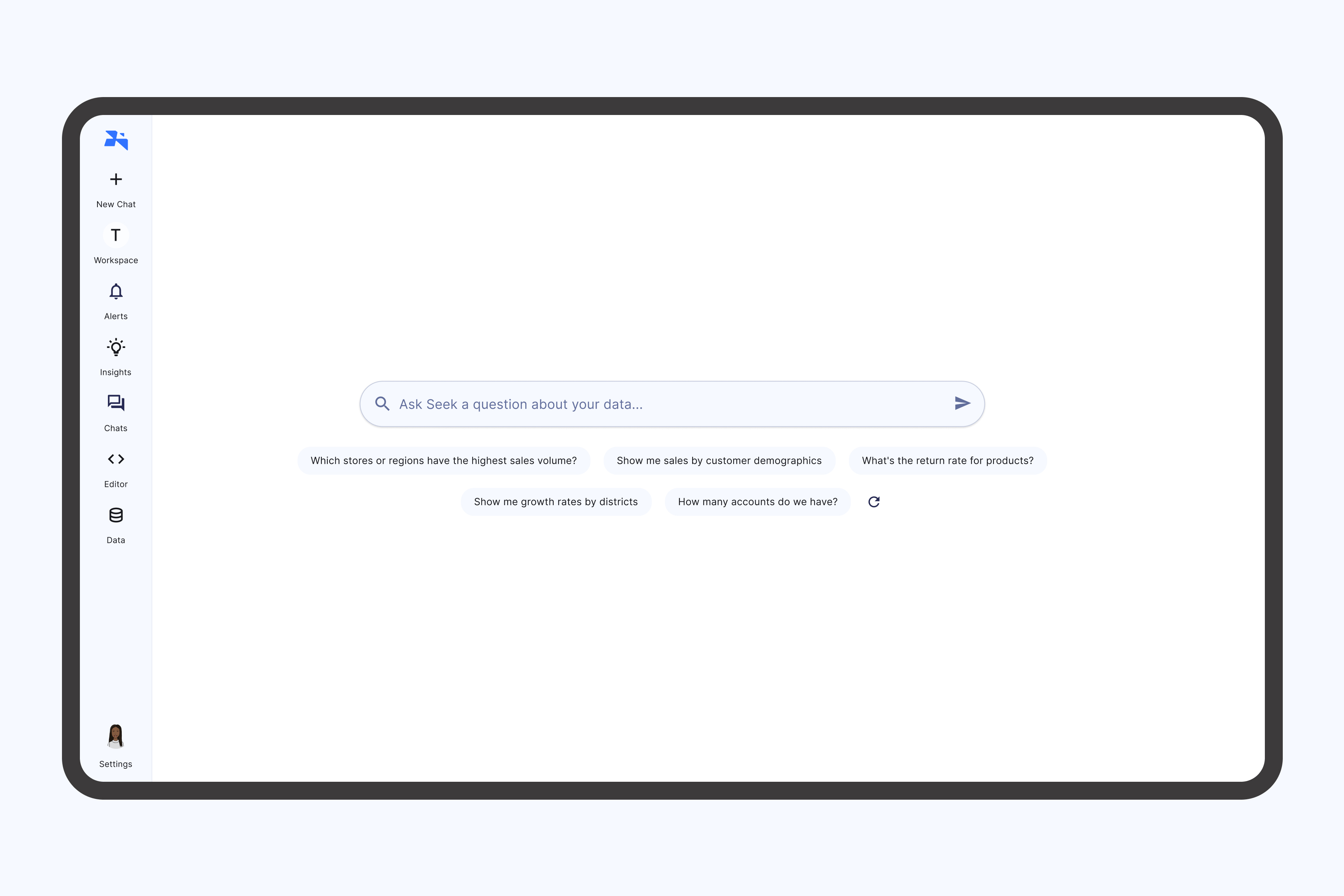
SEEKER-1, announced in November 2023, was the production natural-language-to-SQL system behind the product. Seek described a proprietary system of models with a semantic-network architecture, reinforcement and in-context learning, plus the option to use third-party language models. MiniSeek, a simplified research version, scored 91.2% execution accuracy on the Spider 1.0 test benchmark. It was a serious result at the time. Spider 1.0 stopped accepting submissions in February 2024, so the number is a milestone, not a permanent crown.
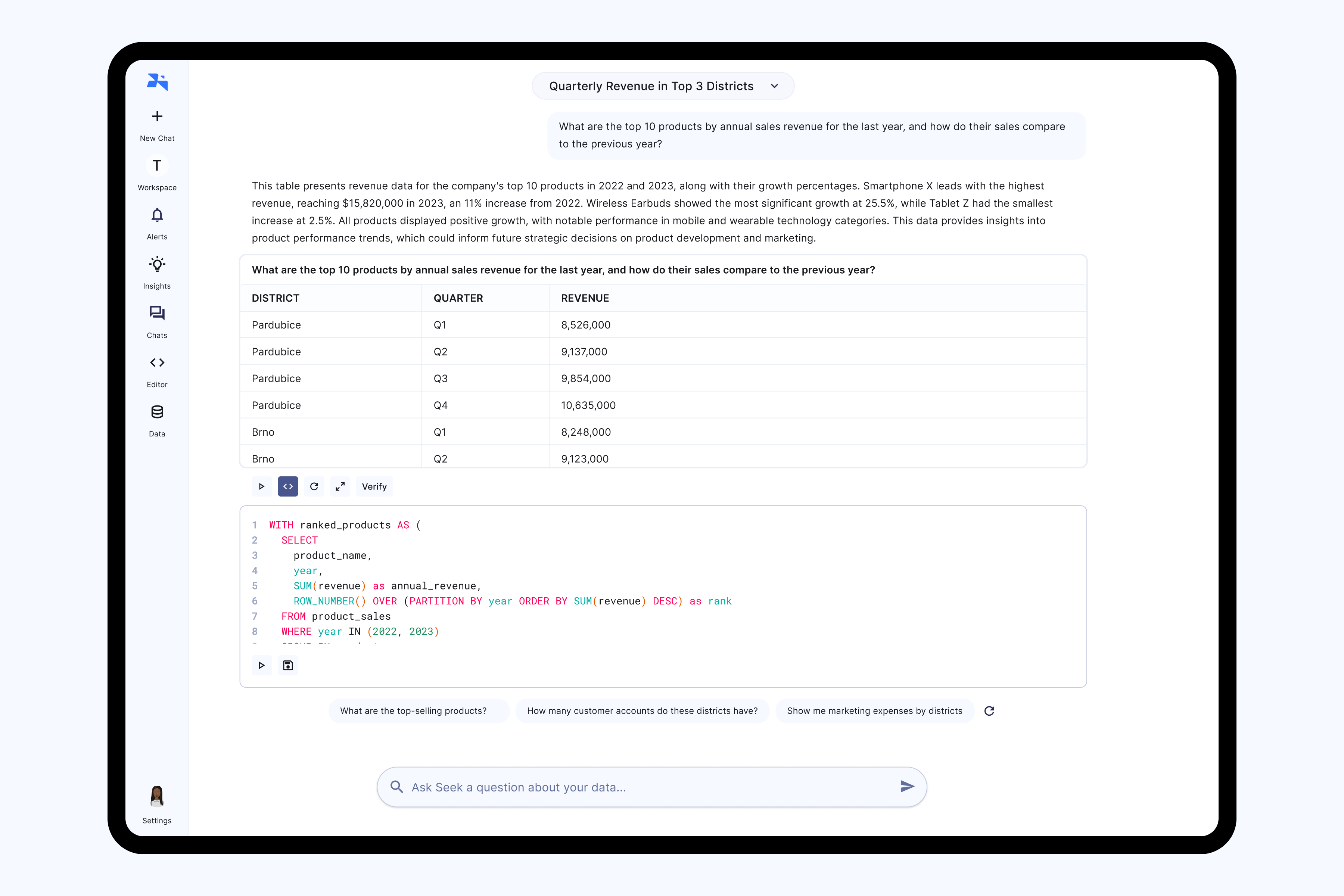
The product’s Natural Language Summary explained what a query did. Its Auto Verify feature estimated confidence and let customers set a threshold. Answers above it could return immediately; work below it entered a human review flow. Seek later received two US patents covering human-in-the-loop workflows for language-model-generated dataset queries. Plenty of software says a human is in the loop. Seek made that person part of the interface and the operating model.
A bridge, with guardrails
Seek connected to Snowflake, Databricks, BigQuery, Redshift, Microsoft SQL Server, and Azure Synapse; public materials also named dbt and Slack. The Snowflake version ran through Snowpark Container Services inside Snowflake’s governed environment. In February 2025, it added preview access to DeepSeek-R1 through Cortex AI alongside models such as Mistral Large, Llama 3.1, and Claude 3.5 Sonnet. Seek held SOC 2 Type II compliance.
For a buyer, those details mattered more than another cheerful demo. Sending a question about quarterly revenue to an AI service creates three practical problems: which data may leave the warehouse, which definition of revenue applies, and who signs off when the query is wrong. Warehouse-native deployment addressed the first. Semantic modeling and a later self-building knowledge graph aimed at the second. Confidence thresholds and analyst review addressed the third.
How it compared
Seek sat between conversational BI and the analyst workspace. ThoughtSpot emphasized search-led business intelligence. Tableau owned dashboard territory. Sigma offered spreadsheet-like analysis on cloud data. Hex centered collaborative notebooks and data apps. Snowflake Cortex Analyst brought natural-language querying closer to the warehouse itself. Seek’s pitch was narrower and rather sensible: automate ad hoc structured-data questions, keep the query visible, and make analyst verification a product feature.
| Buying priority | Seek’s angle | Also examine |
|---|---|---|
| Business self-service | Chat, follow-up suggestions, explanations, reusable insights | ThoughtSpot, Tableau |
| Analyst control | Visible SQL, SQL chat, schema tools, review workflow | Hex, Sigma |
| Snowflake governance | Native App and Snowpark Container Services | Snowflake Cortex Analyst |
| Embedded analytics | Powered by Seek API and product integration | ThoughtSpot Embedded, Sigma Embedded |
The weaknesses were equally enterprise-shaped. No public price meant no quick cost comparison. Setup depended on clean permissions, useful schema context, agreed metric definitions, and people willing to review early outputs. The promise of natural language can make those prerequisites disappear during a demo. They do not disappear in production. Independent user reviews were scarce, and Reddit offered almost no substantive firsthand discussion. The richest public evidence came from customers selected by Seek and from award juries. One UX Design Awards jury praised the natural-language and expert editing features while noting that the brand expression could use refinement. Fair.
Deep reasoning, then Big Blue
In March 2025, Seek previewed Deep Data Reasoning for the harder cases: billions or trillions of rows, messy business logic, and questions that simple text-to-SQL could not answer reliably. The system combined agents and tool use with a self-building knowledge graph connecting enterprise rules to underlying data. Nagy said a Fortune 100 engagement produced twice the accuracy of a simpler code-generation approach. It was early access, so that claim belongs in the promising column, with a pencil mark beside it.
Three months later, IBM announced watsonx AI Labs in New York. IBM’s release said it would acquire Seek’s expertise and license its technology; Seek said it had been acquired. The distinction may interest lawyers more than users. The practical result is clear: Seek’s team and ideas became foundational to a developer-focused IBM lab building domain-specific AI solutions. The old Seek website now points visitors toward IBM, and the independent product’s current commercial availability is unclear.
That makes this a curious buyer’s guide. You cannot assume the 2024 package, interface, or contract is waiting behind a “Start free” button. Teams interested in the technology should contact IBM watsonx AI Labs and ask precise questions: Is the Seek workflow available in a shipping IBM product? Which warehouse integrations remain supported? Where does inference run? Can reviewers set confidence thresholds? How are semantic definitions versioned? What happens to approved queries when the schema changes? Ask for a pilot using your ugliest real questions, not a sample retail database that has already learned its lines.
The verdict
Seek AI understood the office politics of data. Business teams wanted answers now. Analysts wanted definitions, code, and accountability. Its best product decision was to serve both sides in one visible workflow. The benchmark win and IBM deal make a tidy story, but the enduring lesson is smaller: an AI answer becomes useful when someone can inspect how it was made.
For data leaders evaluating descendants of Seek, use that as the test. A good system should shorten the queue without turning uncertainty into false confidence. It should remember verified work, expose generated logic, respect warehouse permissions, and make escalation easy. If the sales demo spends twenty minutes on the chat bubble and thirty seconds on review, ask to see the review again.