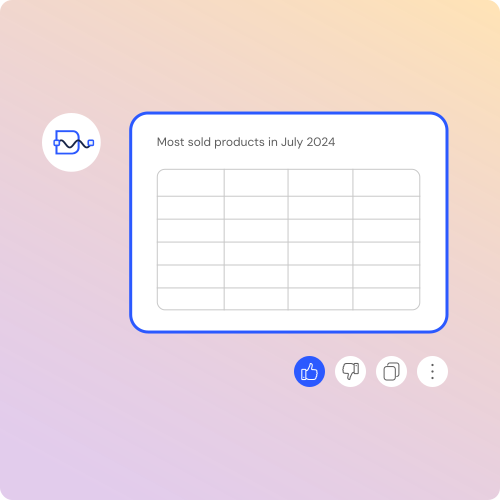
The most expensive answer in a company is often the easy one that arrives three days late. A sales director wants to know which region slipped. An operations lead spots a peculiar Tuesday. Somebody opens a ticket, explains the metric, waits for an analyst, receives a chart, then immediately asks the follow-up that the chart cannot answer. Defog was made for that little corporate farce. Ask the question in ordinary language; it writes the SQL, runs it where the data lives, and returns the result with a visualization. The analyst gets fewer errands. The curious person gets to stay curious.
That makes Defog most useful for organizations with real data infrastructure and a recurring queue of business questions. Think finance, healthcare, publishing, life sciences, SaaS, and government teams where access must be governed and definitions matter. The company’s site displays Toyota, AllianceBernstein, Macmillan, and Genmab among its users. A tidy five-column spreadsheet does not need enterprise AI. A warehouse full of institutional memory, ambiguous column names, and impatient colleagues might.
Why this exists
Defog arrived in 2023 from a pivot. Co-founders Medha Basu and Rishabh Srivastava had been building Data Narratives, a profitable service for finding and visualizing public data. Large language models opened a more pointed opportunity: let organizations talk to their own information. Their Y Combinator launch described an embeddable “ChatGPT for data,” a phrase that was useful in 2023 and slightly misleading now. Chat is the visible trick. The difficult work sits underneath it: schema metadata, business rules, permissions, evaluation, query execution, and the awkward fact that two different SQL statements can both be right.
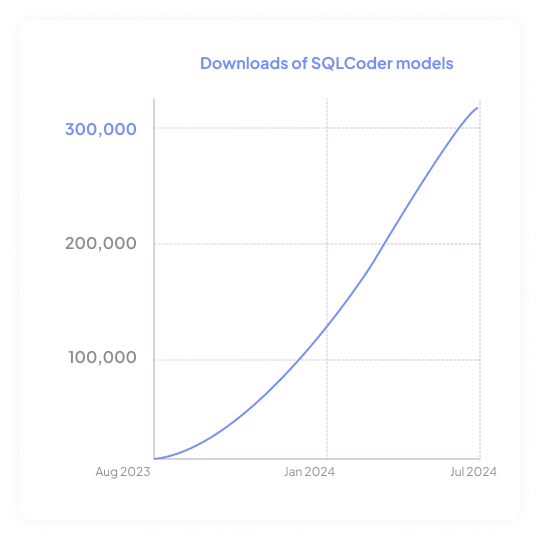
That last problem produced SQLEval, Defog’s open-source framework for judging generated queries by what they mean and return, rather than whether their text matches an answer key. It also produced SQLCoder, a family of specialist language models trained to turn a question and database schema into SQL. Defog says its early training data included more than 20,000 human-curated questions across ten schemas. The current public model lineup tops out chronologically with Llama 3 SQLCoder 8B, fine-tuned from Meta’s Llama 3 8B Instruct and intended for PostgreSQL, Redshift, and Snowflake.
What happens after you ask
The clean version goes like this. Defog receives the question plus a map of the database, generates SQL, checks the query against deterministic security filters, executes it inside the customer’s environment, and turns the output into an answer or chart. Because the underlying rows stay in that environment, the model does not need a suitcase full of customer records. This is a valuable architectural distinction, though any serious buyer should still inspect connector permissions, logs, retention, subprocessors, and the exact boundary of a chosen deployment.
The product accepts databases and warehouses including PostgreSQL, Snowflake, SQL Server, and MySQL. It can also ingest CSV and Excel files and connect to SaaS tools. Delivery options cover the corporate bingo card: a web experience, desktop app, native Slack bot, API, Docker deployment, AWS and Google Cloud marketplaces, and fully local hosting. The desktop version is charmingly literal. Run its Python application and it opens a local browser interface.
| Job | Defog’s approach | Buyer’s reality check |
|---|---|---|
| Quick lookup | Plain question to SQL and result | Test your messiest joins, not the demo schema |
| Exploration | Follow-ups and multi-step analysis | Define metrics before inviting the whole company |
| Presentation | Automatic charts and saved results | Keep a human in the loop for consequential claims |
| Governance | Local execution, filters, SSO, self-hosting | Verify row-level rules with adversarial prompts |
| Alignment | Feedback, preferences, custom tools, fine-tuning | Budget time for metadata and acceptance tests |
The coachable layer matters more than it sounds. Every company has definitions that never made it into the schema: “active” means one thing to finance and another to product; refunds are counted on settlement date; the west region includes a city that is plainly east of something. Defog lets teams add guidance and business logic without writing code, and it offers suggestions for improving database metadata. This is where a promising demo becomes a useful colleague. It is also where implementations can bog down. If nobody agrees on the number, software cannot rescue the meeting.
Defog is at its best when the question is casual but the answer still needs adult supervision.YesPress verdict
The proof, and the fine print
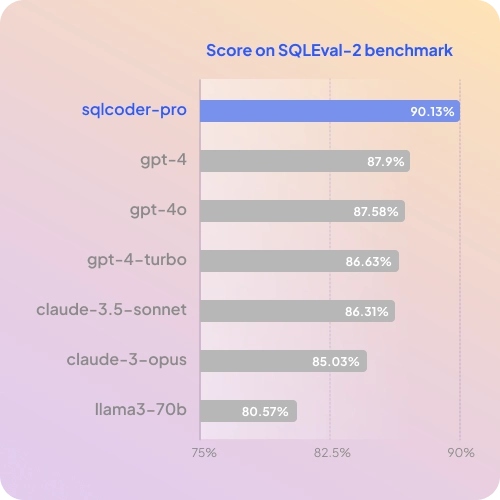
Defog’s public benchmarks gave SQLCoder its reputation. The company reports that members of the family beat GPT-4 and GPT-4 Turbo on its SQLEval tasks, and its newer product graphic gives SQLCoder Pro a 90.13 percent score on SQLEval-2. Those are useful signals, not a universal warranty. A benchmark has a dialect, schemas, prompt format, and scoring method. Your warehouse has all that plus years of eccentric decisions. Run a pilot on unseen questions from real users and grade execution results, permission behavior, latency, and graceful failure.
Public feedback supplies a welcome pinprick. In an early Hugging Face discussion, a user showed SQLCoder missing a requested monthly grouping. Srivastava responded that the model was not yet instruction-tuned and suggested a clearer prompt. On Reddit, the 70B launch drew genuine interest alongside skepticism about model-makers beating GPT-4 on their own tests. That is healthy. The right reading is neither “benchmark solved SQL” nor “benchmarks are useless.” Defog has built a serious evaluation practice, and buyers still need their own test set.
Practitioners have also been unusually direct in their praise. AWS solutions architect Pawel Zwadzki called SQLCoder-34B “faaar better” than other open text-to-SQL models. JLL data architect Or Hiltch said it was among the rare examples he had seen reach GPT-4-level results. The open weights help here: engineers can inspect the model card, run it locally, test quantized community versions, and argue with the results in public. That is more informative than a polished testimonial carousel alone.
Who should pay for it?
The current documentation describes a free API key for experiments: up to five tables, 25 columns, and 1,000 monthly queries. The pricing page lists cloud-hosted enterprise service at $5,000 per month, starting at 20,000 queries and adding SSO, custom no-code tools, onboarding, priority support, contractual paperwork, and rates up to 200 queries per minute. Self-hosted enterprise plans require an annual commitment and a conversation; they add local 8B, 14B, or 32B models, unlimited queries, and no rate limits.
Call Defog when…
- privacy or on-prem deployment is non-negotiable
- analysts are buried in repeat requests
- your schema has usable metadata and owners
- you need an API or Slack surface, not another dashboard
Keep walking when…
- a conventional BI filter answers most questions
- nobody owns metric definitions
- you cannot assemble a realistic evaluation set
- $5,000 monthly exceeds the cost of the bottleneck
Compare it with Vanna for an open-source natural-language-to-SQL toolkit; Seek AI and ThoughtSpot for commercial conversational analytics; Hex for collaborative analysis; and Tableau or Power BI when governed dashboards remain the better interface. Defog’s clearest edge is the combination of specialist open models, visible evaluation work, and enterprise deployment control. Its weakness is the same one shared by every conversational data product: language makes access feel easy while the organization’s definitions remain stubbornly complicated.
A sensible 30-day trial
Start with one domain and fifty questions nobody has shown the system. Include vague prompts, impossible requests, permission traps, dialect quirks, and follow-ups that change the grain of the answer. Score the returned result, not merely whether the SQL runs. Track how often a human must clarify a term. Then hand it to five business users and watch what they actually ask. The winning metric is not query volume. It is useful questions answered without creating a new cleanup queue.
The surprising next chapter
Defog’s founders have already carried the lesson into another product. In September 2026, Basu announced FactIQ, a cleaned and standardized financial and economic database designed for AI agents. She wrote that the team started it after running Defog for three years and wrestling with messy schemas and undocumented columns. The Y Combinator directory now presents the company as FactIQ, while Defog’s product site, documentation, Python package, and repositories remain online.
Defog launches from Data Narratives, enters YC W23, opens SQLCoder and SQLEval, earns SOC 2 Type II, and announces $2.2 million.
SQLCoder-70B arrives in January; Llama 3 SQLCoder 8B follows in May.
Introspect opens deep research across databases, spreadsheets, documents, and the web; the repository is later archived.
The founders launch FactIQ, applying their schema lessons to investment data made specifically for agents.
That pivot does not erase Defog. It makes the product’s core observation look more durable. Natural-language analysis is rarely blocked by the eloquence of the chatbot. It is blocked by whether the machine can find the right field, understand what it means, respect who may see it, and show its work. Defog gives companies a practical way to tackle those chores. Buy it for the queue you can measure, the deployment controls you genuinely need, and the questions your dashboards keep dodging. Leave the robot-analyst fantasy in the sales deck.