There is an agreeable irony in the name Magic. The company Sebastian De Ro co-founded wants software to do work that now requires a skilled engineer, but the visible record of his own career is full of ordinary engineering labor: assembling teams, writing systems, finding bugs, making machines behave. The story begins in a technical school in Vienna, where De Ro and Eric Steinberger met years before there was a company to name. It passes through Austrian enterprise software, a climate education project and a farewell note to colleagues. Only then does it arrive at the vast context windows that made Magic known in AI circles.
The chronology matters because a spectacular number can flatten a biography. In 2024, Magic said its LTM-2-mini model could reason over a context of 100 million tokens. The company translated that into roughly 10 million lines of code, or 750 novels. Those comparisons are hard to resist. Yet De Ro’s route to that announcement was less a leap from nowhere than a long practice of building software with other people.
A partnership with a school address
HTL Spengergasse is a higher technical school in Vienna. Its gifted-student program brought De Ro and Steinberger into the same orbit. The school has since held them up as an example of what technical education can produce when students get room to work on real projects. Their former teacher Harald Zumpf remained part of the story, publicly celebrating the founders’ progress after Magic attracted major investment.
De Ro returned to Spengergasse after becoming a founder. A teacher who invited him described the visit as a conversation about his education and the practicalities of starting a company. The advice the teacher singled out was cheerfully unglamorous: “KEEP ON LEARNING!” A school can hardly ask for a better alumni slogan. It also happens to fit the career that followed: the tools changed, the scale changed, and De Ro kept taking on unfamiliar problems.
The partnership with Steinberger outlived the school. They were connected to ClimateScience, an education initiative, before founding Magic in 2022. Steinberger became CEO and De Ro CTO. That pairing has the neatness of a startup pitch, though the record suggests something more durable than a hastily arranged division of titles. They had already known what it was like to work together before investors, chips and AI model announcements entered the picture.
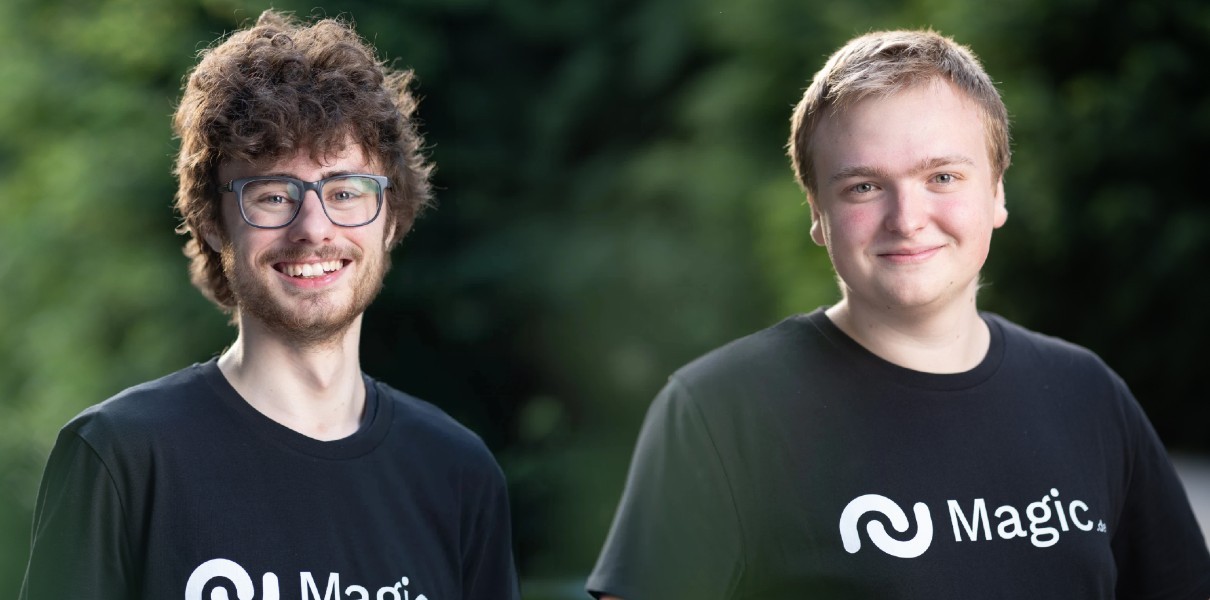
The CTO before the AI lab
After school, De Ro worked in Austrian software businesses, including Automic Software and twinformatics. His career then moved through FireStart, a company that makes business process management software. The subject sounds dry until one considers what it requires: software that must survive the habits and constraints of actual organizations. There is no applause for a workflow that runs correctly on a Tuesday. That is the point.
At FireStart he became CTO. In a public recommendation, a former colleague said the technology department doubled during his tenure and built FireStart Cloud, a new version of the company’s platform. The colleague described De Ro as a leader who invested time in understanding product management and in developing the people around him. Another colleague praised his willingness to guide teams without prescribing every move. Recommendations are naturally warm documents; the specific work they describe is still useful evidence of what his role involved.
His own 2022 farewell post is more revealing than a polished executive biography. De Ro thanked people by name, including colleagues in product discovery, human resources, user experience and engineering. He said he had helped build a 25-person product development team across product, UX, engineering and site reliability. It reads like a map of the organization he was leaving, drawn in gratitude rather than boxes and reporting lines.
“Thank you to the rest of the team ... for letting me lead and for the incredible memories that I will forever cherish!”Sebastian De Ro, on leaving FireStart in 2022
Steinberger commented on that post that he was excited they would finally work on a startup together. In retrospect, it is a small hinge in a large story. At the moment, it was a friend and future co-founder replying to a career announcement. The next chapter would make the line look prophetic; at the time, it was simply personal.
What a longer memory buys
Magic’s founding goal was to build AI that could take on substantial software engineering work. The company’s early public research focused on context: how much material a model can keep available while it works. For a coding system, context might include the repository, documentation, libraries and the conversation about the task. If the system can see only a sliver, it may write a plausible function while missing the architecture around it.
In 2023 Magic introduced LTM-1 with a five million token context window. In August 2024 it announced LTM-2-mini and the 100 million token figure. That is a twentyfold increase in the reported window. The company also described the infrastructure challenge behind the number: a custom training and inference stack, repeated experiments to stabilize training, and enough compute to make the research possible. De Ro’s role as CTO places him in the organization responsible for turning that ambition into a working system, although public company research is credited to the Magic team rather than to him alone.
Magic was candid about the gap between a large context window and an excellent coding assistant. Its 2024 research post said an early text-to-diff prototype was far smaller than frontier models and that its coding ability was not yet good enough. It showed a few examples that worked, including a simple interface change, but did not present a finished replacement for a human software engineer. That candor gives the number more meaning. A model may read a great deal and still need to reason, plan, edit and verify well.
The company announced a $320 million investment alongside the 2024 research and described plans for large computing clusters on Google Cloud. Funding expanded the resources available for the bet. It did not settle the question at its center: whether long context, combined with strong training and careful evaluation, can produce the kind of dependable work developers would entrust to an AI colleague.
The next set of hard problems
By September 2026, Magic’s public research had moved toward pretraining efficiency. The company reported that its recipe was more than ten times as compute-efficient as leading open-weight base models on its chosen comparisons, and said it matched one model using far less compute. These are Magic’s measurements. They are part of a continuing research program, with product performance still to be judged on what users can actually do.
The new post listed familiar engineering frustrations beneath the grand claim: unstable early training runs, the need for smooth convergence, low precision arithmetic, infrastructure reliability and, in the company’s memorable phrase, hunting the bugs. It described progress as the compound result of many changes across architecture, optimization, training objectives and data. That picture feels closer to De Ro’s public career than a fairy tale about one sudden breakthrough. The work is cumulative, distributed and stubbornly technical.
De Ro’s own public voice has been relatively restrained. On LinkedIn he wrote that building aligned superintelligence was, in his view, the most important problem of the time. In a hiring post, he invited engineers interested in making large computing systems run reliably and mentioned thousands of Kubernetes nodes. This is a particular sort of founder rhetoric: the aspiration is enormous, while the job advertisement is about getting production operations to work. The distance between those two registers is where much of a CTO’s day goes.
His colleagues’ comments add another dimension. One former FireStart teammate described him as someone with strong views who would discuss and revise them. Another emphasized his care for people. Such observations do not prove a permanent personality, but they do show how people who worked beside him chose to remember the experience. The farewell post points in the same direction. De Ro did not mark his exit with a list of technical wins alone; he named the people who had made the team.
How far the partnership travels
There is still an open ending to the Magic story. The company wants coding agents that can handle longer tasks and, eventually, help with AI research itself. Its reported context windows and training efficiency results are milestones toward that goal, with much left for future systems to demonstrate. De Ro’s biography is distinctive without pretending that a promised future has already arrived: a Vienna technical school, years in enterprise software, a substantial team built at FireStart, and a co-founder he knew well before Magic had a name.
The old teacher’s advice survives the change of setting. Keep learning is easy to print on a classroom wall; harder to practice while the size of the computer, the team and the ambition all grow. De Ro’s public record suggests that the method is still the same one he learned early: find capable people, build the thing, and then find out what the thing cannot yet do.