The first opening came from a message sent into the apparent void. Logan Kilpatrick was studying computer science at De Anza College in California when he began contacting NASA researchers on LinkedIn. He wanted to work on their projects. One researcher replied months later and invited him in for a conversation. Kilpatrick has recalled the episode with a certain matter-of-factness: he went in, talked, and joined a team working with satellite data. The route from a community college classroom to a federal research center sounds dramatic only after it has worked. Before the reply, it was simply a student willing to ask.
His résumé would later acquire names with considerable gravity: Harvard, Oxford, Apple, OpenAI, Google DeepMind. Yet that early approach remains the most useful clue to how he works. His own website declares, “Agency is a superpower.” He expands the thought with a preference for doing the thing over endlessly debating it. A cold message is a small act of agency. So is releasing a first version, asking a developer what failed, or returning to the code with a correction. The tools have changed; the reflex has not.
The long way to the launchpad
Kilpatrick grew up in Chicago. He began higher education at De Anza College, a public community college in Cupertino, before studying at Harvard University and the University of Oxford. The sequence matters because it complicates a familiar Silicon Valley origin story. His first line of access to NASA did not arrive packaged as a celebrated degree. It began with coursework, curiosity, and outreach. In an old résumé, he described work on satellite imagery and later on software for planetary exploration. The technical details were concrete: Julia code, a decision framework for missions, visualizations, tests, and documentation.
NASA software is easy to romanticize. It is also software. A mission needs programs that behave predictably and colleagues who can understand them. Kilpatrick worked on SHERPA, a decision support framework for planetary exploration, and wrote tools to visualize and test scenarios. The glamorous noun was lunar; the daily verbs were build, document, and check. That combination introduced a career pattern. He would keep appearing where specialist systems needed a clearer path for other people to use them.
Julia became an important part of that pattern. Kilpatrick contributed to the language's open source community, mentored learners, helped organize events, and served as an administrator for programs including Google Summer of Code. A 2019 NumFOCUS award recognized him as a new Julia contributor. A language community runs on far more than a compiler. People need examples, documentation, patient answers, and someone who will make room for a newcomer. Those tasks rarely look cinematic, but they are how technical ideas survive their first encounter with a wider audience.
A job at the edge of the model
He went on to work at Apple training machine learning models. In 2022, Kilpatrick joined OpenAI and led developer relations through early 2024. The timing put him near a remarkable surge of interest in AI software. As more people tried the company's models, the question facing a developer advocate became both practical and urgent: what does a builder need after the launch announcement? Usually, the answer is less glamorous than the announcement. Clear examples, working APIs, realistic limits, and a way to tell the people building the platform when the experience goes wrong.
In April 2024, he moved to Google to work on AI Studio and the Gemini API. The role gave him a new product and a familiar audience. AI Studio is Google's place for trying models and turning experiments into applications; the API carries those capabilities into software. Kilpatrick has described developers as a primary route through which Google DeepMind's work reaches the world. That description gives his job its stakes. A model can exist in a research report. A developer product has to survive the first ten minutes with a stranger.
He offered a telling example in a 2024 conversation. After a Google DeepMind colleague circulated a careful account of difficulties getting started with a model, Kilpatrick said the teams made changes within a day. It was a small account of product work, with no grand unveiling attached. It also reveals his preferred operating rhythm: listen closely, then move. On his website, he puts it more bluntly: “Shipping fast is required.” Speed is not an abstract virtue here. It is the ability to shorten the distance between a reported problem and a useful fix.
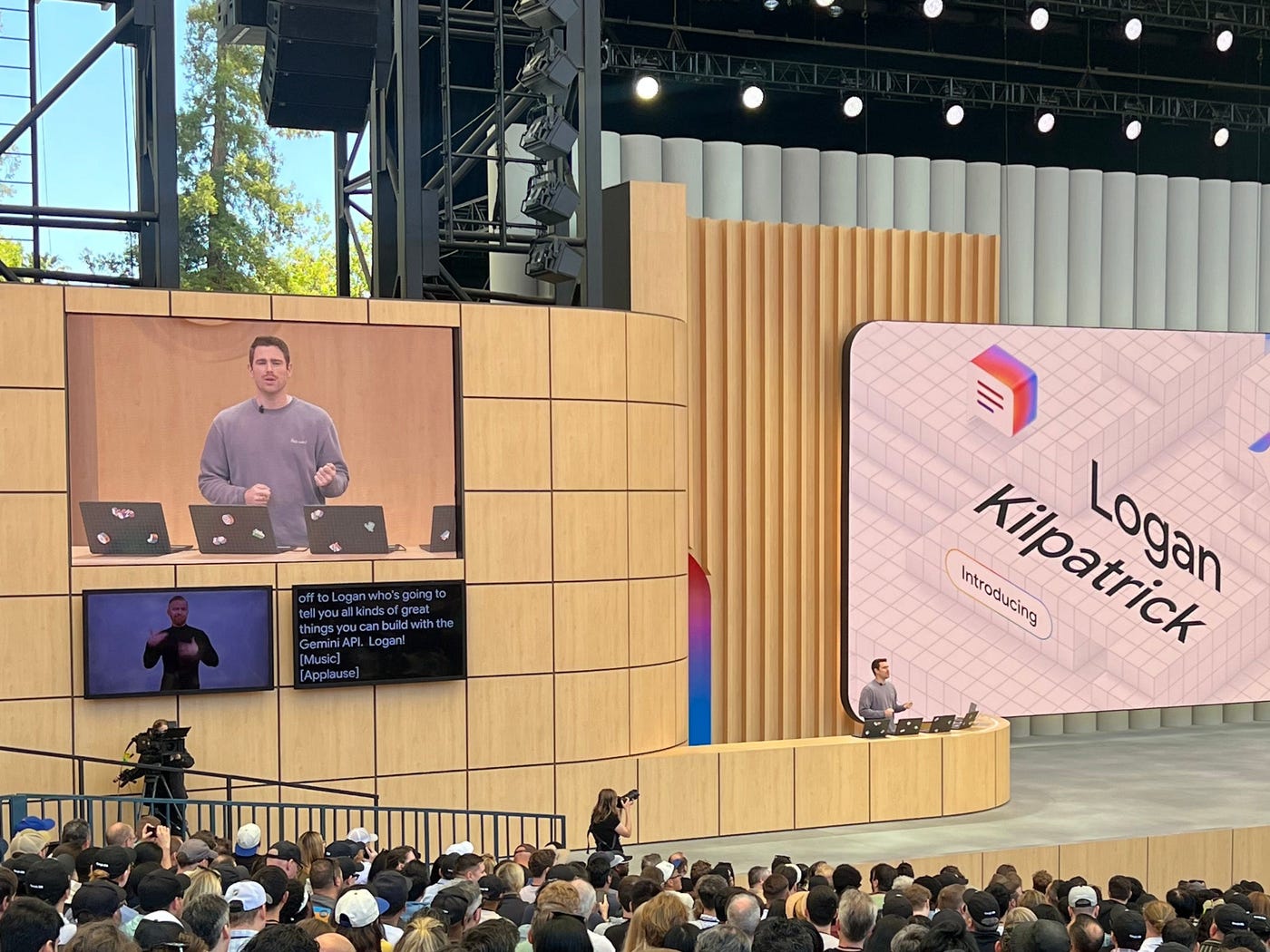
The public role grew along with the tools. He has spoken at Google events, appeared on podcasts, and fielded questions about new Gemini releases. Google's author page calls him product lead for AI Studio and the Gemini API. His current GitHub profile uses the title “Member of the Technical Staff” at Google DeepMind. In early 2026, he publicly embraced that title, a change that suits someone who has long crossed the neat lines between engineering, product, and community. The exact label matters less than the work visible beneath it: helping developers build with Google's models.
The builder's other seat
Kilpatrick's interests do not stop at the platform boundary. He says he has invested in more than 50 startups, naming companies such as Cursor, Cognition, Astral, Braintrust, Stainless, Pydantic, and Exa among them. His stated area of interest is AI applications and developer tools, with personal investments typically between $100,000 and $300,000. That gives him a second view of the same ecosystem: inside a large organization building foundational access, and among smaller teams trying to make a particular product useful enough for someone to keep using it.
There is a tension in those seats, but also a productive conversation. Large labs must make general tools reliable for many kinds of users. Startups can choose a narrower need and move quickly. Kilpatrick has argued in interviews that builders still have room to create distinct products even when the underlying models improve. His investment list suggests that he takes the argument seriously. It includes coding tools, infrastructure, and applications whose value depends on the choices a team makes after gaining model access.
He also co-hosts the Around the Prompt podcast with his friend Nolan Fortman. Their guest list has included programmers, founders, and researchers such as Simon Willison, Jeremy Howard, and Sahil Lavingia. The format gives Kilpatrick another way to ask what people are making and where the tools get in their way. His GitHub profile advertises the show with a modest request to tune in; its bio warns, “Juggling many things - please be patient.” The line is funny partly because it reads like an honest status update from someone whose calendar contains product releases, interviews, and startup conversations.
The human part of a technical career
There is a temptation to make a neat parable out of his trajectory: community college student writes to NASA, then ends up speaking for one of the world's largest AI platforms. The sequence is real, but its interest lies in the work between the milestones. He learned a programming language and helped others learn it. He moved among research, engineering, and product teams. He had to explain complicated tools without pretending they were uncomplicated. The path is full of ordinary acts of translation, repeated until they became a career.
Kilpatrick's public manner reflects that work. In a 2024 interview, he described impatience with delay: “I would like to do things and I would like to do them as soon as they can be done.” A podcast host, Nathan Labenz, described him as earnest, hardworking, and inclined to help. The latter is another person's observation; the former is Kilpatrick's own explanation. Together they sketch a recognizable character: energetic, visible, and oriented toward the person trying to make something happen.
That final belief, posted on his website, is a striking one for someone whose work is devoted to AI. He argues that people will continue to value work made by other people, and that authenticity matters more as generated material becomes easier to produce. It is also a useful way to understand his developer focus. Models can multiply possibilities; people still decide what to build, whom it is for, and whether it deserves trust. The first useful prototype begins with a human judgment, as does the choice to improve it after someone complains.
In 2026 he was still discussing Google AI Studio, the Gemini API, and the changing craft of software development in public interviews. The products and titles will continue to move. His through line is easier to keep in view. At De Anza, he looked for a door into NASA and sent a message. At NASA, he built and documented software for colleagues. In Julia, OpenAI, and Google DeepMind, he has worked where technical capacity meets the person trying to use it. The doorway keeps changing shape. Kilpatrick keeps returning to it.