The first problem Fabian Hedin remembers solving with code was wonderfully small: he wanted to change his Minecraft server. Running it meant deciding how the game should feel for other players. Soon the server needed a website, and the website demanded a new vocabulary: HTML, CSS and JavaScript. He has said he began programming at eleven. It is an origin story without a grand announcement. A child wanted his little world to work differently, so he learned how to alter it.
That appetite carried beyond the game. At school, people heard that he could program and arrived with ideas of their own. Hedin started making business applications for them. The requests were practical, the sort that turn a hobby into a useful skill: someone has a process, a customer, a headache; someone else can make a piece of software to help. He found the work interesting, but he wanted a longer stake in what he built. After high school, he and a friend started a property software venture.
The company became TenFast, a system for the real estate market. Hedin later studied industrial economics at KTH Royal Institute of Technology in Stockholm and took the venture through the university’s innovation program. There is an appealing symmetry to the route. As a boy he had built the tools his server needed. As a founder he was learning to build tools other people needed. The difficult part was no longer merely making a feature run. It was finding out whether it belonged in someone’s working day.
A friendship made in the working parts of software
Stockholm gave him another useful connection. Through people he met around KTH, Hedin was introduced to Anton Osika, who was then building the ecommerce technology company Depict. Hedin joined and eventually led its frontend team. Osika was his boss. The pairing that would later make Lovable began as a fairly ordinary professional relationship: one person leading a company, another responsible for the layer customers could actually see and use.
That frontend experience matters to the Lovable story. The appeal of an AI coding tool is easy to describe in a sentence, but the user still has to know what the tool is doing, see the result, and decide what to change. A working interface is where a technical promise becomes an experience. Hedin’s route through business applications, TenFast and Depict had placed him repeatedly at that meeting point between code and the person who must live with it.
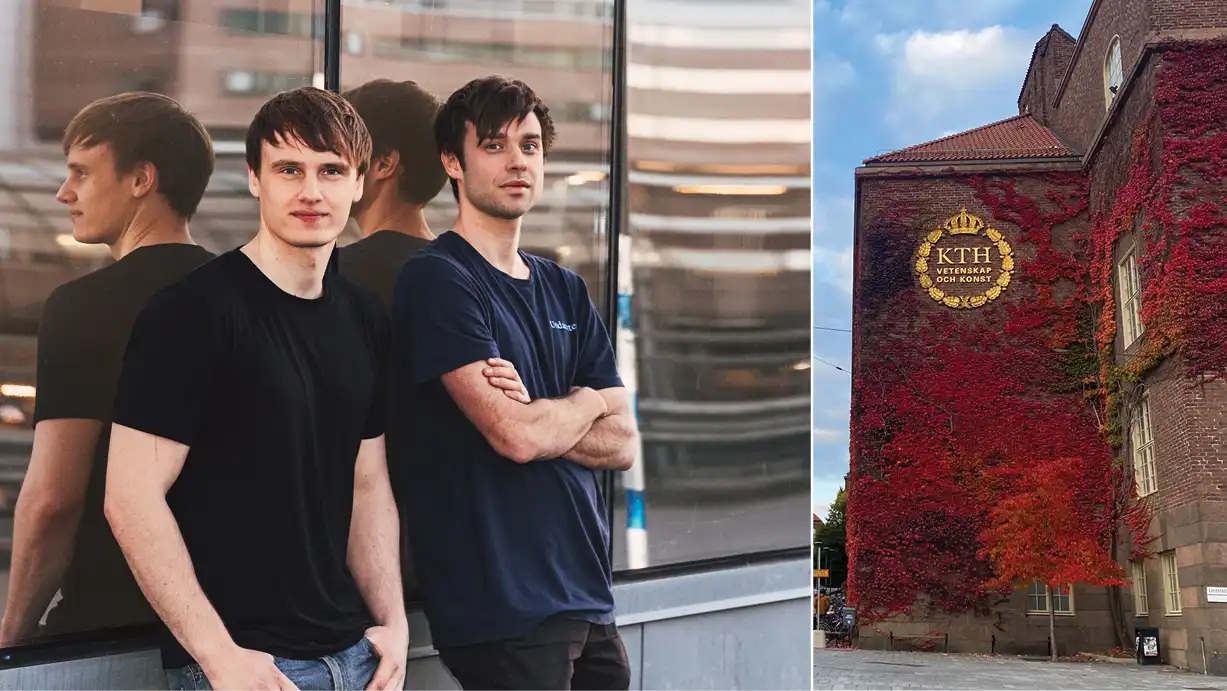
In spring 2023, Osika posted GPT Engineer, an open source coding tool, to GitHub. The response came quickly. KTH’s account of the founders says that within hours of the attention arriving, they decided to start a company. Lovable was founded that year, with Hedin as co-founder and chief technology officer. The product would take longer to find its public form. It reached an open launch in November 2024, after an extended period in which the team experimented and waited.
A Minecraft server leads to websites and programming.
Studies industrial economics and develops TenFast.
Leads frontend work alongside Anton Osika.
Co-founds Lovable as GPT Engineer attracts attention.
Lovable opens to users in November.
Shares KTH’s Innovation Award with Osika.
The name he nearly kept
One small dispute from the early days says a lot about the change the product was making. Hedin liked the name GPT Engineer and argued for keeping it. The company itself was already called Lovable, and the product eventually took that name. The founders connected it to a change in the old startup phrase “minimum viable product.” If AI could help someone make a working product directly, why treat the first version as a disposable sketch? Why not aim for a “minimum lovable product”?
The phrase risks sounding tidier than software ever is. A product may look complete on a screen while still needing a database, payments, testing, security, and a way to deal with the odd things its users will do. Hedin knows this territory from both sides. He has built applications himself, and he now leads the engineering of a system that promises to make that work approachable for others. The ambition is not simply to print code. It is to bring a person with an idea close enough to a real application that they can use it and keep improving it.
“Our goal is to make Lovable the co-founder of your start-up, not just a developer agent.”Fabian Hedin, 2026 interview
Hedin has been frank about what the team learned on its way to launch. In a 2025 interview, he said they should have launched earlier. Lovable had explored complex agent systems while the underlying AI models were still catching up. The team also kept a waitlist longer than he now thinks was useful. His lesson was straightforward: work with what the models can do today, put the product in front of real people, and learn from the way they use it. That is the judgment of an engineer who has seen the cost of waiting for a cleaner future.
Lovable also uses Lovable. Hedin described the team building internal tools with its own product, from an office CRM to operations software. That habit turns colleagues into customers with little patience for a polished demo. If a tool is awkward to maintain or cannot solve a mundane problem, the team meets the limitation at work the next morning. For a product sold on narrowing the distance between an idea and an app, that daily confrontation is unusually useful.
What changed when more people could build
The numbers grew faster than the founders’ original experiments. In the period after launch, Lovable went from $1 million to $100 million in annual recurring revenue in eight months. By August 2026, the company said users had created more than 60 million projects and that apps built on the platform received more than 900 million visits each month. The same month, it announced a $400 million funding round at a $13.3 billion valuation. These figures describe the scale of demand and the pressure on the infrastructure behind it; they do not tell us which ideas will become lasting businesses.
Hedin’s engineering work now sits behind millions of separate attempts to make something useful. A later technical account from the company describes an agent system handling roughly half a billion events on a typical weekday. That is a long way from the Minecraft server, though the underlying question remains recognizable: how does a system help somebody change an experience without collapsing under the accumulated choices of everyone else doing the same?
There is a cultural question in the numbers too. Professional programmers have usually been the people who can turn a problem into software, or at least the people a founder must persuade and pay to do it. Hedin has argued that leaving AI’s value in the hands of only a small technical minority could deepen inequality. His answer is a tool that makes the first step less dependent on knowing how to code. The next steps still ask for judgment: what problem deserves a product, who needs it, and what happens when the first version encounters a real customer?
An award, and a larger invitation
In 2025, KTH gave Hedin and Osika its Innovation Award. The school singled out their attempt to widen access to software creation. It was an apt place for the pair to receive it. Hedin had studied there and built TenFast in its orbit; Osika’s open source project had helped set their next company in motion. Their relationship with KTH runs through work as much as ceremony. The award was followed by recognition from TechSverige, which named the two founders AI Swedes of the Year for 2025.
Their interest in who gets to build has also taken a form outside the product. KTH reported that Hedin and Osika signed the Founders Pledge, committing to donate half their future profits to meaningful causes if Lovable succeeds. The two have also taken part in Project Europe, an effort to support founders building technology companies on the continent. These commitments sit beside the ordinary, daily business of shipping software. They show how the founders have linked a private company to a public argument: if more people can create technology, more people should share in the possibilities it opens.
In interviews, Hedin tends to return to the person on the other side of the keyboard. He has described people arriving at Lovable to make an application for a business, then needing more than an app: payments, distribution, integrations, customer understanding. In 2026 he framed the company’s ambition as becoming something like a co-founder for a new venture, helping beyond the act of writing software. It is a bigger promise than the original coding tool, and one that asks the company to deal with the unglamorous parts of running a business.
The Lovable story is often told through the speed of its growth. Hedin’s own path gives it a slower rhythm. A server needed a website. Schoolmates needed applications. Property managers needed a system. An ecommerce company needed a frontend team. Each stop brought him closer to a recurring fact: people have an idea of how a thing should work, but the gap between imagining it and making it can be wide. His work at Lovable is an attempt to shorten that gap. The best measure may be less the number of prompts typed than the number of people who can now make a useful thing and recognize it as their own.