The future chief executive was in a supermarket at eight in the evening, during the holiday rush, making sure the wine looked respectable. Sean Tresvant had bachelor's and master's degrees in communications from Washington State University. He had played guard for the Cougars. He had imagined himself on ESPN, talking sports with Stuart Scott's ease and electricity. Instead he was in a QFC, carrying bottles from the stockroom and wiping dust from the shelves.
A man had been watching. Eventually he asked Tresvant whether he liked his job. Tresvant said he did. The man pointed out the hour, the season, the repetitive trips to the stockroom. Tresvant explained that customers who cared about the brand should find it available and presented properly. The answer was earnest, perhaps stubbornly so. The man handed him a business card. He worked for Campbell Soup, he said, and admired the young marketer's work ethic.
After the holidays, Tresvant called. That small exchange rerouted his professional life. In the polished grammar of an executive biography, careers advance by promotion: Campbell, PepsiCo, Sports Illustrated, Nike, Taco Bell. In real life, they snag on chance, disappointment and somebody paying attention near the pinot grigio. Tresvant's own favorite instruction is “be where your feet are.” That night, his feet were in a grocery aisle. He treated the aisle as if it mattered.
The broadcast that never happened
Sports had supplied the original map. Tresvant grew up in Kirkland, Washington, and played college basketball. His father, John Tresvant, had been a Seattle University star and an NBA player. The son understood that he did not have his father's height, so he pictured a place beside the court rather than on it: sports broadcasting. He returned to Seattle with graduate training and discovered that no queue of television producers had formed to hire him.
The setback has the plainness of most formative setbacks. There was no grand collapse, merely the absence of the expected door. The wine job followed. Then Campbell. Tresvant decided that if brands were to become his field, he needed a business education to match his communications background. He enrolled at Seattle University and completed an MBA in 1998. He later called it one of his best decisions because it “unlocked a lot of stuff.” The phrase is modest, almost comically so, for a degree that helped turn a broadcaster's ambition into a marketer's career.
A doctorate in sneakers
After early posts that included PepsiCo and Sports Illustrated, Tresvant spent more than 15 years at Nike. He has described the stretch as his practical Ph.D. in marketing. By the end he was chief marketing officer of Jordan Brand, responsible for its voice around the world and for the entire consumer journey: campaigns, products, creative collaborations, athlete sponsorships, stores and social platforms.
Jordan is a useful school for anyone hoping to understand why some businesses acquire a cultural life beyond the objects they sell. A shoe carries performance specifications, but it also carries memory, status, allegiance and argument. Its audience reads every collaboration for signs of authenticity. The job demands a feeling for timing and a respect for history without embalming it.
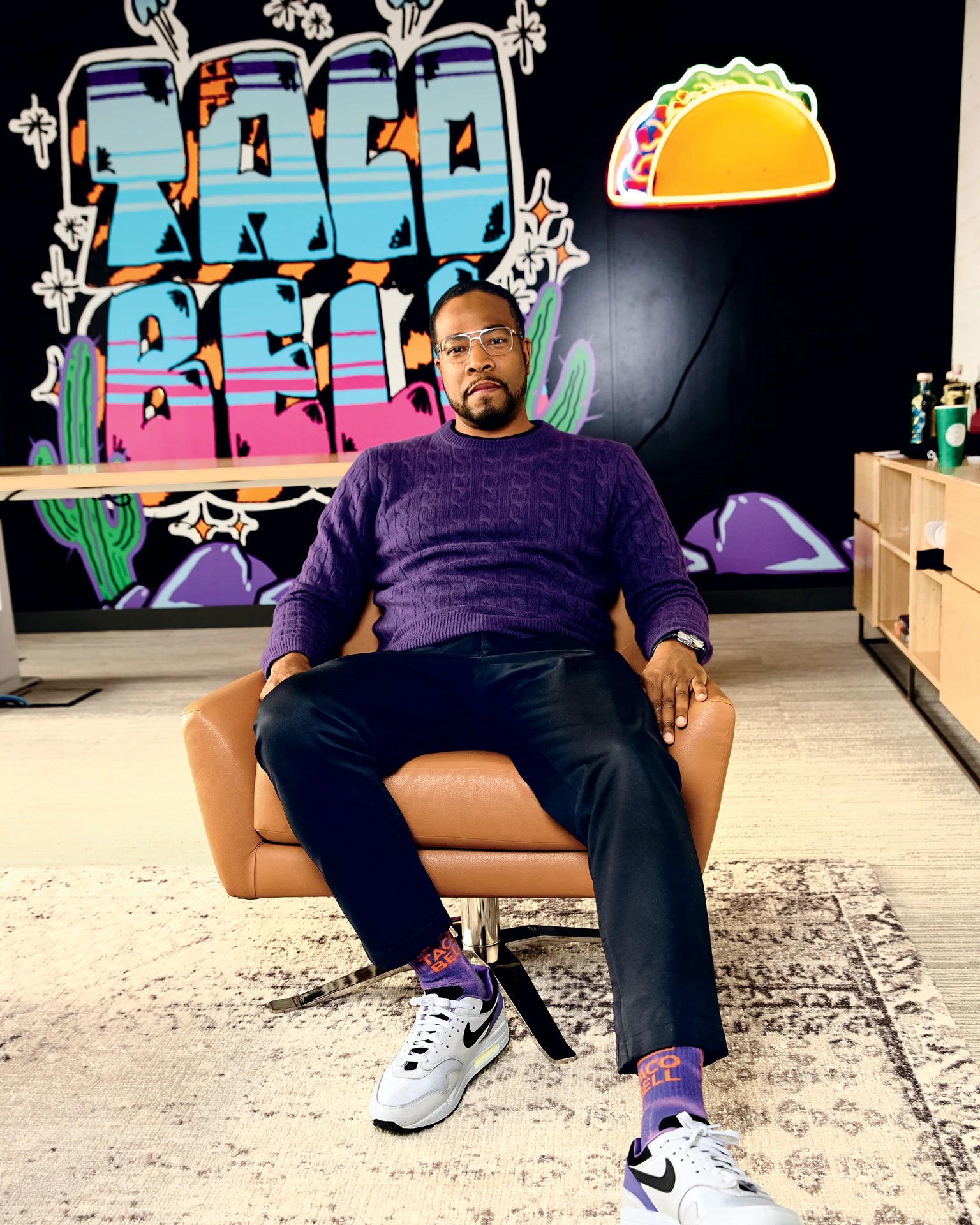
Those lessons traveled surprisingly well from sneakers to tacos. Taco Bell also has collectors, rituals and an audience fluent in its archive. A discontinued menu item can inspire the emotional diplomacy usually reserved for a beloved band reuniting. Soon after Tresvant joined the company, the return of Mexican Pizza demonstrated what happens when a brand recognizes enthusiasm that already exists. Doja Cat had publicly asked for it. Fans had done the same. Taco Bell joined the conversation and made the comeback feel like a response, not an assignment written in a conference room.
Math meets magic at the counter
Tresvant's compact theory of marketing is that the discipline requires “math and magic.” Math means consumer evidence, loyalty behavior, sales and the accumulated knowledge of a franchise system. Magic means judgment, imagination and the courage to act while the cultural moment is still warm. Data should inform the route, he argues, but brands can analyze and correct themselves until the opportunity has quietly left the building. Instinct alone is equally fragile. A hunch in an expensive suit remains a hunch.
First-party data, loyalty behavior, value, operations and what customers actually do.
Taste, speed, cultural fluency and the nerve to move before the moment cools.
The balance is harder in restaurants than in advertising seminars. A cultural idea may bring someone to the app, but a kitchen has to make the order accurately. A promotion may be charming, but a franchisee has to operate it at speed. Taco Bell's personality has long been playful, while its machinery is industrial: thousands of restaurants, supply chains, price architecture, digital ordering and a fan base happy to customize nearly every component.
Tresvant's remit grew accordingly. He arrived in January 2022 as Global Chief Brand Officer. In 2023 he added strategy, food innovation, design, communications and the international business. On January 1, 2024, he succeeded Mark King as CEO and became the first Black chief executive in Taco Bell's history. He assumed responsibility for global growth, franchise operations and performance. The marketer now had to care for the whole machine.
The useful limits of the boss
A promotion from brand chief to chief executive carries a particular temptation: to disguise the new gaps in one's knowledge. Tresvant received advice that relieved him of the performance. “Don't try to be a black belt in everything,” he was told. He could remain a black belt in marketing and become a brown belt elsewhere. He understands finance well enough to work with it; he also understands that Taco Bell has a chief financial officer whose expertise deserves room.
His description of the CEO's role is less about personal command than climate control. Make sure the culture is right. Make sure the team works together. Move the organization from “me” to “we.” Encourage leadership without waiting for a title, then coach people who may one day occupy your chair. The difficult part, he has admitted, is resisting the urge to roll up his sleeves and do the work himself. Competence helped him rise. Leadership sometimes asks him to keep his hands off.
That view retains something of a point guard. The position is responsible for seeing the floor, understanding who is open and moving the ball at the useful instant. It is a poor point guard who insists on taking every shot. Tresvant does not lean on the analogy in public, but the habits rhyme: spacing, trust, tempo and the knowledge that a team can be well designed yet still require decisions in motion.
Keeping curiosity operational
In 2025, his brief widened again. Yum! Brands named him Chief Consumer Officer while he remained Taco Bell CEO. Collider, Yum!'s in-house consumer insights agency, began reporting to him, creating a bridge between research and the marketing work across the restaurant group. Marriott International also elected him to its board. There he chairs the Inclusion and Social Impact Committee and sits on the Technology and Information Security Oversight Committee.
The appointments suggest that the craft learned around shelves, shoes and menu boards has become broader corporate work: how an organization notices people, translates what it learns and acts without sanding away every surprising edge. Taco Bell now presents product news through Live Más LIVE, a stage show where menu announcements mingle with entertainers and fan commentary. Tresvant opened the third edition in 2026 by thanking the audience whose appetite and opinions power the spectacle. The event is promotional theater, certainly, but also a public acknowledgment that customers have become participants.
Away from the office, Tresvant collects art and follows sports. He has said that looking at art helps when he feels creatively stuck. This, too, fits the method. Attention is renewable when it travels. The executive studying a canvas is not escaping the consumer; he is refreshing the faculty needed to see one.
Two days after this profile's publication date, Tresvant is scheduled to address business students at Howard University. The announced subjects are leadership, innovation and the building of global brands. He could bring the long résumé. The better story begins before any of its grand titles, with a disappointed would-be broadcaster doing a modest job unusually well. The stranger in the grocery aisle saw diligence. Tresvant saw the task in front of him. Decades later, both observations still hold.