Sean Gourley arrived in Silicon Valley in 2008 with a suitcase, a few thousand dollars left from his graduate stipend and a decision to become an entrepreneur. He had turned down a comfortable corporate job. For a month, he slept on other people’s couches. The financial crisis was an unpromising welcoming committee, though it did at least make uncertainty a widely shared condition.
He had a doctorate in physics and an interest in what happened when small groups confronted much larger organisations. He had also begun asking how an explanation could become something useful. After a Pentagon briefing, he had noticed people he thought were contractors selling things officials could actually use. A theory might secure an audience. A tool could stay behind after the meeting.
“If I want to have an impact or make a difference, I have to build something,” he recalled. That thought helps connect a career which otherwise looks as though several people have accidentally contributed to the same résumé: decathlete, physicist, political candidate, startup founder and company director.
Ten events, then Oxford
Gourley grew up in Christchurch and attended Cashmere High School. Born in Belgium to New Zealand parents, he had moved to New Zealand as a small child. At 15 he took up the decathlon. By the time a Rhodes Scholarship was taking him towards Oxford, he had already won a national senior title.
The decathlon is an agreeably inconvenient sport for anyone hoping to specialise. Running, jumping and throwing all demand their turn. In Gourley’s early life, sport sat alongside physics and politics. At Canterbury, he worked towards a master’s in physics; he was also involved in the Alliance Party. None of those interests was merely a decorative line beneath his name.
His scholarship began in 2002. He wanted an older Oxford college, with the traditions that came with it, and anticipated arguments with interesting people. Balliol was the destination. The research plans then under discussion concerned nanotechnology, including tiny motors inspired by bacteria. Human conflict was not the only complicated system available to a young physicist with a ticket to England.
Looking back at that combination, it is tempting to make the athlete explain the entrepreneur. The evidence allows a less tidy pleasure. Here was someone taking several pursuits seriously before the professional world required him to choose a description short enough for a conference badge.
A dinner with consequences
At an Oxford dinner in 2003, Gourley found himself talking about the impending Iraq war with James Woolsey, the former CIA director. The setting was traditional; the question it helped provoke was contemporary. Could the accumulating information about a war reveal something that arguments around a dinner table could not?
His research with collaborators approached insurgency through complex systems. A paper published in Nature in December 2009, “Common ecology quantifies human insurgency,” examined similarities in the size and timing of violent events across different conflicts. Its authors included Juan Camilo Bohorquez, Alexander R. Dixon, Michael Spagat and Neil F. Johnson alongside Gourley. This was a collective scientific project.
The proposed model treated insurgent populations as groups that formed, changed and broke apart. It connected observable patterns to that changing organisation. The intellectual attraction was the possibility that events with very different political circumstances could share measurable features. A pattern could make a question tractable without making the history behind it simple.
How do small groups organise inside a larger conflict?
Gourley took that work to TED in 2009. Seven minutes is an economical allowance for discussing war, mathematics and what anyone ought to do about either. The talk brought an unfamiliar research approach to a public audience. It also established a recurring feature of his work: trying to make an abstract relationship visible enough for another person to examine.
The map becomes a business
Quid, which Gourley co-founded in 2009 and served as chief technology officer, put that interest into software. It collected and structured information, then used models and visualisations to help people explore it. The subject could be technological change, investment or political developments. The interface offered a way into a collection too large to hold in one person’s head.
He described the company as a continuation of research using different resources. Venture capital could assemble an interdisciplinary team and support a larger undertaking. That is a particular view of entrepreneurship: a company as an instrument for pursuing questions. The instrument still needs customers, payroll and working software, which are excellent remedies for excessive abstraction.
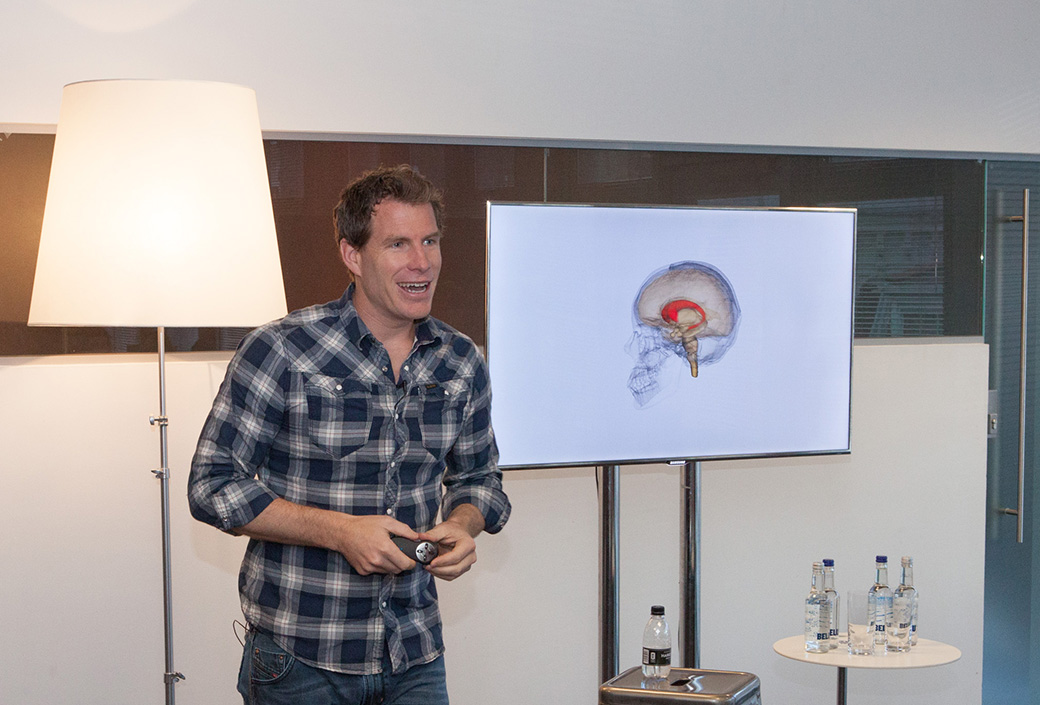
In 2013, Gourley and ecologist Eric Berlow showed what this way of looking could offer beyond the world of conflict. Their TED presentation examined 24,000 TEDx talks, finding connections between ideas. A collection of videos became something a viewer could explore through relationships.
The distinction matters. A popularity list brings the already prominent to the surface. A network can reveal neighbours, bridges and unexpected proximity. You may know which subject you want to search for. You are less likely to know the connection you have never encountered. A good map makes that second kind of discovery possible.
That demonstration also makes a useful introduction to the person behind it. Gourley’s attention repeatedly returns to relationships: between groups, between documents, between ideas. The resulting picture gives someone a place to start asking questions. It need not pretend to finish the conversation.
Teaching a machine to read the pile
Gourley founded Primer in 2015, well before conversational AI became a routine topic at dinner. Its ambition involved software that could read, write and help people understand large volumes of information. When it emerged publicly in 2017, its early customers included Walmart, GIC and In-Q-Tel, the organisation that invests in technology relevant to intelligence agencies.
Those names suggest different worlds. A retailer needs to understand customers and markets. An intelligence organisation needs to understand developments that may carry national consequences. Both face a stubborn administrative fact: potentially important information can be buried in a quantity of material no individual can reasonably read.
A person may miss the consequential detail because it sits deep inside an obscure report. The document exists. The reader is competent. There are simply too many documents. Primer’s proposition was to give that reader software capable of doing some of the preparatory work.
- 01 / GatherBring information into the system.
- 02 / StructureIdentify relevant entities and relationships.
- 03 / ReviewGive an analyst material to examine and edit.
This places an ordinary human activity at the centre of an apparently futuristic business. Reading takes time. Comparing accounts takes more. A shorter route through the material changes the work available to the reader. The quality of the eventual decision remains a serious question, even when the pile has become more manageable.
The argument over attention
Information also has adversaries. Gourley’s public work increasingly addressed people trying to manipulate what others see and believe. In an O’Reilly presentation in 2019, he discussed computational propaganda and the consequences of AI-generated material blurring the distinction between real and fabricated content.
In 2020, he proposed a large public knowledge effort, combining people and AI to maintain a continually updated account of events. The ambition resembled a public reference work operating at the speed of unfolding news. He also acknowledged the tension between defending democratic information and protecting freedom of speech. Building a shared account of reality comes with arguments about who gets to write it.
“If you want to change the future, stop trying to predict it.”
Sean Gourley, at an AKQA talk
Primer acquired Yonder, a disinformation analysis company, in June 2022. The acquisition brought tools for examining information operations into its portfolio. It gave a commercial form to a subject Gourley had already been discussing publicly.
His concern extended beyond whether an individual statement was false. In a 2022 interview, he discussed the way repetition and selection could shape a worldview. A feed could concentrate attention on real incidents until their apparent importance changed. The question becomes who is arranging the view, with what intent, and whether that arrangement can be detected.
It is an uncomfortable extension of the earlier mapping work. The same broad problem of navigation returns, but now someone else may be drawing the route deliberately. A system that helps a person find information operates in a world where other systems are competing to decide what that person notices.
Another seat at the table
On April 19, 2023, Primer announced that Sean Moriarty would become chief executive, effective immediately, and that Gourley had decided to step down. Founder and CEO became separate descriptions. The distinction gives his subsequent career room to be seen.
- 2009
- Quid co-founder and CTO
- 2015
- Primer founder and CEO
- 2023
- Steps down as Primer CEO
- 2024
- Joins Serko’s board
- 2025
- Chairs a Serko board committee
In February 2024 he joined travel technology company Serko as an independent non-executive director. Since June 2025, he has chaired its People, Remuneration and Culture Committee. He had served on Anadarko Petroleum’s board from 2015 until its acquisition in 2019. Governance belongs in this biography alongside invention: someone must ask how a company is being run after the interesting idea has arrived.
His public attention to conflict has continued. In February 2025, he appeared on New Zealand’s Q+A to discuss AI, drones and military advantage. He argued that technological changes could alter the balance between opponents. These were arguments about the future of warfare, carrying his perspective as a founder and physicist, rather than a report of a settled outcome.
The suitcase and the couch are now distant details. They remain useful because they place a decision before the successful-sounding titles. Gourley had to leave a familiar path and find people willing to let him begin. Years later, the work still circles a demanding question: once an intricate part of the world becomes visible, what are you prepared to build so someone can use that understanding?
Keep following the questions
TALKS, PROFILES & FURTHER READING
- Personal website ↗ · LinkedIn ↗ · Twitter / X ↗
- Watch: The mathematics of war / TED, YouTube ↗
- Watch: Mapping ideas worth spreading ↗
- Read: Physics Today’s conversation with Gourley ↗
- Read: Gourley on disinformation and public knowledge ↗
- Read: His 2025 Q+A interview ↗
- Explore: Serko’s board ↗ · Primer company profile ↗