The advice was almost offensively simple. Dimitar "Mitko" Simeonov wanted a place on Bulgaria's national mathematics team. An older student, already on the team, told him to read ten math books over the summer. No secret handshake. No grand theory of talent. Just a library, some difficult problems and the possibility that preparation could change the result.
He took the advice. In his telling, the books made him more willing to look for knowledge himself, beyond what a teacher had assigned. A teenager who had considered his performance ordinary began to see a different route into the competition. The useful discovery was that resources could be sitting in plain sight until somebody showed you how to reach them.
Years later, Simeonov would co-found Pioneer, helping companies navigate funding opportunities with artificial intelligence. There is a family resemblance between the two situations: something valuable exists, but getting to it requires work that many people cannot fit into their day. A library shelf and a government solicitation have rather different personalities. Both reward the person who knows where to look.
A puzzle worth getting lost in
Simeonov describes himself as a compulsive problem solver. His account of competitive mathematics is full of the pleasure of exploring: trying a transformation, discovering a route, following it far enough to see whether it leads anywhere. He compares a difficult problem to a video-game maze. Even an approach that ultimately fails can supply the excitement needed to keep going.
That enthusiasm had a social setting. He liked travelling to competitions and meeting other students who enjoyed the same work. Mathematics was cool among his peers, which is a considerable advantage when an afternoon's entertainment involves proving something. The attraction came from both the puzzle and the company. His later writing returns often to the importance of the people around an undertaking.
The biography becomes easier to understand with that combination in mind. He likes a problem with enough complexity to explore, and he pays attention to the conditions that make exploration productive. In a competition, those conditions might be books and fellow students. In a company, they include colleagues, clear decisions and tools that remove the tedious part of getting started.
“compulsive problem solver”Mitko Simeonov's own description
The robot needs to understand “it”
At MIT, the puzzle acquired a physical body. Simeonov's 2012 Master of Engineering thesis concerned the PR2 robot and its ability to understand manipulation commands expressed in ordinary language. His advisor was Nicholas Roy, and the work belonged to electrical engineering and computer science. The title is wonderfully specific: The use of coreference resolution for understanding manipulation commands for the PR2 Robot.
Coreference is what lets a listener work out when different expressions refer to the same thing. A command can introduce an object and then refer to it again in another clause. The research examined how linking those references could improve a robot's choice of actions. The small word “it” turns out to have a substantial engineering department behind it.
His thesis reported limitations as well as improvement: its initial implementation performed below earlier versions of the underlying approach, while adding coreference information improved the ability to infer the intended action sequence. That distinction matters. Working with language means measuring what a system understands, identifying where it stumbles and making a particular part better. It is an apprenticeship in the distance between an appealing demonstration and dependable behavior.
Four years inside the timeline
Simeonov spent roughly four and a half years at Twitter, leaving in November 2017. He worked as a software engineer and data scientist, including on the Timelines team as it moved from reverse chronological ordering to ranking. The company offered a rather different laboratory from MIT: software encountered people at the scale of a public social network.
His retrospective makes the work sound less like a parade of brilliant individual insights than an accumulation of practices. Review other people's code. Make a large dataset small enough to investigate. Give a structure an unambiguous meaning. Test the case you would prefer to assume is covered. He recalls an overlooked test case that caused trouble during the ranked-timeline launch, followed by a calm effort to reproduce and repair it.
He also took a course with Edward Tufte and came away attentive to how findings are communicated. A result needed a form another person could understand. That lesson sits comfortably beside his interest in language: the information may be there, but someone still has to make it usable. A graph, a software interface and an explanation all have that job.
MIT master's thesis
Leaves Twitter
Joins Slapdash
Co-founds Pioneer
A volcano with its own schedule
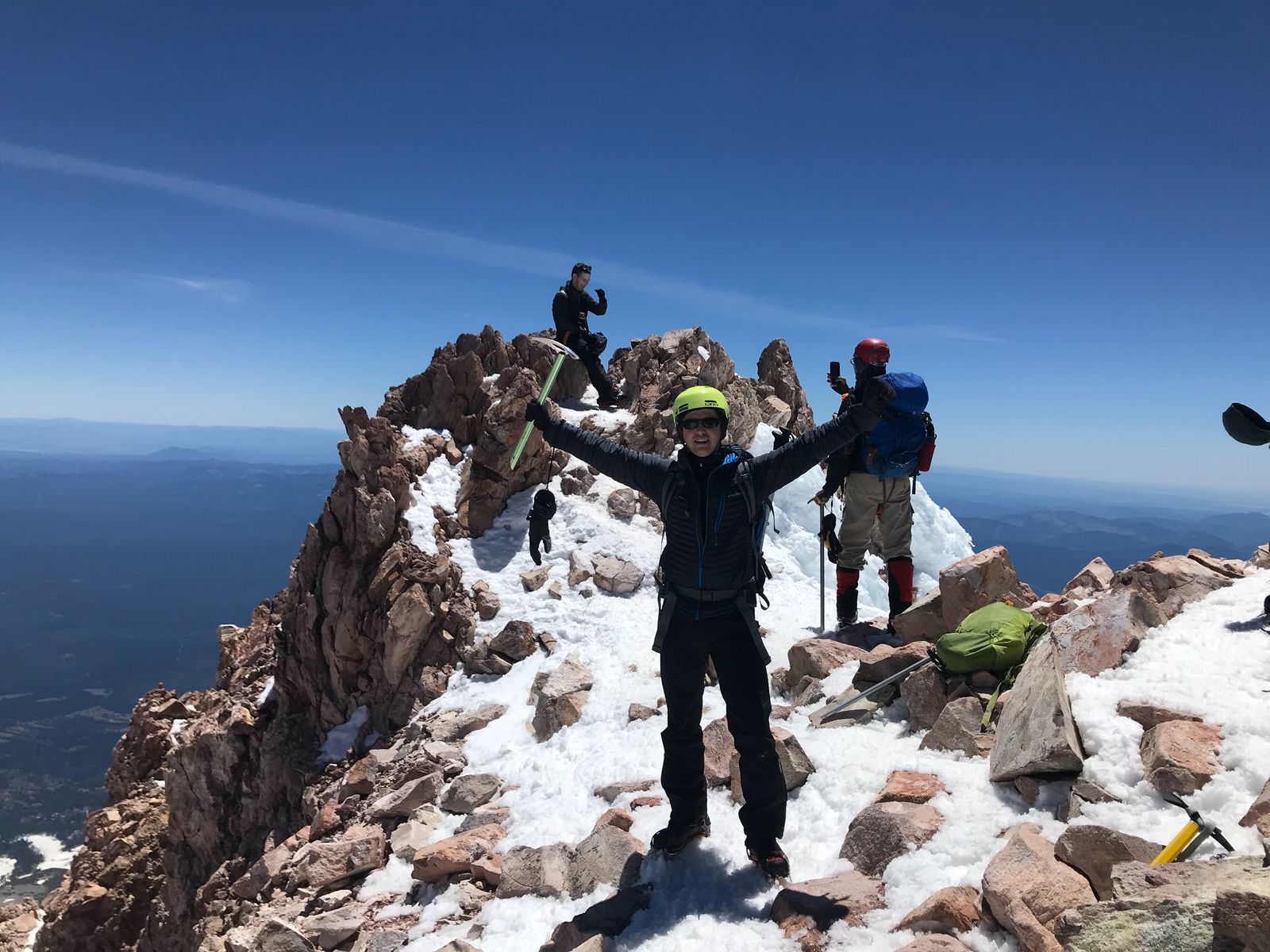
In June 2018, he wrote up a one-day ascent of Mount Shasta. His account includes a 4:12 a.m. departure, a 12:47 p.m. arrival at the summit and a return to the trailhead at 4:38 p.m. He photographed the trip, signed the summit book and descended partly by sliding down the snow. Even the success came with a list of adjustments for another attempt.
The following year, he went back and stopped a few hundred feet below the summit while his partner reached the top. He added that result to the account. It gives the adventure an agreeable lack of polish: a successful climb, a return, a different outcome. Mountains have an inconvenient habit of refusing to repeat yesterday's experiment.
The queue moved faster than the kitchen
His next business problem was closer to lunch. In 2019, Simeonov worked on Sleek, later renamed Swift, to make ordering from a phone faster and reduce waiting in line. The team found a pilot customer, Bonito Poke. He described a cycle of deploying the system, watching it operate and returning to build around what needed fixing.
The system eventually moved orders through quickly enough to outpace the kitchen. Yet the project also brought a separation from his co-founder and a reassessment of what made a company worth building. When he joined Slapdash as its first non-founder, he valued the team fit and the ambition to make work happen with less interruption. The practical interest in saving time remained.
His reflections on that period contain a charming side project: a limited edition hot sauce, complete with labels and shrink wrap. The engineer who wanted fewer impediments between thought and action had also attended to the packaging on a condiment. It is a useful detail to retain beside the corporate titles. People make things for reasons that will never fit a pitch deck.
What if the rules are optional?
In 2021, his writing examined the games people enter without much consideration. One essay begins with urban traffic: you can compete within its rules, or reconsider the vehicle, the route or even the decision to live in that city. The example broadens into a question about which frameworks deserve your participation in the first place.
He had approached a related question in an earlier essay about reinforcement learning. An intelligent agent responds to rewards somebody defines; a person can stop and ask who established the rewards they are pursuing. Simeonov's concern is the authorship of one's choices. Grades, status and money can become objectives before anyone has examined why they should be.
Another essay takes aim at cynicism. He describes growing up in Bulgaria amid expectations that improvements would be obstructed or appropriated. His argument is that treating the world as permanently fixed can make people miss the ways it changes. It is an idea with consequences for a founder: entering an awkward market requires believing that its awkwardness can be reduced.
Giving the grant writer a better cockpit
Pioneer, founded in 2022 with Kyle Treige, applied language models to the work around funding. The service launched in February 2023. In November that year, the company announced a $2.9 million seed round led by Blue Bear Capital, with Collaborative Fund, Soma Capital, Cool Climate Collective and Kayan Ventures participating. Its initial focus was helping climate technology companies pursue grants, contracts and incentives.
The division of labor made sense for this particular pair. Simeonov brought his AI and software background; Treige had founded two startups and worked at an early-stage investment firm. Pioneer combined technology with people who could execute the process. Matching an opportunity was only a beginning. An application required decisions, documents and coordination.
Led by Blue Bear Capital
During a 2023 conversation with OpenGrants co-founder Sedale Turbovsky, Simeonov explained why a standalone tool would address only part of the problem. He wanted consultants to handle more work and concentrate on strategy and project management. Applicants would still want a person they could talk to. His enthusiasm for the machinery left room for the human responsible for the outcome.
The metaphor he used was an Iron Man or Iron Woman suit, or a Formula One car: equipment that makes the practitioner more capable. He also connected broader access to better representation among applicants. The ambition was to help smaller organizations compete, rather than letting the complexity of the process decide who could participate.
The spark between two organizations
Pioneer's current story widens the view beyond grants. Under the PioneerAI name, it presents a prospecting tool for people making deals in climate, deep technology and manufacturing. Simeonov describes customers, partners and grants as connections between organizations that can bring an innovation into use. He identifies diligence, prospecting, finding a champion and preparing a proposal as points where momentum leaks away.
The stated mission is to help ignite a million innovations. That is an aspiration, with a great deal of work between the sentence and its fulfillment. It also makes the progression of his career legible. The teenager looked for a way into the national team. The researcher investigated what a robot understood. The engineer considered how information and colleagues could work together. The founder keeps returning to the steps that stop a useful idea from moving.
There is something pleasingly unromantic about choosing those steps as one's subject. A proposal must be prepared. A reference must resolve. A team must fit. Somewhere there may be a dramatic breakthrough; somebody will still need to do the work around it. Simeonov has made a career out of finding that surrounding work interesting enough to improve.