The software worked. That was the trouble. In 2017, SDLC Corp delivered a logistics platform that looked sound in staging, according to its founders. Dispatch, routing, live updates: the features were there. Then peak orders arrived. The system went down for four hours.
- SDLC builds custom software and connects business systems, including Odoo ERP and Salesforce CRM.
- Its commerce work tackles mismatched stock, orders, payments, and customer records.
- Buyers can commission a project, add a dedicated team, or start with an existing module and pay for the work around it.
The staging-room illusion
In a 2025 interview, co-founders Kishan Srivastava and Anuj Yadav traced the outage to inadequate stress testing and shifting scope. Yadav visited the client and revised the load strategy. They say mandatory load tests, architecture reviews, and a formal discovery phase followed. Yadav’s description of the testing rule was admirably brief: “No exceptions.”
The company began in 2015 with three developers; its first assignment was an eLearning platform for a US client, the founders recall. The later failure gives that origin a useful second chapter. A finished feature list had proved an insufficient definition of finished software.
“No exceptions.”
Anuj Yadav, on mandatory load testing and architecture reviews, 2025
That distinction matters when buying development services. A demonstration shows that a transaction can succeed. A business needs it to succeed on a busy afternoon, with imperfect data and an impatient customer. Ask what happens after the demonstration; the answer is often where the engineering begins.
The last pair of shoes
SDLC’s Apex Shoes case study supplies a more ordinary drama. The footwear business had wholesale and direct-to-consumer channels, with disconnected tools handling stock, orders, and customer information. The team reconciled records manually. Sizes and colours made the inventory problem more demanding as the range grew.
SDLC describes bringing catalogue management, stock, payment reconciliation, and fulfilment into an Odoo back office. Wholesale and consumer orders retained their different pricing and workflows. The shared system gave staff a common place to look up the order, the payment, and the available stock.
The implementation account describes process mapping, staged configuration and approvals, testing, and a phased rollout with staff onboarding. Its reported benefits include fewer manual handoffs and an end to overselling caused by delayed stock information.
Imagine the last pair in a particular size. Two sales channels can each display it, but a warehouse can dispatch it only once. That is the practical attraction of a common inventory record. Software earns its keep when the second buyer sees the right answer before placing the order.
Wholesale
Retail
Two doors to the shop. One answer about what is on the shelf.
A connector with an exception desk
Consolidating everything inside one platform is one approach. Connecting systems that already have useful jobs is another. Shopify runs a storefront; Odoo handles operational records. SDLC’s Shopify-Odoo connector is intended to keep their products, customers, orders, prices, and inventory aligned.
The product page describes webhooks for event-driven updates, scheduled jobs as a fallback, and manual synchronization. It also exposes logs and retries inside Odoo. Those features acknowledge that a connection needs attention after installation. A missed update should leave a trail someone can follow.
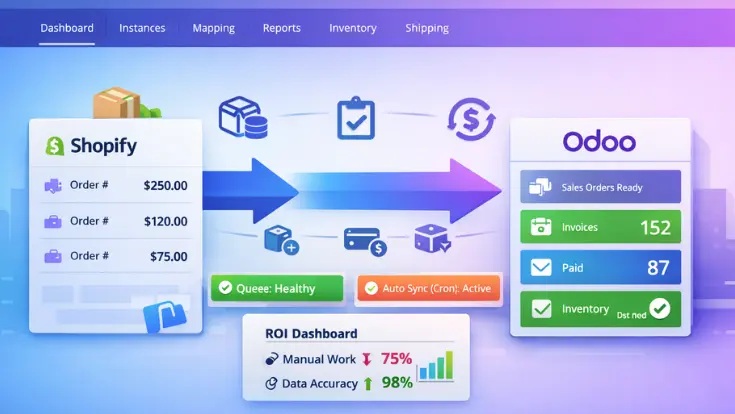
Its May 2026 launch announcement adds detail about mapping products and variants, validating fields, and recovering failed records. It describes configurable order review, invoice creation, tax treatment, and fulfilment updates. Crucially, teams choose which system controls particular statuses.
That is a business decision with technical consequences. If two applications both have permission to declare a payment settled, the people configuring them need a clear rule. The announcement also discusses scheduled inventory pushes to manage API usage. Speed is useful; an orderly queue can be useful too.
The copyable lesson is to request a failed transaction in the demo. Give the implementer an order with a missing mapping. Ask where it appears, who gets told, and how it is recovered. A successful sync sells the product. A recoverable failure tells you how it might behave at work.
The invoice still needs a grown-up
SDLC’s Transworld Logistics document-processing case concerns another seam: between a freight invoice and the operational record it belongs to. The company describes varying document layouts, repetitive entry, and slow approval. Its proposed pipeline extracts fields, flags uncertain values for review, and sends validated data into enterprise systems.
The human review step is part of the design. A low-confidence field becomes an exception somebody can resolve. The AI reads; the workflow determines what happens next. That arrangement is more intelligible to an operations manager than a promise to automate paperwork in the abstract.
Figures reported in SDLC’s case study. Operating cost per document is separate from the price of building the system.
The case reports processing time falling from 48 hours to four, and cost per invoice from $2.50 to $0.45. For a prospective buyer, the useful questions concern document variety, approval authority, and the cost of handling exceptions. Those determine whether the design fits another operation.
Paying for the seams
SDLC sits in the services market: it sells engineering, implementation, consulting, and continued help running what it builds. Its dedicated-team offering gives clients another route, adding managed development capacity to an ongoing programme. A buyer can purchase a defined outcome or arrange access to a team over time.
There are also reusable products. Odoo lists SDLC as a Ready partner, and its Apps Store carries the company’s WooCommerce connector. The partner profile describes marketplace connectors, financial reporting, inventory analytics, and industry modules. These give a technical buyer something concrete to inspect alongside a proposal.
The Shopify product page advertises a free core module, with implementation and customization handled separately. Free code can still require paid field mapping, migration, testing, and support. A module is a starting point; fitting it to the business is work.
Clutch lists a $10,000 minimum project size and an hourly band of $25-$49. Its pricing snapshot identifies $10,000-$49,999 as the most common project range among 15 reviews. Those figures offer orientation. A proposal must still specify what is included, especially third-party subscriptions, data preparation, and post-launch responsibilities.
The broader service menu reaches into mobile applications, cloud work, AI, blockchain, and games. Salesforce services cover implementation, integration, and managed support, with examples involving marketing journeys, service desks, and quote-to-cash operations. The common commercial proposition is access to specialists who can carry a build beyond its first release.

A useful brief starts with a difficult order
The interesting distinction in SDLC’s integration practice is the combination of consulting, module development, and ongoing delivery. Its Odoo materials describe both standard implementations for growing businesses and custom work for complicated operations. A firm with several warehouses has different needs from one replacing its first spreadsheet.
Alternatives include another implementation partner, a freelance specialist, middleware, or an internal team. The sensible comparison follows the workflow. Who understands it? Who will maintain the mapping when a field changes? Who owns the response when an order fails?
A small business with a standard setup may need only configuration. A company whose records have no consistent identifiers must address that before synchronization can be dependable. Heavy customization also needs an upgrade plan. These are conditions to settle during discovery, when changing the brief is still relatively cheap.
Start with one awkward order: a variant, a discount, a return, a payment exception. Trace it from the storefront to fulfilment and accounting. Decide where each fact belongs, agree what peak demand means, and name the person responsible for exceptions. That gives SDLC, or any candidate partner, a brief worth pricing. It also makes the four-hour story useful to someone who never hires the company.