Scott McFarlane had already spent thousands of mornings putting on orange when he arrived at the New York Stock Exchange in June 2018. His company sold tax compliance software. His jacket suggested that somebody, somewhere, had decided this need not be a punishment. The combination was characteristic: an obligation almost every business understands, presented by a founder who refused to dress like an obligation.
Avalara’s stock-market debut gave the outfit a particularly suitable audience. The company had begun on Bainbridge Island in 2004, with McFarlane, Rory Rawlings, and Jared Vogt. Fourteen years later, its co-founder stood at the opening bell. By then, he had worn orange for more than 4,000 consecutive days. Even a successful public offering could only be a brief interruption in a streak like that.
There is an easy joke here about a software executive making a fashion commitment. The more interesting question is why he kept making it. A tax calculation disappears into a transaction. A good result is supposed to pass without incident. Building a company around such work requires people to care about something customers would preferably never have to think about. McFarlane gave that work a color, and then kept showing up in it.
A wardrobe with a job to do
In his account of Avalara’s early branding, the decisive view came from a trade-show balcony. Below was a financial-software industry dressed in blue: booths, suits, lights. Orange offered a way to be recognized. It also offered permission to behave with a little more life than the setting seemed to require. Avalara added tiki huts to the visual vocabulary. The sales pitch now had somewhere to sit.
The color choice belongs beside the company’s commercial argument. Customers were already using software to run their businesses, while compliance demanded work around those systems. McFarlane wanted Avalara connected to the applications customers used for accounting, invoicing, and ecommerce. The ambition made partnerships central. The company needed to become familiar to other software businesses as well as to the merchants buying its services.
Seen this way, the orange shirt was a small act of repetition in a business that depended on repeated introductions. Most branding advice is wonderfully affordable until somebody has to follow it every morning. McFarlane accepted that particular assignment himself. The daily wardrobe made the company’s preference visible without requiring a presentation, a meeting, or another inspirational slide.
“Sales tax is boring, but the business of sales tax is really, really exciting.”Scott McFarlane
The hotel job that disappeared
His route to that business was crooked enough to resist the usual founder mythology. At Claremont McKenna College, where he earned an economics degree, he worked with his roommate Augie Nieto on the venture that became Lifecycle. Asked about that early chapter, McFarlane gave Nieto credit for turning it into the business people would come to know. He described his own involvement as an early part of a much longer story.
Then came the family hotel company. McFarlane wanted to run it. He had watched his father build the business and worked alongside him, imagining a future that continued the family enterprise. His father’s decision to sell removed that future. The new owners wanted their own team. What looked like an apprenticeship with a destination became experience he would have to take somewhere else.
That distinction matters. His early education in business had given him exposure and expectations; it could not guarantee a place. After trying hotel projects of his own, he accepted an invitation to join a software startup in Seattle. A career that had seemed attached to buildings moved toward products delivered through computers. The change was substantial, though the need to understand customers and work with partners remained.
Before Avalara, he helped build MetaInfo with Jared Vogt. The company was sold to Check Point Software Technologies. Vogt would later join him in the Avalara founding team, making their connection older than the tax-software business itself. An earlier company had supplied both experience and a collaborator. When a founder’s biography looks like a sequence of unrelated industries, the relationships sometimes provide the continuity.
One way to read these detours is as preparation for a business that would demand many kinds of persuasion. Exercise equipment, hotels, and software present different buying decisions. Each still requires somebody to believe a proposed change is worth the trouble. McFarlane arrived at Avalara having worked on several versions of that problem. He also arrived having learned that the work you expect to inherit can disappear.
Selling the inevitable
Avalara’s earliest premise sounds tidy in retrospect. Transactions were becoming digital; calculating their taxes should become digital too. But the founders’ confidence did not relieve them of the need to find money. McFarlane remembered an early investor from a previous company responding to their request with an instruction to suffer. Fundraising occasionally supplies feedback with remarkably little interest in being constructive.
Early backing came from angels, friends, and family. That put personal relationships alongside the commercial wager. McFarlane emphasized the conviction required to ask people close to you to invest. There is a particular weight to that kind of funding: the business case goes home with somebody who knows you. Optimism becomes harder to keep at a convenient distance from its consequences.
He became Avalara’s chief executive in February 2007, having already served as chief operations officer. The dates give the founding story some useful texture. Building a company involved operating responsibilities before it settled into the title most people associate with him. The work preceded the familiar label. For anyone studying the career, that is a better place to begin than treating the CEO’s chair as a birthright.
A company also has to turn a useful premise into reliable delivery. Avalara’s reported third-quarter results in 2018 described the work in terms of tax content, a platform, partners, and integrations. That is a much less photogenic inventory than the orange jackets. It helps explain what sat beneath them: a service had to fit into a customer’s existing business and continue functioning as circumstances changed.
For McFarlane, the operational question was how to make that idea ordinary. A customer should not need to share the founder’s enthusiasm for taxes to use the product. The useful promise is time returned to the customer’s own work. Selling such a promise requires attention to a buyer’s routines, including the routines they dislike enough to wish someone else would handle them.
Hospitality on the eighteenth hole
In June 2015, Avalara hosted customers and partners in a corporate tent at the U.S. Open at Chambers Bay. The setting had food, drinks, televisions, and an address beside the eighteenth hole. The company also arranged accommodation and transport. A tax-software gathering had acquired some of the practical concerns of a hotel operation. McFarlane’s earlier career suddenly seemed less distant.
The founders had written a “Shoot The Moon Manifesto” in 2004 and revised it in 2010. At the golf tournament, a set of aspirations had become something people could actually visit. McFarlane framed the occasion as gratitude to customers and partners. Growth, in that moment, came with chairs and a place to spend an afternoon together.
There is a sensible limit to what a corporate tent can prove. Hospitality does not demonstrate the quality of software. It can demonstrate that an organization understands relationships need occasions as well as contracts. McFarlane’s version of enterprise sales left room for those occasions. Someone discussing a demanding product could still enjoy the company of the people around it.
He had received GeekWire’s CEO of the Year award the previous month. Accepting it, he directed the recognition toward employees and investors. The acknowledgment fits a recurring feature of his public career: the founder appears as a host as well as a salesman. He wants people gathered around the project. An award provides another opportunity to make that gathering visible.
A bell, a buyer, a different chair
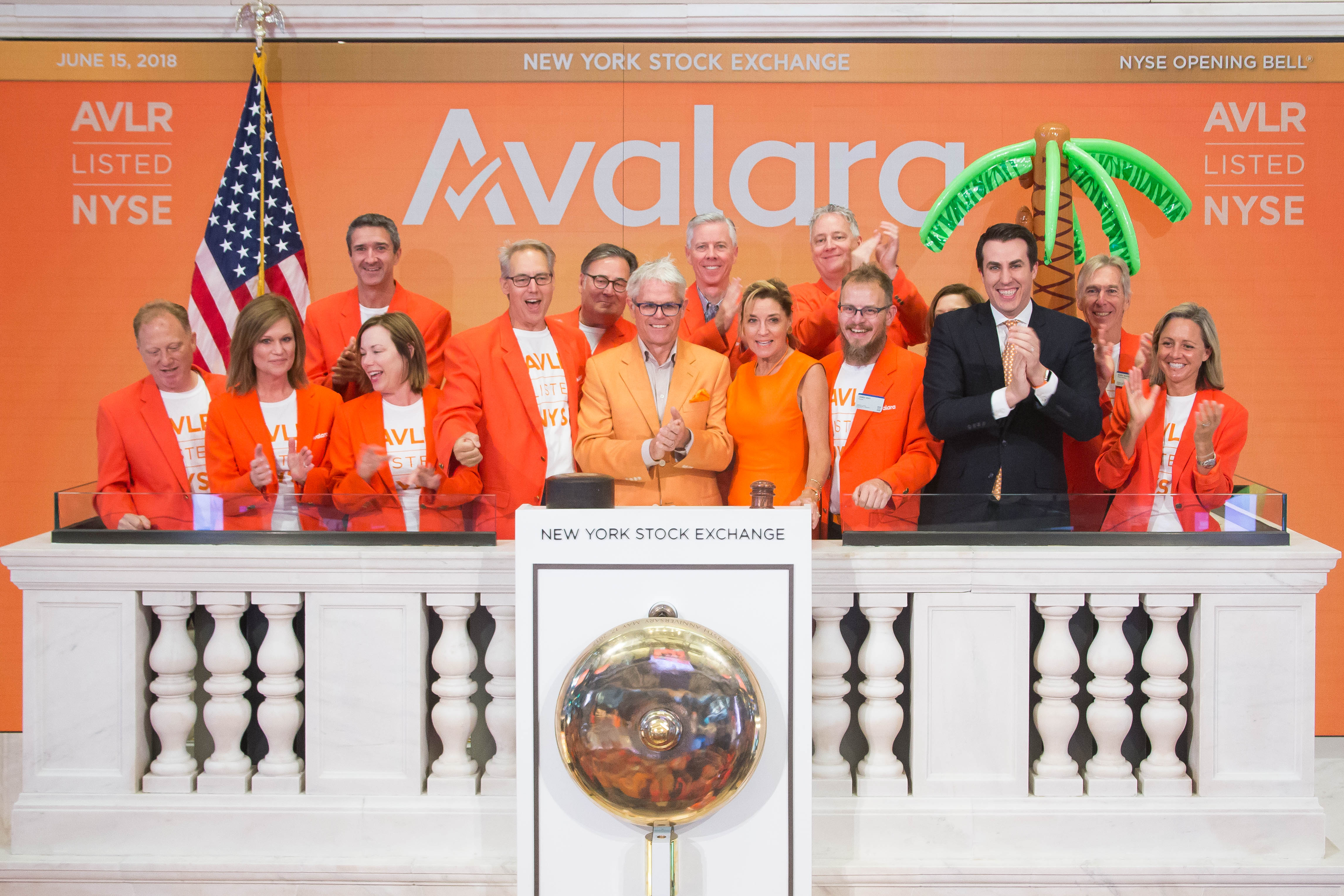
Four years after the listing, Avalara entered a different ownership chapter. Vista Equity Partners completed its acquisition on October 19, 2022, paying $93.50 per share in cash. The announced transaction valued the company at $8.4 billion. McFarlane stayed CEO. For him, the change meant carrying the company’s ambition into a relationship with a software-focused investment firm.
The next change concerned his own responsibilities. On May 28, 2026, Hugo Sarrazin became Avalara’s CEO and McFarlane became an advisor. The announcement positioned the transition around scaling operations and advancing the company’s AI work. The founder who had spent years explaining a cloud product would now advise a business preparing for another change in how software works.
For colleagues marking the handover, the memories included his accessibility, his orange clothes, and his familiar sign-off, “Best ever.” Melissa Dallmeyer recalled that the respect he showed extended from executives and partners to the event photographer. It is a revealing detail because it concerns behavior at the edge of a business occasion, where titles provide less guidance about whom to notice.
The lasting interest in McFarlane’s career is in those smaller decisions. Give an old obligation a memorable identity. Carry experience from a lost opportunity into another industry. Keep an earlier collaborator close. Thank the people who helped. None guarantees a company will succeed. Together, they make this particular founder easier to understand. Sales tax gave him a serious subject. He supplied the orange jacket.