Scott Killoh has spent much of his career selling a proposition that sounds modest until someone tries to deliver it: the various parts of a business ought to work together. Publishers needed advertising and content to travel across different channels. Banks needed customer information to survive the journey between applications. Now artificial intelligence has arrived, carrying another suitcase full of things to connect.
The businesses change. The untidy handoffs remain. Seen across OpenPages, Mediaspectrum, Nymbus and Flare, Killoh’s career suggests an enduring attraction to the machinery behind the public experience. A reader sees an article. A customer sees an account balance. Somewhere behind each, software has to keep the promises made out front.
That is one way to understand a founder associated with community banking who is now running an AI company. The present chapter follows quite naturally from the earlier ones. The question has moved from how institutions publish and transact to how they put new intelligence to work without turning everyday operations into an experiment.
A publisher’s problem, before the bank’s
Killoh founded OpenPages in 1995, and his early work there included engineering leadership. The company supplied content-management software to large publishers, including Gannett, Thomson Financial Media, Knight-Ridder and Tribune. His education was in finance: a BA from the University of Massachusetts Amherst. His working life took him into the systems through which other people did their work.
Those early customers make the later banking move less surprising. A publishing business contains editors, salespeople, production staff and commercial obligations. A story and its accompanying advertising may appear together to a reader while having taken very different routes through the organization. Making the result look simple can require a remarkable amount of backstage coordination.
Mediaspectrum, which Killoh co-founded in 2001, continued that work as publishing acquired more destinations. Print was joined by websites, smartphones, tablets and broadcast channels. Each new outlet created another opportunity to reach an audience and another opportunity for the organization’s internal systems to disagree.
The product brought advertising and content workflows into a shared cloud platform. Orders, campaigns, payments and publishing could be handled within the same environment. In July 2013, Insight Venture Partners invested $35.8 million for a minority equity stake. Peter Sobiloff and Cian Cotter joined the board. Mediaspectrum then had approximately 100 employees, with offices spanning Boston, London, Moscow and Sydney.
A minority investment from Insight Venture Partners to support expansion.
The financing was consequential, but the product’s ambition is the more useful clue to Killoh’s career. Mediaspectrum was addressing a business whose output had multiplied faster than its administrative simplicity. An advertisement could have several lives. Someone still had to book it, produce it and collect the money.
There is a certain comic justice in this corner of technology. A new device promises freedom. The enterprise buys another system to manage the freedom. Killoh’s opportunity lay in making the systems less demanding companions.
For the buyer, connecting those systems is part of the purchase calculation. A company can offer a useful tool and still leave its customer with more coordination to do. The attraction of a shared platform rests on reducing that burden. This is where a software feature meets the less glamorous arithmetic of a working day.
The bank behind the banking app
In 2015, Killoh and Alex Lopatine founded Nymbus. Banking presented a different set of obligations, but another coordination problem: institutions trying to offer modern digital services while relying on older core systems. The intended customers included community banks and credit unions, organizations with customer relationships worth preserving and technology that could be expensive to change.
Killoh’s early description of the product included the phrase “a true SaaS product.” Nymbus offered SmartCore as a hosted platform, bringing banking functions and customer information together. Its interface emphasized a single sign-on, search, documents and a consolidated customer view. These sound like conveniences until a customer needs an answer while an employee is searching several applications.
The promise was practical. A banker should be able to see a customer’s accounts, activity and related material in one place. Built-in customer relationship management connected the administrative record to the human being asking for help. For a founder coming from content management, the emphasis on finding, organizing and using information has a familiar ring.
Across many channels
Across banking functions
Across bank operations
An editorial reading of the work across Mediaspectrum, Nymbus and Flare.
In February 2017, Nymbus announced $16 million in funding led by Home Credit Group, following a $12 million round six months earlier. Killoh, then executive chairman, connected the investment to the constraints older technology placed on banks’ ability to grow. His argument concerned the institution’s prospects as much as its software.
The distinction matters. A community bank does not modernize merely to acquire a more fashionable screen. It needs to serve customers, introduce products and keep operating while the technology changes. The customer is perfectly entitled to remain uninterested in the architecture. The balance should still be right.
Nymbus also acquired Sharp BancSystems, KMR and R.C. Olmstead during 2016. Building a banking platform involved acquisitions alongside product development. The growing business had to contend with the established systems and relationships of the industry it wanted to serve.
A new bank without moving the whole house
SmartLaunch widened the proposition. Instead of asking an institution to replace everything at once, Nymbus offered a way to launch a separate digital bank with technology and operational support bundled together. The company marketed a 90-day launch timetable. That was a stated proposition, rather than a promise that every institution would finish on the same schedule.
The package included services such as digital marketing, customer relationship tools and operational support. The sales conversation could therefore extend beyond software capabilities to the work required to run the new operation. It was an acknowledgment that buying a platform creates a second question: who is going to make it useful on Monday morning?
In 2019, Nymbus helped Inspire Federal Credit Union change its core, internet banking, mobile banking and payment systems. In June 2020, the company announced another $12 million investment, led by Insight Partners and Vensure Enterprises. The connections around Killoh’s businesses were continuing, too: Insight had backed Mediaspectrum seven years earlier.
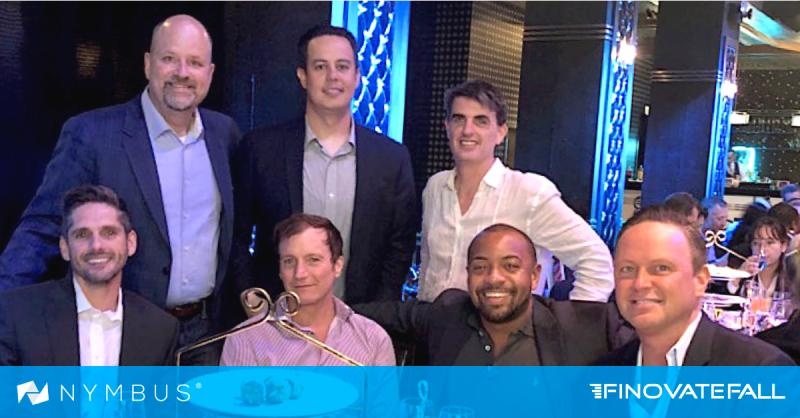
A photograph from the Finovate gala puts people around these abstractions. Nymbus colleagues joined Surety Bank and booyah! bank CEO Ryan James in New York, where Surety and Nymbus were nominated for a fintech and bank partnership award. The companies were selling infrastructure, but partnerships still involved the ordinary business of getting people together.
It is a useful image for this career: several institutions, several responsibilities, one table. No photograph can establish a management philosophy. It can, however, remind the reader that software businesses depend on relationships as well as code.
October 1, 2020: the job changes
Nymbus announced the appointment of Jeffery Kendall as CEO in September 2020, effective October 1. Killoh moved to executive chairman. Kendall brought experience from Kony’s digital banking business and Temenos. The founder would chair the board, advise Kendall and participate in long-term strategy.
The announcement assigned different responsibilities to founder and incoming executive. Killoh emphasized Kendall’s banking knowledge and ability to take products to market. It was a concrete leadership transition, with a named successor and an effective date, rather than a vague promise that everyone would concentrate on vision.
Nymbus continued developing after the handoff. By September 2025, Kendall was discussing the company’s approach to modernization through a separate core alongside an institution’s existing system. That later development belongs to the company’s continuing story. Killoh’s own path had already opened another chapter.
- 1995OpenPages: content-management software
- 2001Mediaspectrum: publishing and advertising workflows
- 2015Nymbus: banking infrastructure
- 2020Nymbus CEO handoff to Jeffery Kendall
- 2022Flare founded in Miami
- 2026Flare partners with Liberty Bank on AI
The next system still needs an operator
Flare dates its founding to 2022 in Miami. Killoh is its founder and CEO. The company’s current focus is enterprise AI, including deployment and governance for financial institutions. Jay Cody serves as chief product officer and co-founder, while David Mitchell joined as president and chief strategy officer in June 2026.
Mitchell had been president at Nymbus and subsequently spent six years at Liberty Bank. His arrival brought a familiar banking relationship into Killoh’s new company. Flare assigned him responsibility for strategy, expansion, partnerships and customer success, a list that places the customer’s ability to use the technology near the center of the business.
On June 18, 2026, Liberty Bank announced its AI Center of Excellence and selected Flare as a strategic technology partner. The initial priorities included productivity, customer experience, automation of complex processes and reusable AI capabilities. These were proposed areas of work, with governance built into the initiative.
“Most banks have been sold AI platforms and left to figure out the rest.”
Scott Killoh · Liberty Bank partnership announcement, June 2026
The remark is pointed, and it also gives his career a pleasing symmetry. The publisher needed help managing multiple channels. The bank needed help connecting its operations. The AI customer needs help turning a purchase into working systems. Each technological advance arrives with a bill for implementation.
Flare’s July 2026 update reported that Deploy IQ, Policy IQ and Lead IQ were live at Liberty. That is the latest documented development in this account: the new venture moving from an announced partnership toward applications inside a bank.
Across these companies, Killoh has kept returning to the work between the announcement and the everyday result. The nouns have changed considerably since OpenPages. The practical demand sounds familiar: bring the pieces together, make them usable, and stay close enough to the customer to see whether they work.