The quick read
- Scalr is a remote operations and state backend for Terraform and OpenTofu, aimed at platform teams that need developer autonomy with central controls.
- Its decisive product lesson came early: easy provisioning created a maintenance bottleneck, so the company shifted attention from the request to the full infrastructure lifecycle.
- The commercial wedge is a familiar workflow and a different meter - 50 runs free each month, then $0.99 per run before volume discounts, with no user, resource or concurrency fee.
- The repeatable migration pattern is to model costs, map RBAC, back up state, pilot, freeze writes briefly, import, and validate every workspace.
There is a particular kind of failure that arrives disguised as convenience. In Scalr's early years, the company built a service catalog: a neat storefront where developers could ask for cloud infrastructure without filling out a ticket. It worked. Requests became deployments. The button did what the button promised. And then the platform team inherited everything that happened after the click - updates, maintenance, exceptions, repairs. Provisioning got faster while ownership did not. According to co-founder Igor Savchenko, advanced customers eventually asked Scalr to remove the feature.
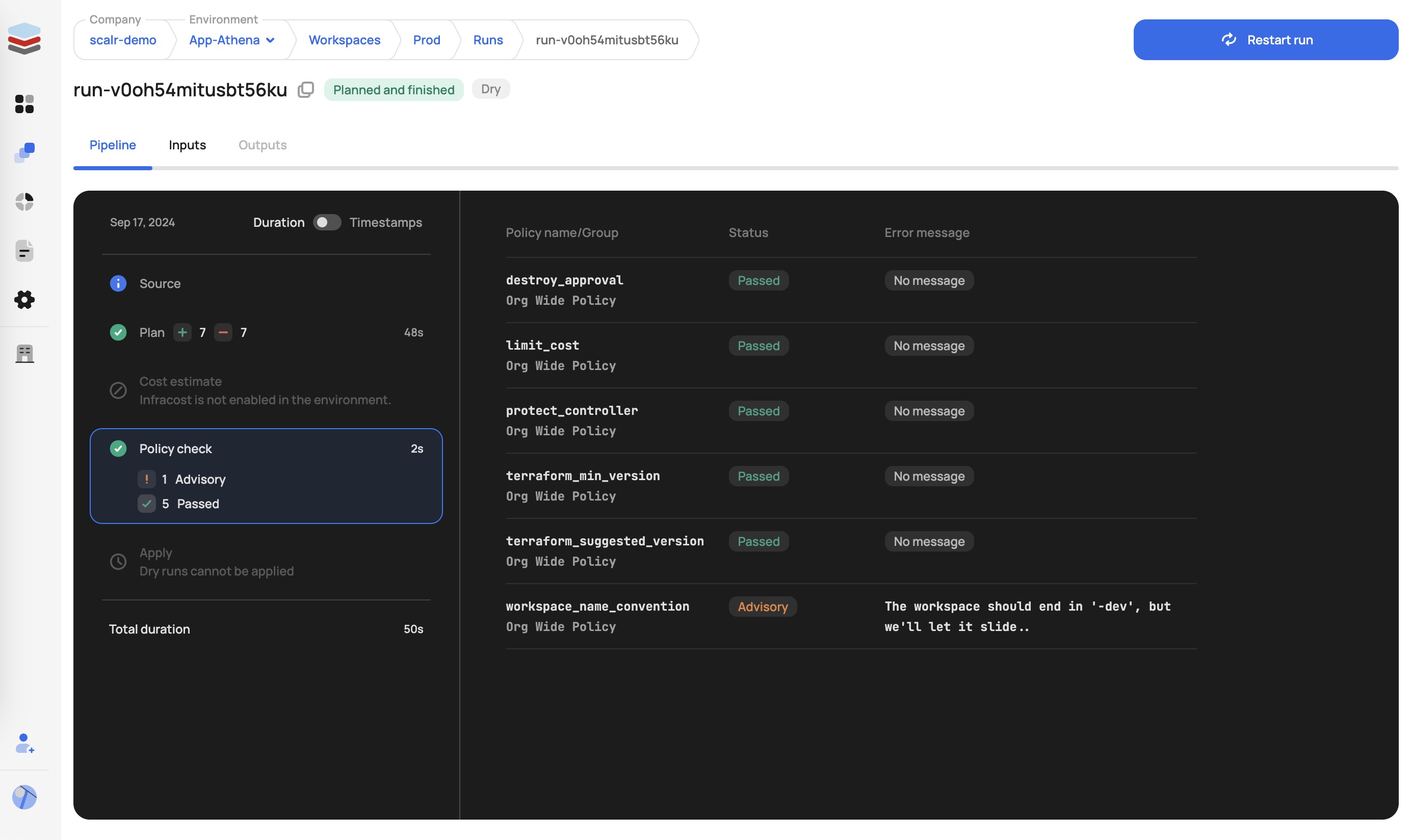
This is funny in the grim way that infrastructure stories are funny. The feature failed because it succeeded at the smallest version of the problem. Scalr's correction was to stop treating self-service as a vending machine and start treating it as a governed workflow. Today the company provides remote execution, state storage, approvals, role-based access, policy checks, registries, drift detection and Git automation for Terraform and OpenTofu. A developer can still move quickly. The platform team can decide where, how and under which rules.
The button was never the product. The product was everything that had to remain understandable after someone pressed it.The lesson inside Scalr's early service catalog
The old company inside the new one
Scalr predates Terraform. Sebastian Stadil began the original open-source project in 2007, years after a traffic surge overwhelmed his shared-hosting server and gave him an enduring interest in scaling. The company was incorporated in 2011 and sold cloud management at a moment when “multi-cloud” itself felt like a new administrative species. OpenView Venture Partners led a $7.35 million Series A in 2016. Scalr spent years selling control across AWS, Azure and Google Cloud before narrowing the proposition around infrastructure as code.
That history matters because the current product can look, at first glance, like one more Terraform dashboard. It is better understood as the residue of a long argument between developers and central IT. Developers want the native CLI, pull requests and short feedback loops. Security and operations teams want credentials, audit trails, policy and separation of duties. Scalr places an account above environments, and environments above workspaces. Variables, provider configurations and Open Policy Agent rules can be defined high in that hierarchy, inherited below and locked against local changes. The hierarchy is the quiet mechanism by which one platform team can govern many application teams without copying the same policy into every workspace.
Three meters, three kinds of anxiety
Infrastructure automation vendors can make nearly identical feature grids feel completely different on an invoice. HCP Terraform meters managed resources. Some competitors sell concurrency - the number of jobs that can run at once. Scalr meters runs. Its Business plan currently includes 50 runs a month at no cost, then lists usage at $0.99 per run before volume discounts. Users, workspaces, managed resources, self-hosted agents and concurrency are not separate billable units. Drift checks and several kinds of failed or policy-blocked runs do not count.
Resources
The bill grows with the estate, even when much of it sits unchanged.
Concurrency
The bill buys parallel lanes, whether those lanes are busy or idle.
Runs
The bill follows plans and applies - the frequency of infrastructure work.
Scalr's model is not automatically cheaper. It favors an estate that is large relative to how often it changes. A compact environment running automation all day may prefer another meter. The useful comparison is embarrassingly practical: export recent run history, count billable activity, and place it beside the renewal quote. The feature that matters here is not cleverness. It is that the arithmetic is public enough to do before a sales call.
The migration is the demonstration
“Drop-in replacement” is the sort of phrase that should make an infrastructure engineer narrow their eyes. Scalr supports the Terraform remote backend and familiar CLI commands, along with Terraform Cloud API compatibility. Its open-source migration tooling can copy workspace settings, variables, state history and VCS configuration, then generate Terraform code for managing Scalr itself. The promise is not that migration has no work. It is that teams do not have to reinvent their pipeline in order to leave.
The customer accounts are valuable because they describe what failed first. TV4 encountered minor pagination problems, missing IAM roles and old lockfiles. FLYR spent roughly two days testing its customized script, about a day on the bulk import, and two weeks validating the result. Primer moved around 150 workspaces in a month and found that the hardest task was not state transfer but defining its internal RBAC model. Ably kept its old platform live until cutover, compared state serials and lineage, locked the source workspaces, ran final plans and switched in about 20 minutes.
What changed their minds was rarely a dramatic outage. FLYR says Terraform Cloud held up operationally; its growing footprint simply stopped fitting the pricing and architecture. Primer faced a renewal increase. TV4 combined cost concerns with slow job starts. Sierra-Cedar had built its own automation, then discovered that maintaining a home-grown platform pulled engineers away from the company's actual business. Scalr won by looking less like a reinvention and more like an exit ramp.
The part worth copying
A buyer can copy the migration discipline without buying Scalr. The sequence below is what makes the published moves credible. It also explains why the shortest cutover can follow weeks of preparation.
Use actual run history, resource count and peak concurrency. Marketing examples are not your workload.
Decide which teams, environments and credentials belong together before importing workspaces.
Export state, configuration and project data. Make the rollback path a real procedure, not a comforting noun.
Move a representative team first, run speculative plans and repair old assumptions before the bulk event.
Stop writes, run the final migration, compare state and execute plans across every workspace before releasing teams.
The other copyable idea is product restraint. Scalr's early catalog confused access with autonomy. Its present design lets central teams publish modules, policies and provider credentials while developers keep working through pull requests or the CLI. The control is inherited, which means the paved road can be easier than the improvised one. That is a better definition of self-service: not “anyone can create anything,” but “the safe path does not require a ticket.”
This approach weakens when a team wants a fully self-managed open-source stack, cannot use a SaaS control plane, or executes so many runs against so little infrastructure that per-run pricing loses its advantage. It also depends on organizational work: unclear ownership and careless RBAC will survive a migration perfectly.
A narrow place in a crowded market
Scalr sits between HCP Terraform, commercial platforms such as Spacelift and env0, and the do-it-yourself route of Atlantis or ordinary CI. Its claim is narrower than “manage every cloud.” It wants to be the compatible operations layer for Terraform and OpenTofu, with stronger pull-request workflows and a bill tied to activity. The company says more than 1,000 teams use it, reports 99.96 percent uptime in 2025, and describes itself as profitable, growing and venture-backed. It has also tied its future to OpenTofu: CTO Igor Savchenko helped found the project, which moved under Linux Foundation governance after HashiCorp changed Terraform's license.
The oddity is that a company born to simplify cloud management found its clearest identity by shrinking the promise. Scalr does not abolish infrastructure politics. It gives those politics names - account, environment, workspace, policy, approval - and turns them into things a team can inspect. The hard work remains. It is simply less likely to arrive disguised as a friendly button.