Sanjay Deshpande has spent much of his career worrying about the distance between a clever idea and a paying customer. It is a deceptively small distance on a presentation slide. In practice, it can swallow a research laboratory. His answer has involved computer science, bank tenders, patient engineering and the occasional reminder that a customer is under no obligation to be impressed.
The question began taking shape during his years at Tata Research Development and Design Centre. Conversations with its former director, E. C. Subbarao, sharpened his concern about India’s ability to turn research into commercial value. The country had scientific talent. Deshpande wanted more of that talent to result in products that travelled, sold and stayed useful after the demonstration ended.
That concern would help produce Uniken, co-founded in 2003, and later Fortytwo Labs, where he is Chief Scientific Officer and co-founder. The two ventures belong to different chapters of his career. The recurring ambition is recognisable: build intellectual property in India, then do the difficult work of putting it into service.
From pattern recognition to purchase orders
He completed his computer-science undergraduate studies at VJTI in Mumbai in 1993, worked as a research associate at C-DAC, and pursued a master’s in computer science at the University of New Brunswick in Canada. In 1997 he returned to India and joined Tata’s research operation, working in imaging and pattern recognition.
The sequence matters. It gave him experience of research before he took responsibility for selling technology. At Infosys he led a mobile-computing initiative for Europe and later handled business development in the United States. A scientist accustomed to asking whether something could work now also had to consider who would buy it, and why.
His account of that transition contains a useful observation: “Science is about personal creativity while sales are about understanding the customer.” The sentence makes a rather good antidote to the founder who believes the public should buy a product out of gratitude for its ingenuity.
Uniken began as a broader innovation venture. Its early work extended across embedded systems, high-performance computing and security. The ambition was to give ideas a route through development and into commercial use. That meant building an organisation around research, with all the awkward obligations that an organisation acquires: customers, costs, recruitment and decisions about what to leave unfinished.
- 1993Computer science
VJTI, Mumbai - 1997Tata research
Imaging & patterns - 2003Uniken
Research meets business - 2015Chief Scientist
Uniken’s Pune R&D - 2016Fortytwo Labs
The next research venture
The bank must prove itself, too
Discussions with India’s defence research community helped focus Uniken’s work on private, secure communications. REL-ID, short for Relative Identity, became central to the business. The problem had an everyday face: when somebody connects to a bank, how can each side establish that the other is who it claims to be?
Customers are accustomed to proving themselves to institutions. They supply credentials, answer questions and wait for permission. Mutual authentication adds the other half of that relationship: the institution’s endpoint must establish its identity as well. A convincing imitation of a bank should receive no credit merely for having excellent manners and a familiar-looking screen.
Uniken’s early banking product TruBank used REL-ID, and by 2010 Deshpande was discussing adoption by State Bank of India and Bank of India. These were demanding settings for a young technology business. A product had to make sense to the people responsible for operating a bank, as well as to the people who enjoyed inventing it.
The commercial route included a Bank of India tender won with HP. It is an unglamorous detail, and therefore a valuable one. Technology transfer can sound like a stately procession from laboratory to market. Here it also required a partner, procurement and a customer prepared to put the result to work.
By July 2015 Uniken was reporting more than two million users in India. The figure belongs to that period, but it gives the early story its scale: an idea about trusted connections had reached people conducting ordinary financial business. The laboratory’s work had acquired a life beyond the laboratory.
A historical milestone in the company’s banking-security work.
A product needs allies, and a patient wallet
Deshpande’s descriptions of entrepreneurship are often less romantic than the word innovation suggests. In 2010 he called running a business “a real-time school”. He discussed mistakes, adaptability and the need to keep business ethics intact even when doing so slowed growth. It is a demanding syllabus, with fees collected while the lesson is still being taught.
Funding brought another kind of education. In May 2015 Uniken raised ₹12 crore from Exfinity Ventures after an earlier ₹30 crore round from Nexus Venture Partners. Deshpande described the Exfinity investment as a bridge round and emphasised the investors’ experience alongside the money. Advice becomes considerably more interesting when it comes with introductions and some understanding of the customer.
The wider network grew across borders. During the US expansion, Uniken brought Thane Plambeck and Greg Whitehead into its technology advisory council and Menny Barzilay into a security-evangelist role. In 2014 Deshpande also promoted collaboration between Indian and Israeli product companies through iSPIRT and Uniken’s security summit.
His argument for these connections was practical. An Indian product business needed access to demanding markets, experienced security practitioners and people who could help it understand unfamiliar buyers. Inventing the technology and arranging its passage into the world called for different relationships. He devoted attention to both.
“Correct the path but don’t give up on the final goal.”
Sanjay Deshpande · 2014
A second laboratory, a familiar colleague
By July 2015 Bimal Gandhi had been named Uniken’s global chief executive, while Deshpande was continuing to lead the Pune research centre as Chief Scientist. The change put a clearer distinction between the company’s international operating leadership and its research leadership. His earlier CEO title belongs to the company’s history.
Fortytwo Labs followed in 2016. Nilesh Dhande, a fellow Uniken co-founder, is its CEO and co-founder; Deshpande is Chief Scientific Officer and co-founder. Their association gives the later venture a human continuity that a list of product names would miss. People who had already worked together on commercialising security research were doing it again.
An October 2016 research announcement described Deshpande’s work on L5NET45, a distributed secure-networking technology, and a core R&D centre in Pune. The emphasis remained on fundamental research and working prototypes. Even the language of the new venture returned to the old problem of getting an idea far enough along to be used.
Fortytwo’s present work centres on cryptographic identity and digital trust. Its banking explanation begins with a customer called Alice, who wants to know she is really dealing with her bank, retain control of her transactions and avoid unnecessary bother. Alice has admirably little interest in a complicated sales pitch. Her requirements are a useful test of the engineering.
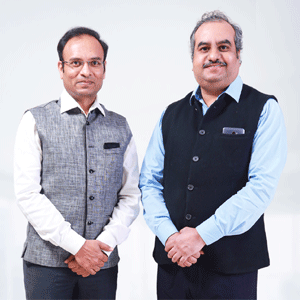
The philosopher has to ship
There is a quieter detail in Deshpande’s professional biography: he likes reading the Upanishads and Indian and Western philosophy. The same biography stresses patience, empathy and sensitivity towards colleagues. The pairing is revealing without requiring a grand theory of his personality. His interests extend to questions for which a product release is unlikely to provide a final answer.
He has also taken the commercialisation argument into classrooms. At a 2012 entrepreneurship session for SIMSREE students, he discussed underused talent, funding and acceptance of new products. He emphasised execution and the choice of which ideas deserved to go to market. A laboratory can produce more possibilities than a company can responsibly pursue.
His writing about customer-centred security makes a related point: digital services must work across devices while keeping protection unobtrusive for the user. It is an awkward brief. People want access to be easy and abuse to be difficult. An engineer has to hold both demands in mind, even when the marketing department would prefer a shorter sentence.
At the national level, his 2014 policy comments argued for India to gain recognition as a centre of product innovation. The aspiration was consistent with his own choices. He had moved between research and business development, then founded organisations intended to keep those activities in conversation. For him, the customer belonged somewhere in the research discussion.
The long question continues
Fortytwo’s later milestones show that institutional work continuing. In May 2022 the company signed an agreement with the Army Institute of Technology in Pune for a multiyear R&D project. It is the sort of relationship that requires a timetable longer than the launch announcement and a reason for researchers to keep working together.
In November 2025, Deshpande and Dhande discussed Fortytwo’s π-Control platform and plans to make its cryptographic stack more accessible to developers and partners through tools and programmes. In May 2026 the company announced recognition of a quantum-safe algorithm through DSCI’s C-SAFE assessment programme. These are company milestones in the later chapter of his scientific leadership.
The changing vocabulary is striking: private networks, cryptographic identity, quantum-safe security. The underlying concern is familiar. A person needs a dependable connection; an institution needs grounds for granting trust; an invention needs the scrutiny and practical work that make it usable. Deshpande has kept returning to the junction of those problems.
One of his earlier pieces of advice was to “Correct the path but don’t give up on the final goal.” His career gives the line some substance. The organisations, titles and technologies have changed. The question that drew him towards entrepreneurship remains stubbornly employed: what will it take for this research to earn its place in the world?