SiRF Technology
Co-founded with Kanwar Chadha. Built the chip that opened consumer GPS - dashboards, fitness trackers, every smartphone made until dedicated silicon got cheaper than software. IPO'd 2002, acquired by CSR plc.
He taught a billion devices to know where they were. Now, from a low-slung office on Page Mill Road, he is teaching datacenters to talk in laser light - quietly, the way he has always done it.
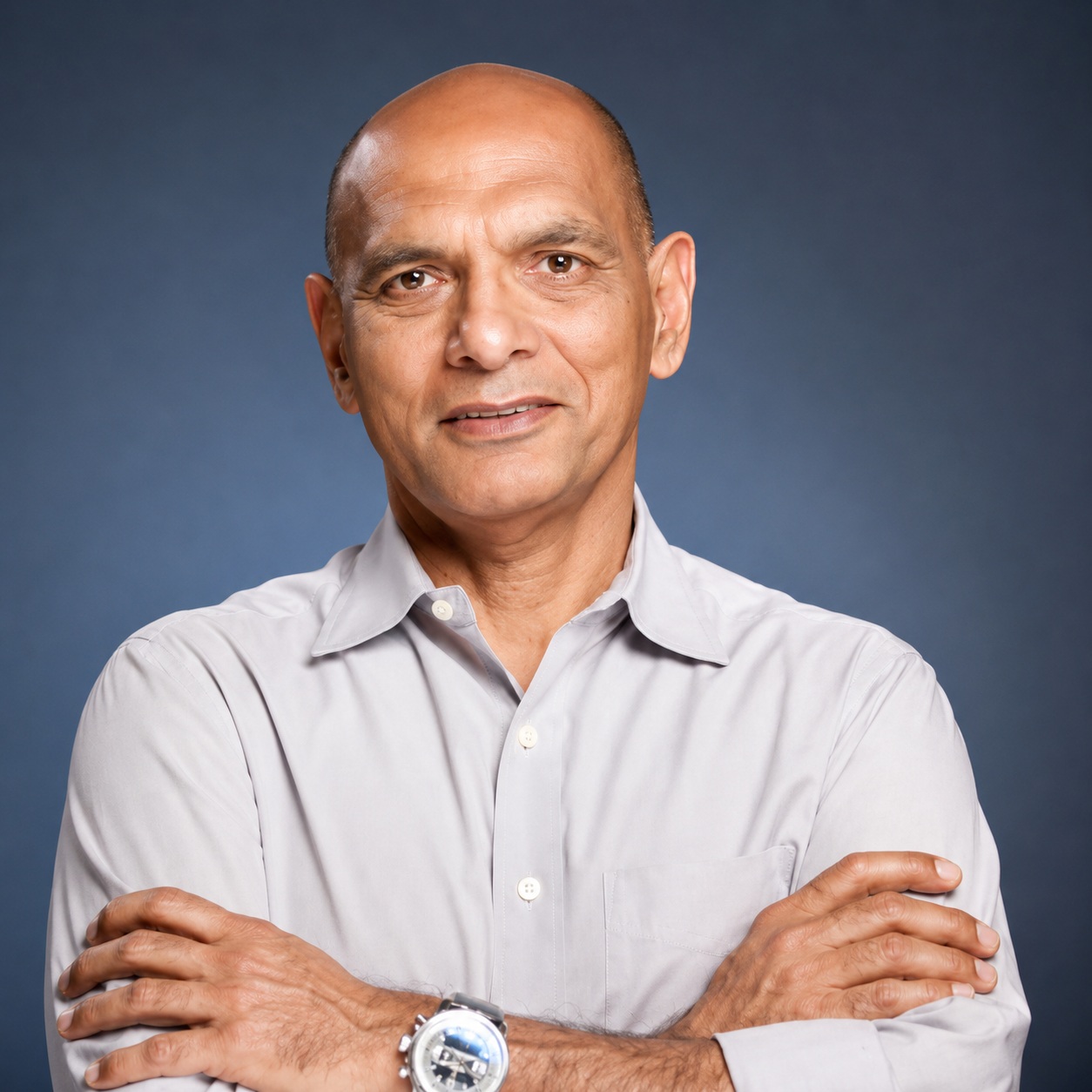
Pick up a phone made any time after 2002. Open a map. The little blue dot lighting up exists because, in 1995, an electrical engineer named Sanjai Kohli and a patent attorney named Steven Chen wrote a circuit that could pull a GPS signal out of the noise floor of a busy city street.
The chip was called the GPS Spread Spectrum Receiver. The company built around it was SiRF Technology. By 2007 it sat inside more than seven out of every ten consumer GPS devices on Earth - the cheap ones, the ones in the dashboards of rental cars and the cargo holds of container ships and, eventually, the back of every smartphone.
Kohli is not a man you have heard of. He prefers it that way. The Times of India called him the father of mass-market GPS. The European Patent Office gave him their Inventor of the Year award in 2010, jointly with Chen. The IEEE made him a Fellow in 2012. And then he went and did three more startups.
He grew up in India and trained, of all things, as an aeronautical engineer - a B.Tech from IIT Bombay in 1979. Two years later he had an M.S. in Systems Science from Washington University in St. Louis. The aeronautics never quite stuck. The radios did.
What followed was thirty years of small bets in hard places: WirelessHome in 1999, which by 2003 owned roughly 40% of the last-mile wireless market. TrueSpan, building multi-standard chips for digital TV on cellphones, a problem most people in 2005 didn't yet know existed. Inovi, a millimeter-wave mesh networking company that Facebook bought in 2014 and turned into the bones of its Terragraph platform. Geoverify. Visible, working on integrated sensors for autonomous robots.
Then in 2019 the phone rang and it was a board. Wave Computing - a custom AI silicon firm that had acquired the storied MIPS architecture - needed a CEO. Kohli took the job. He kept it through the company's 2020 Chapter 11, kept it through emergence the following March, kept the MIPS brand alive long enough to see it relaunched.
In 2021 he turned up as Entrepreneur in Residence at Sutter Hill Ventures, the unflashy but ferociously successful venture firm just up Sand Hill Road. EIRs at Sutter Hill don't tend to stay EIRs for long.
By May 2023 he was CEO of CSpeed Inc., a Palo Alto company with about fifty-four employees and a public-facing tagline that says, simply, the future of datacenter connectivity. CSpeed works in silicon photonics - the discipline of routing information not through copper wires but through laser light moving across a chip. It is the field every hyperscaler is now obsessed with, because the bottleneck for an AI training cluster is no longer the GPU. It is the cable.
Kohli, who has spent his life squeezing signals through hostile media - GPS through urban canyons, wireless through walls, TV through 3G - is now squeezing photons through silicon waveguides. Same instinct. Different wavelength.
Three decades of careers and the connecting thread is small: he picks problems that involve getting a signal from somewhere it isn't supposed to survive, to somewhere it isn't supposed to reach.
- The PatternCo-founded with Kanwar Chadha. Built the chip that opened consumer GPS - dashboards, fitness trackers, every smartphone made until dedicated silicon got cheaper than software. IPO'd 2002, acquired by CSR plc.
Last-mile wireless before anyone called it that. By 2003 the company held roughly 40% of its market - in a year when most homes still ran on DSL.
Co-founded. Multi-standard chips designed to put live digital television onto cellphones - a problem nobody quite knew they had yet.
Co-founded. Millimeter-wave mesh networking. Acquired by Facebook in 2014; the technology became part of the Terragraph wireless platform.
CEO. Inherited a bankrupt AI silicon company sitting on the storied MIPS instruction set. Steered it through Chapter 11 and out the other side as MIPS, the RISC-V company.
Silicon photonics for AI and datacenter connectivity. About 54 employees on Page Mill Road. The tagline reads: the future of datacenter connectivity.
A GPU in 2026 can move more data than the wire connecting it to its neighbour can carry. Hyperscalers building AI clusters are running into a wall that has nothing to do with silicon transistors and everything to do with the copper traces between them. Light is the obvious answer. Light is also famously hard to wrangle inside a chip.
That is the field Kohli is now working in. Silicon photonics has been ten years away for thirty years. It is finally, quietly, arriving - because the economics finally demand it, and because the manufacturing tooling finally exists. CSpeed sits in the middle of that arrival.
It is a fitting third act. GPS taught the world where things were. The wireless mesh business taught it how to talk without wires. The next problem is teaching machines to talk to each other faster than copper allows. Kohli has done the first two. The third is the hardest. He is, by all accounts, characteristically uninterested in being loud about it.
"He pioneered cutting-edge hardware and software solutions that have greatly increased the utility of wireless communications and the Global Positioning System."
- IIT Bombay Alumni Association, Distinguished Alumnus citationAeronautical engineering before semiconductors - a pivot that, in hindsight, looks more like a redirect than a break.
Shared with Steven Chen. The award recognised a 1995 patent for the GPS Spread Spectrum Receiver that, by then, had been quietly shipping for fifteen years.
Per The Economic Times, after SiRF's exit to CSR plc. Current figures are not public.