A man, a lost fin, and four hours of pure terror
In 2015, Hadrien Dorchy was windsurfing off the coast of Cape Verde when his board fin snapped off. One moment he was riding Atlantic swells. The next, he was floating, powerless, miles from shore, with no way to signal anyone. His phone was useless. Traditional safety gear required a signal tower. He spent four hours in open water before being spotted by chance.
He came home with a obsession: why, in a world where satellites circle the Earth every 90 minutes, does a person still need a cell tower to call for help? That question became O-Boy.
Dorchy, a Belgian jurist turned entrepreneur, teamed up with Antonin Rovai - a mathematician with a PhD in mathematical physics - and approached Brussels design studio Futurewave. Joachim Froment, Futurewave's co-founder and art director (MA, Royal College of Art, London), took on the challenge of making satellite hardware wearable. Not just functional - wearable. There is a crucial difference.
The moment you design something to look extreme, you narrow your audience to people who already identify with that world.
- Yanko Design on O-Boy's design philosophyWhat O-Boy Actually Is
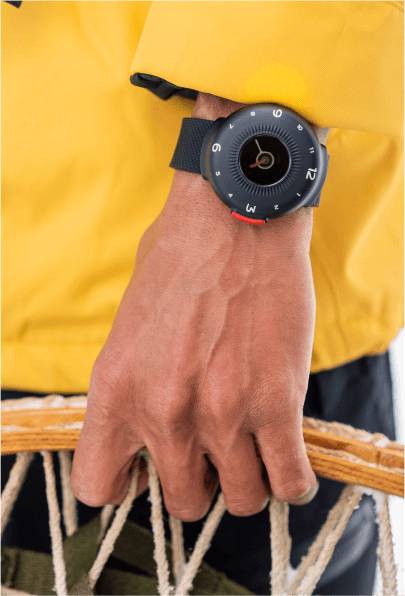
O-Boy is a 50mm wristwatch with a private satellite transmitter built inside. Not paired with a satellite device - inside. There are no external antennas to extend, no specific sky-facing orientation required. The patented omnidirectional antenna is concealed in the case itself, which is why O-Boy looks like a watch rather than an emergency beacon strapped to a backpack.
Communicating via a private satellite constellation and using Galileo GNSS (the European navigation system accurate to sub-meter precision), O-Boy can pinpoint your location and transmit it to the people who matter - or to professional rescue services - from anywhere on Earth outside of the polar regions. No phone. No Wi-Fi. No tower. Just satellites.
And here is what makes it worth talking about: it does exactly one job and does it perfectly. There is no heart rate monitor. No step counter. No notification mirror. O-Boy doesn't know or care how many calories you burned this morning. It only cares about one question: are you safe right now?
Who This Watch Is Actually For
Before you dismiss this as a product for extreme athletes in high-visibility vests, consider the broader picture. O-Boy is for anyone who regularly operates outside reliable cell coverage - which turns out to be a much larger group than the outdoor gear industry would have you believe.
The solo adventurer. Hikers, climbers, trail runners, backcountry skiers. You know the scenario: deep in a forest, no bars on the phone, one rolled ankle from a very bad situation. O-Boy is the device that makes solo adventure a calculated risk rather than a reckless one.
Water sports enthusiasts. Surfers, sailors, kayakers, windsurfers (Dorchy's own tribe). The sea does not care about your cell plan. O-Boy was literally designed for this context.
Remote workers and travelers. Journalists, researchers, geologists, humanitarian workers. People who travel to places where infrastructure is aspirational rather than actual.
The quietly risk-aware urban adventurer. Here is where O-Boy's design philosophy earns its keep. Froment deliberately styled it as a clean, modern watch - something you'd wear to a dinner party, not just to Everest base camp. That was intentional. The goal was to make safety wearable every day, not just on designated adventure days.
It's trying to be the one you'd actually want on your wrist when a situation becomes life-or-death.
- Yanko DesignThe Red Button - Three Presses, Three Meanings
O-Boy's interface is ruthlessly simple. There is one large button. It is red. You cannot miss it in the dark, in the rain, on a heaving boat, or with numb fingers. And that button has three distinct functions, each activated by deliberate multi-press sequences - engineered specifically to prevent accidental SOS transmissions, which are a serious problem with other devices.
GetMe (5 presses): Sends your GPS coordinates plus a prewritten custom message to up to four personal contacts via SMS. No satellite voice call required - the system does the translation. Your contacts receive a text message with a link to your exact location. Perfect for letting someone know you are running late, need a pickup, or are sheltering in place.
RescueMe (8 presses): This is the nuclear option. Eight deliberate presses - not something you do by accident - transmits an official SOS signal to the nearest Emergency Operation Coordination Center. Actual search and rescue professionals receive your coordinates and are dispatched. O-Boy includes up to $50,000 in rescue operation cost insurance per activation. In places like Switzerland, a helicopter rescue can run $15,000 before you reach the hospital.
TrackMe (hold 10 seconds): Activates live location sharing at intervals you choose - every 5, 20, or 60 minutes. Your four designated contacts receive updates as long as TrackMe is active. Ideal for solo expeditions where someone should be watching your progress without requiring satellite voice calls.
The Engineering Achievement Nobody Talks About
Making a satellite transmitter fit inside a 40-gram wristwatch is not a software problem. It is a physics problem. Satellite communication requires antenna size and orientation that conventional watch manufacturing has no answer for. Futurewave's engineering team, led by co-founders Cédric Mély (Electronics, University of Southampton) and Guillaume Hervet, had to invent a new manufacturing process from scratch.
The result is a patented omnidirectional antenna - meaning it transmits in all directions simultaneously, with no need to orient the watch toward the sky. This is the core technical breakthrough that separates O-Boy from every previous wearable emergency device. Everything before O-Boy either required directional signaling (the Breitling Emergency's analog PLB approach), was bulky (Garmin's clip-on devices), or depended on your phone (Apple Watch's satellite SOS).
The European Space Agency agreed it was worth backing. O-Boy joined ESA BIC Belgium in 2021, and separately participated in NATO's DIANA programme - the Defence Innovation Accelerator for the North Atlantic, which focuses on emerging technologies for defense and civilian resilience. You don't get into either of those programs with a PowerPoint deck.
The Branding Argument
Safety gear has a branding problem. Traditionally, it comes in two flavors: medical-grade and clinical, or military-tactical and intimidating. Neither gets worn voluntarily on a Tuesday afternoon. O-Boy's design team made a deliberate bet: emergency preparedness should look like something you'd want to wear.
The 50mm case, clean lines, Gorilla Glass face, and available analog dial option give O-Boy the visual language of an everyday sports watch. The black-and-red palette nods to emergency equipment - fire extinguishers, life rings - but subtly, as a design reference rather than a screaming warning. The silicone strap and IP68 waterproofing are pure function. The overall effect is a watch you wear because it looks good and because it might save your life, with neither quality undermining the other.
Time and Tide Watches made the comparison explicit after the 2023 disappearance of actor Julian Sands in the San Gabriel Mountains: Sands' cell phone died during his hike, and search and rescue teams spent weeks before finding his remains. A device like O-Boy, they noted, would have changed that story entirely.
The Pay-Per-Use Model - A Rare Act of Respect
The subscription economy has trained us to expect monthly fees for everything. O-Boy pushed back. The device requires no activation fee and no mandatory subscription. GetMe credits cost $9.95 for 50 uses. If you activate GetMe twice in a year, you pay for two activations. TrackMe annual plans go up to $199.95 for heavy users. RescueMe is available without a plan.
This matters for a specific reason: the people who most need O-Boy are not necessarily regular users of adventure gear. A person who kayaks once a year, hikes twice, and sails on vacation is exactly the right O-Boy customer. The pay-per-use model means they're not paying $15/month for a service they activate four times annually. They buy the watch once, load some credits, and carry the peace of mind.
What the Press Said
When Futurewave published the O-Boy story in March 2026 - across Designboom, Yanko Design, Notebookcheck, Interesting Engineering, and Stuff South Africa within a single week - the coverage captured something real about the product. Cool Material called it "just the kind of peace of mind you need when all else fails." Robb Report, a publication not given to product enthusiasm, ran a feature. New Atlas covered the technical architecture in detail.
Dezeen Awards 2023 longlisted it in the Consumer Design and Wearables category. That is not a small distinction - Dezeen's product longlist is competitive and global.
The pattern across all coverage was consistent: reviewers kept returning to the same core insight. Most emergency technology is designed for professionals who train for emergencies. O-Boy is designed for everyone else - for the moment you didn't plan for, wearing something you had no reason to take off.
The Honest Assessment
There are legitimate questions about O-Boy's current status. Stuff South Africa's March 2026 coverage noted that LifeLineSat, the product company, may have ceased operations. Futurewave confirmed the project in its portfolio but continues to present it as a design achievement rather than an active product line. The Kickstarter shipped; early production ran; ESA confirmed mass production underway in January 2024. The fate of the consumer launch beyond the initial batch is genuinely unclear.
What remains undisputed: the technology works, the design is exceptional, the concept is sound, and the patent on the omnidirectional satellite antenna is held. Whether that becomes a new product generation, a licensing deal, or a design case study depends on commercial decisions we cannot observe from the outside.
For anyone evaluating alternatives today: Garmin's inReach ecosystem is mature, reliable, and uses Iridium for true pole-to-pole coverage. Apple Watch Ultra's satellite SOS is excellent if you already carry an iPhone. SPOT devices are battle-tested. O-Boy's distinctive value was always its form factor and its design ambition - a satellite rescue device you would choose to wear even when you had no immediate reason to.
That ambition was real. The engineering to support it was real. What comes next is a chapter still being written.