A patent is a peculiar kind of object. It is technical enough to intimidate the merchant, legal enough to irritate the engineer and commercial enough to keep both of them in a meeting. Sandeep Agarwal has spent his career in that meeting. He has worked where inventions leave laboratories, where patent portfolios are bought and sold, and where dense claims become decisions about money, markets and risk. Now he runs XLSCOUT, a company training machines to read the paperwork faster.
The move looks fashionable only from a distance. Agarwal arrived at artificial intelligence by the long route. His public biography counts 35 years across manufacturing, consulting and research-and-development environments as of 2022. His education moves through the same practical triangle: mechanical engineering, a master's degree in industrial engineering, and an MBA in international management from the University of Dallas. The sequence is almost diagrammatic. First understand the machine. Then understand the system around the machine. Finally, understand how the system does business.
He was organizing invention before the machines learned to read it.
Early in his career, Agarwal worked as an engineer and business-development manager for international consulting, engineering and original-equipment-manufacturing companies. He then developed experience in federal and university technology transfer, including work associated with Idaho National Laboratory and the National Technology Transfer Center. Technology transfer is the patient middle of innovation: finding useful research, clarifying who owns it, locating a commercial partner and carrying a deal through the administrative weather.
The work leaves a trail. In 2003, he published an article called “A Broad Perspective on Federal Technology Transfer.” In 2006, he wrote “Electronic Management and Tracking” for the Association of University Technology Managers' practice manual. The title is wonderfully unglamorous. It also anticipates the question that follows him into the present: when technical knowledge multiplies faster than people can process it, how should an institution keep track of what matters?
“We have just begun to realize the potential of LLMs and how to use them effectively to increase productivity and precision.”Sandeep Agarwal, announcing his move to XLSCOUT
From technology transfer, Agarwal moved closer to the market for patents themselves. At IPVALUE Management, he helped monetize portfolios owned by large companies. At Tessera, he worked in portfolio development and market development. A 2009 industry meeting roster listed him as a Certified Licensing Professional and a senior director at the company. By 2013, he had also been recognized in the IAM Strategy 300, a guide to practitioners known for turning intellectual property into business strategy.
A career measured by the decision in front of him
A portfolio is a collection only until someone must decide.
Agarwal's years around Tessera, Xperi and the licensing business that became Adeia placed him inside a large patent operation. At Xperi he served as vice president of acquisitions and business development, working in an organization described at the time as holding roughly 11,000 patents and generating more than $300 million in annual licensing revenue. He managed the life cycle of acquisition opportunities from evaluation to closing. This was not invention as an abstract virtue. It was invention with a price, a counterparty and a due-diligence list.
There was a turn as CEO and president of Clairvolex, an IP services company focused on prosecution and monetization. Later he founded Goalset IP, a consultancy designed to help clients balance portfolios through acquisitions and divestitures. “Balance” is the useful word. Patent portfolios can become attics: full of things once considered important, expensive to maintain and difficult to inspect. Buying can fill a strategic gap. Selling can free capital. Either action begins with the slower work of understanding what each asset actually covers.
His conference schedule reflects the same commercial bent. At the 2024 Licensing Executives Society annual meeting in New Orleans, he joined a workshop on new approaches to patent valuation and the use of AI. In Boston a year later, the topic widened to the year's IP transactions, mergers and acquisitions, startups and litigation funding. The software may be new, but Agarwal keeps returning to the moment where analysis has to support a transaction.
Patent AI is useful when it respects how strange patents are.
Agarwal became CEO of XLSCOUT in 2023. His announcement did not promise a robot lawyer or the end of professional judgment. He emphasized productivity and precision on difficult patent problems. Those words describe the responsible version of automation. A fast irrelevant answer creates a faster mistake. A precise answer delivered after the commercial window closes becomes an elegant obituary.
XLSCOUT builds tools for novelty checks, invalidity searches, preliminary patent drafting and related portfolio analysis. Each job begins with a document problem. Novelty work looks for earlier disclosures that may overlap with a proposed invention. Invalidity research tests an issued patent against prior art. Drafting turns an invention disclosure into the structured language of claims, descriptions and figures. Portfolio analysis looks across many assets for technical and commercial patterns. People remain accountable for the consequential interpretation. The machine reduces the amount of hay one must lift before finding the needle.
This is also where Agarwal's acquisition experience becomes product experience. A patent buyer rarely asks whether a document sounds intelligent. The buyer asks whether its claims read on a technology, whether the priority trail holds together, whether better prior art exists, whether the remaining term is useful and whether the asset belongs in this portfolio at this price. Each answer needs evidence that another person can inspect. Software can rank, retrieve and draft, but a commercial decision still requires a chain of reasoning. Agarwal has spent enough time near transactions to know that a polished paragraph is not the same thing as diligence.
The company's work on ParaEmbed 2.0 makes the thesis tangible. An embedding model turns language into numerical representations that software can compare. Ordinary prose is difficult enough. Patent prose brings specialized terminology, long dependencies and claims whose meaning can turn on a phrase. XLSCOUT worked with Hugging Face to fine-tune open models on patent data curated by subject specialists. Agarwal described the combination as open-source capability joined to deep patent expertise.
The reported result was a 23 percent accuracy improvement over ParaEmbed 1.0 and production throughput of about 2,700 embeddings per second. The collaboration also tells a quieter story about product judgment. The team had tested proprietary general models and found them less able to hold the context of technical patent claims. Instead of treating scale as a substitute for specialization, it tuned open models on the language of the job.
There is a useful restraint in that design choice. Patent databases have offered keyword search for decades, and experienced researchers know how quickly a synonym, translation or drafting habit can hide relevant art. Semantic retrieval tries to find conceptual neighbors even when the wording changes. It does not abolish search craft. It gives the researcher another route through a corpus too large for any one person to read, then asks that person to test what comes back.
The job is still translation, only the instrument has changed.
Agarwal's biography is unusually linear once one ignores the company names. Engineering taught him to inspect the object. Technology transfer taught him to move knowledge between institutions. Licensing and monetization taught him to find commercial relevance. Acquisitions taught him to price conviction. Consulting taught him to advise from the other side of the table. XLSCOUT gathers those lessons into a product question: can software shorten the distance between a technical document and a defensible business decision?
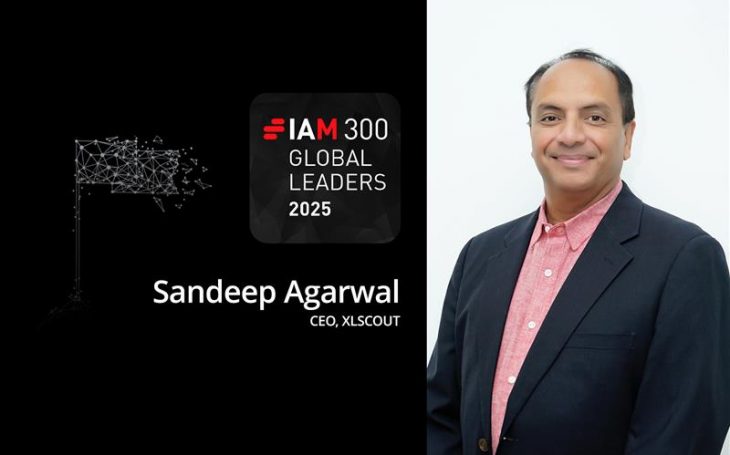
He has also stayed in the professional rooms where that answer will be tested. His recognition in IAM's strategy guides stretches from 2013 through listings announced in 2023, 2024 and 2025. His public appearances remain focused on valuation, transactions and portfolio choices. In September 2026, he joined an XLSCOUT webinar about using AI to identify potential standard-essential patents, uncover undeclared candidates and verify declared ones. It is a particularly sharp version of the old problem: the relevant patent may exist in the portfolio, yet still escape notice.
There is an appealing symmetry to the career. In 2006, Agarwal explained how a technology-transfer office could manage and track its information electronically. In 2026, he is still working on management and tracking, except the collection is global patent literature and the search instrument can model meaning. The nouns have become more impressive. The administrative headache has retained its dignity.
His aspiration is plainly stated: use large language models to increase productivity and precision in patent work. The interesting part is the order. Productivity earns attention, but precision earns trust. Patent professionals do not lack enthusiasm for speed; they lack permission to be casually wrong. Agarwal's advantage is less that he knows the current vocabulary than that he remembers the old consequences.
The distance from an invention to a deal is paved with documents. Agarwal's career has been an argument for reading them with commercial purpose.
That leaves XLSCOUT with a demanding assignment. Its products must satisfy engineers who care about technical correspondence, attorneys who care about claim language and executives who care about timing and value. Agarwal has occupied enough seats around that table to know when one constituency has been forgotten. Artificial intelligence provides the new instrument. His career provides the tuning fork.