After twelve years building GreyOrange, Samay Kohli found himself working as a cashier and barista at Starbucks in Palo Alto. He had stepped aside as CEO in 2023. Now, among the things on his list for a six-month break, was a job on the front line. The title had become smaller. The opportunity to learn had not.
The same break included a three-day train journey from Seattle to New York with his mother, and a family road trip through six national parks. He also drove a loaded, 26-foot truck more than 3,400 miles. His attempt to spend twelve hours delivering for DoorDash lasted only four or five: too few orders, and he got bored. Even an ambitious bucket list has to negotiate with demand.
There is something pleasingly awkward about this interlude in the life of a robotics founder. GreyOrange had spent years changing how goods moved through warehouses. Kohli had helped sell automation across borders. Then he went to work at a counter. The episode offers a useful way into his career: a repeated willingness to put himself where the work happens, even when that means beginning again.
A robot with somewhere to go
At BITS Pilani, Kohli studied mechanical engineering and economics, graduating in 2010. The combination placed machines and incentives in the same education. It would eventually prove relevant to selling warehouse systems, where technical possibility has to survive a customer's arithmetic. First, though, there was AcYut, a student humanoid robotics project, and the wonderfully unreasonable business of getting a machine to stand up and compete.
AcYut brought Kohli together with Akash Gupta, who was two years behind him at BITS. Their partnership grew through robot competitions and travel. In the midsize humanoid category, a robot roughly a metre tall took part in kung-fu contests. Success required more than a persuasive explanation of what it ought to do. It had to stay upright while another machine tried to make that difficult.
The ambition did not begin with a tidy business plan. Kohli later described early competition engineering as improvisation, with repeated practice to get a robot running reliably. He credits other people with encouraging him, rather than presenting the whole enterprise as an act of solitary genius. One early school experience stayed with him: he backed out of a presentation, then learned from his teacher that he might have won.
By June 2008, he was already telling an interviewer that he wanted to start a company making robotics kits after college. He was impatient with the pace of further formal study and enthusiastic about learning online. That student was quite prepared to challenge an adult's assumptions about education. The subsequent career would make his argument more demanding: finding information is one task; making something useful from it is another.
The shelf comes to you
The founders began GreyOrange in 2011, initially working in robotics education before narrowing their attention to warehouse automation. There was no shortage of interesting things a robot might do. Warehouses offered a more specific problem: online shopping could promise convenience while the work behind the order remained slow, repetitive and difficult to coordinate. A checkout button is very fast. A building full of inventory is rather less obliging.
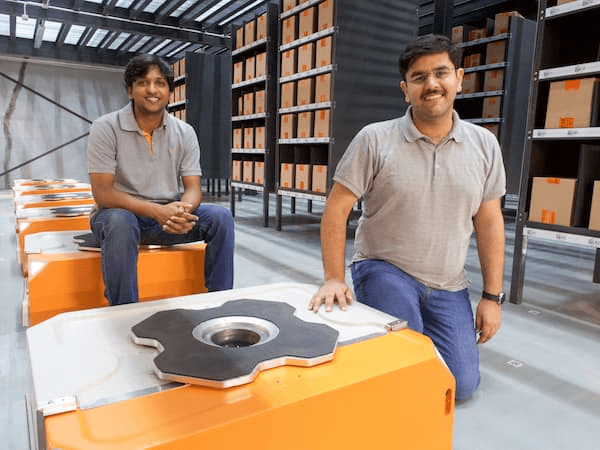
Kohli and Gupta chose to build products that could be deployed repeatedly. Their early Butler moved shelves to workers, while Sorter directed packages through the facility. Bringing a shelf to a person changes the choreography of a warehouse. Instead of spending a shift travelling to the stock, the worker can receive it at a station. The useful machine here was a squat workhorse, with little need for a humanoid's theatrical resemblance to its maker.
That shift also changed the founders' audience. At a competition, the machine has judges. At a customer site, it has an operation depending on it. A robot that works beautifully for a demonstration still has to justify its purchase, keep working and fit around the rest of the building. The difference is measured in orders, maintenance and the patience of people whose day is already busy.
Hardware made the early years difficult. Kohli recalled importing components from around the world because the local supplier network they needed was not ready. Engineering therefore included the unglamorous task of obtaining the parts. The prospect of building in India had to be reconciled with the practicalities of making, assembling and supporting a physical product. A drawing cannot be shipped in place of a functioning robot.
The robot needs a support office
GreyOrange's expansion required Kohli to learn a second kind of construction: building the company around the machines. He has described customer support as an essential companion to research and development. Growing demand exposed pressure on the company's own operations, prompting regional maintenance and support offices in India. A warehouse installation creates an ongoing obligation. Someone must answer when the customer needs help.
The language inside the office retained traces of the students who had enjoyed robot combat. Meeting rooms were named after machines from the film Real Steel, including Atom and Zeus. It is a small detail, but a good one. The founders could pursue the sober economics of fulfilment without entirely surrendering the pleasure that had got them into robotics.
Recognition arrived alongside the commercial work. Kohli and Gupta appeared on Forbes Asia's 30 Under 30 list in 2016. That year Kohli was also named to MIT Technology Review's global Innovators Under 35 list. Awards offered a compact public account of a much less compact task: taking an engineering interest, choosing a market and persuading customers to let machines into their daily operations.
By 2019, GreyOrange had deployments at more than seventy client sites across India, Japan, Europe, Latin America and the United States. Kohli explained the move to Singapore through access to the Asia-Pacific region. The business was learning to operate near its customers as well as invent for them. Its geographic reach had grown far beyond the college project that first brought the founders together.
A college partnership reaches warehouses across five regions: India, Japan, Europe, Latin America and the United States.
A founder clocks in
On April 12, 2023, GreyOrange announced Gupta as its new CEO, with Kohli moving to the board. The change gave an established partnership a different shape. Gupta had spent years in technical and product leadership. Kohli had spent twelve years leading the company. A founder's relationship with a business can continue after the daily operating job passes to someone else.
Kohli's break was deliberately varied. Travel, a moving truck, deliveries and a coffee counter supplied experiences outside the executive routine. Read together, they suggest a curiosity about work at several distances: as a traveller, as a driver and as the person serving a customer. That is an interpretation of the list, rather than a claim that every item was preparation for his next venture.
The Starbucks job is an especially revealing detail because it is concrete. It does not require a grand declaration about humility. He took the job. The contrast with the former title supplies its own comedy, but also raises a serious question about experience: how often does someone who builds tools for workers try a different worker's day?
There is a limit to what an anecdote can establish. A few months outside a CEO role do not explain an entire person. They do, however, complicate the familiar portrait of a founder travelling straight from one company to another. Kohli made room for a detour. The next business would move away from shelves and parcels, toward the less visible machinery of enterprise software.
Another app is a lot to ask
In March 2024, Kohli introduced Budy, his next venture, around a problem he had encountered while building an enterprise company. Businesses bought useful software, then struggled to deploy it within existing processes and systems. Sales and marketing teams could accumulate applications faster than they could make them cooperate. Each purchase promised assistance. Taken together, the tools could become another job.
His starting plan was deliberately small: an initial product for ten to fifteen customers around one application, followed by customer feedback and a wider beta. He set a choice between working toward a million dollars in annual recurring revenue and returning to the drawing board. The revenue figure was a goal, not a result. It gave the experiment a condition that enthusiasm alone could not satisfy.
“Dream big but aim small,” he wrote. That phrase fits the difference between the scale of his ambition and the size of his proposed first test. The world of enterprise software offers a great many problems to describe. Choosing one, finding customers and asking them to pay is a less accommodating exercise.
In October 2024, Budy announced a $4.2 million pre-seed round led by RTP Global. Backers included Beenext, The Neon Fund, BITS SPARK Angels and individual investors such as Postman's Abhinav Asthana and Pure Storage co-founder John Hayes. Raju Reddy also participated. The investor had supported Kohli's work long before Budy; the new company brought some established relationships into a different technological setting.
“Dream big but aim small.”Samay Kohli · Introducing Budy, 2024
The wheels disappear; the work remains
Kohli now leads Budy with co-founder Naveen Boppana. Its work has narrowed toward digital teammates for senior living sales teams, helping with follow-ups and the information dispersed through customer relationship management systems. The business setting matters here: salespeople need continuity across conversations, records and tasks. Useful assistance has to fit into that sequence rather than merely produce a clever answer.
In a February 2026 conversation on The Neon Show, Kohli discussed digital workers operating across existing tools, including calendars, inboxes and CRMs. The proposition carries a familiar concern from his warehouse years: what happens between separate pieces of a system? A shelf, a worker and an order need coordination. So do a conversation, a reminder and a customer record. The materials have changed; the gaps still offer work to do.
The 2026 SMASH programme lists him as Budy's co-founder and CEO for a session about the prospect journey and an agentic digital teammate. The emphasis is on helping sales counselors spend time on conversations, tours and follow-through. It is a more specific destination than the broad software-deployment problem with which Budy began, and a reminder that a new company finds its shape through the work it chooses.
Kohli's career now spans a student humanoid, warehouse products and software that acts within other software. The connecting idea is practical enough to resist a slogan. Find a job that takes too much effort. Understand its sequence. Build something that helps. Then see whether people can use it and will pay for it. Somewhere along the way, there may also be a coffee order. The customer is waiting.
Keep following the work
X and Facebook are historically attributed profile links.