The useful thing about a defender is that she learns to watch what happens before the obvious thing happens. The run starts before the pass. The space disappears before the tackle. A defender reads the whole field, then makes a choice that may never appear in the highlights. Samantha Stewart spent years learning that grammar on a soccer pitch. Now she applies it to the less photogenic machinery of community sport: budgets, calendars, sponsorships, coaches, parents, registration cycles and the stubborn question of whether a child will want to return next season.
Stewart is the chief marketing officer at Burlington Soccer Club, a not-for-profit organization that has served its Ontario community since 1962. The title suggests campaigns and logos. Her actual remit is wider: sponsorship, events, brand, communications, social media and digital strategy. It sits close to every department and, eventually, every player. Marketing here is not a decorative ribbon tied around the program. It is part of how the program reaches a family and how the family understands what it has joined.
I. The game before the job
She knew the field. The industry was hiding behind it.
Born in Dartmouth, Nova Scotia, in 1988, Stewart grew up as a high-performance athlete. At Cardinal Carter Catholic High School she competed in soccer, cross-country and track and field, collecting team MVP recognition in all three. Her club soccer carried her to major tournament finals and provincial and national competition. In 2006, she moved south to Gardner-Webb University in North Carolina to play NCAA Division I soccer.
Her first college season established the pattern. She started all 20 matches, helped produce a series of shutouts and scored twice against High Point, including the winning goal. She also made the Atlantic Sun All-Academic Team. In her own recollection of that first preseason, she was the only freshman to pass the fitness test and one of only four players on the full squad to do so. It is the sort of detail an operator remembers: preparation becomes permission.
The curious part is that she did not yet see sport as a business career. The adults visible to a young player were usually coaches and officials. The people designing programs, selling partnerships, managing facilities or planning communications lived beyond the touchline. Stewart could see a future in the game, but not the office that made the game possible.
She studied commerce and marketing, played again at York University, and entered the private side of sport. For roughly five years, she worked in sales and marketing for a Canadian golf-course owner and operator. Soccer remained in her life in what she cheerfully calls “weekend warrior” form. The corporate years gave her scale, commercial discipline and a close view of how a large collection of assets is managed. They also clarified what she wanted from her work: a shorter distance between decision and consequence.
II. More tools, same game
The return was deliberate
Stewart stepped away for a concentrated MBA at Ryerson University, now Toronto Metropolitan University, completing the program in 2017 with a focus on business strategy. She competed in case challenges, finished second in the Haskayne 24-Hour Epic Case Challenge and worked as a graduate assistant in a sports marketing course. The education supplied vocabulary for choices she had already encountered in sport: strategy, allocation, positioning and the discipline of deciding what not to do.
Then she moved back toward soccer with intent. She earned a Canada Soccer C Licence, coached girls in the Ontario Player Development League and worked across technical and administrative roles at clubs. She delivered sessions on the pitch. She served as a female technical lead. She ran a club. By the time Burlington Soccer hired her, she had viewed the same organization from several seats.
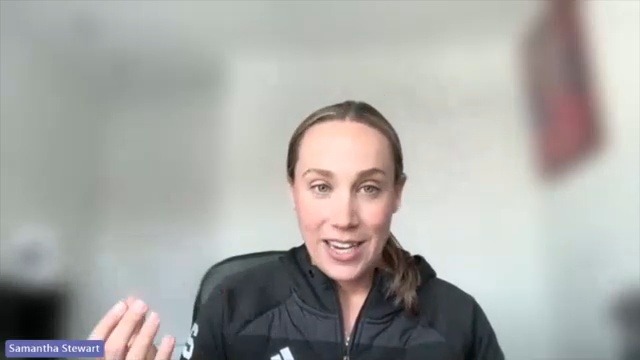
That range is her advantage. A marketer who has been a player knows that the campaign’s promise will eventually meet wet grass, a hurried parent and a coach with fifteen minutes to reset the cones. A former coach knows how policy feels when translated into practice. An MBA can ask for return on investment. An operator can reply with the other return that matters: the player who signs up again.
“Be a problem solver.”Samantha Stewart on the first quality she looks for in sports staff
III. The small pond with a visible wake
Nonprofit proximity is a feature
Stewart speaks plainly about nonprofit work. Teams run lean. People wear several hats. Time is finite, and money does not acquire magical elasticity merely because the mission is admirable. The job rewards independent workers who can identify several variables inside one problem, propose more than one route and keep moving without waiting for a procession of approvals.
But the smaller organization offers something she missed in private industry: proximity. An idea can travel from inception to implementation without vanishing into layers. Its impact is easier to see. Burlington Soccer deals with coaches, members, players, parents, match officials and governing bodies, so nimbleness is less a fashionable management word than a daily survival skill. The organization has to listen across groups and still make a decision before the season arrives.
Her metaphor is compact. In a very large company, an employee can feel like one fish in a pond. In a nonprofit, she says, the setting resembles a fishbowl. The water is smaller, yet the wake made by one person is easier to detect. Visibility brings accountability. It also brings the satisfaction of seeing a program exist in the world rather than in a slide deck.
IV. The number with a pulse
A returning player tells the truth
Burlington Soccer reaches more than 16,000 players and their families through recreational, development and competitive programs. There are proper business questions behind that scale. Which spending produces a return? Which program fills? Which partnership helps keep participation affordable? Stewart does not wave those away. She simply adds a measure that sits closer to the lived experience.
Do players come back?
Retention joins a season’s scattered moments into one answer. Registration may begin with a promotion, but returning requires the promise to survive the program itself. The coach mattered. Communication mattered. The schedule, welcome, competition and sense of progress mattered. A family’s decision to return is both a number and a review written without adjectives.
A practical measurement stack
Illustrative emphasis, not reported performance data. Stewart pairs financial measures with retention and player experience.
This view also changes marketing’s posture. The department cannot merely deliver people to a registration form and declare victory. It has to remain curious about what happens afterward. Testimonials are useful. Season-to-season behavior is more revealing. The club brand is what the player experiences after the branded post has scrolled away.
V. Stop guarding the playbook
The opponent may be an empty calendar square
Stewart’s larger ambition begins with a mild frustration: community sports organizations can be too protective of information. She wants more knowledge sharing across clubs and across sports. Participation is not helped when soccer, baseball, basketball, hockey, lacrosse, rugby and flag football all behave as if they alone own Tuesday evening.
Her example is beautifully ordinary. If one sport knows that another schedules a young age group on Wednesday, perhaps it can use Tuesday. A child can then play both. The obstacle was never a shortage of enthusiasm. It was two calendars that had not been introduced.
Burlington Soccer’s Girls Can Play Day expresses the same instinct in public. The event put a girls’ soccer match in front of younger spectators and assembled opportunities from sports including dance, cheer, football, rugby and baseball. The point was not to keep every girl inside one club. It was to show that sport has more doors than a child may know to knock on.
In 2026, Stewart also became a club lead for TELUS She CAN Coach, a program that combines coach education, peer gatherings, mentorship and practical experience for women. Friends and family call her Sam. The formal biography calls her an advocate for female sport and holistic athlete development. The programs make the description tangible: build a better on-ramp, give people a cohort and let learning reach the field.
“We all only win if children continue to play sport.”Samantha Stewart on sharing knowledge across organizations
VI. Read the whole field
The next play is collective
There is a consistent line through Stewart’s route from athlete to executive. She is interested in the conditions around performance. Fitness made the freshman ready. Coaching made instruction visible. Business training made trade-offs explicit. Club work revealed how much can change when an idea reaches the member quickly. Marketing gave her a place to connect those pieces without pretending they are separate.
The defender’s habit remains. Scan beyond the ball. Notice the parent choosing between two schedules, the potential coach who needs a first step, the employee who needs ownership and the child deciding whether the game still feels like theirs. Allocate the space. Communicate. Make the practical pass.
Sport loves a scoreboard because it settles an argument. Community sport is less tidy. Its useful victories can take years to appear: a player returns, a coach stays, a girl sees a role she had not imagined, two organizations share what they know. Stewart’s work lives in those delayed results. The final whistle is not the conclusion. It is an invitation to come back.