The most memorable piece of furniture in the FBC Mortgage origin story is not a mahogany conference table. It is a card table. The company began on one in downtown Orlando in 2005, a detail that does more work than the usual founder folklore. It describes a business that started without much ceremony, then spent the next two decades acquiring plenty of plot: a punishing housing cycle, a sale, an executive detour, a buyback, a national expansion, a new name, and now a wider mandate.
At the center is Sal A. “Joe” Nunziata, the co-founder publicly known simply as Joe. His career does not fit the smooth ascending line often drawn on executive biographies. It bends back on itself. He helped build FBC, helped sell it, ran the group that bought it, then returned with his brother Rob and a circle of insiders to reclaim the company. The loop is the point. Each trip through ownership left him with a different view of the same operating machine.
Before the card table
Nunziata had already been learning the mortgage trade for sixteen years when FBC opened. From 1989 to 2003, he was a vice president and shareholder at American Heritage Mortgage Corp. That company belonged to a family history in the business: it had been started by his father, Salvatore Nunziata Jr. First Horizon Home Loans acquired American Heritage in 2003, and Joe stayed on as a senior vice president until 2005.
This matters because FBC was not a beginner’s experiment dressed as disruption. It was a new company built by people who knew the old machinery. Joe and Rob could start lean because they were not starting blank. Their working knowledge included originations, sales, capital, the habits of homebuilders, and the unglamorous choreography required to get a loan from application to closing.
Then the timing supplied its own curriculum. FBC launched two years before the mortgage crisis began to tear through the American housing market. The young lender had to grow while peers disappeared and public trust in the industry collapsed. By 2012, the company employed 215 people, held licenses in 15 states, and had reported $24.9 million in revenue when Sterne Agee Group completed its acquisition.
Nunziata’s public comments from that period sound like an operator watching two gauges at once. He spoke about access to resources for continued growth, but also about liquidity for the members who had backed the company. He credited his father’s guidance and acknowledged the severity of the recession FBC had navigated. In other words, the sale had several audiences: the team that needed room to expand, the original investors who had carried risk, and a family whose mortgage experience predated the new firm. Transactions tend to arrive in headlines as a single decisive verb. Inside the business, “sold” contained a stack of obligations.
“This merger will give us the resources to continue our growth.”Joe Nunziata on the 2012 Sterne Agee transaction
The sale that became a detour
The standard founder script would have allowed Nunziata to exit left. Instead, he walked deeper into the buyer. Following the acquisition, he became president and CEO of Sterne Agee Group, an old financial firm based in Birmingham. His vantage point widened from a residential lender to the governance and competing interests of a larger financial organization.
Three years later, corporate rearrangement created an opening. Joe and Rob joined FBC executives, employees, former investors, and other participants in Pine Court Holdings to buy the mortgage company back. The price was not disclosed. The structure tells the more interesting story anyway: the return was not a lone founder’s romantic rescue. People who understood the company were willing to put themselves behind it again.
The 2015 reacquisition kept the headquarters in Orlando and restored FBC as an independent mortgage banker. At the time, it had roughly 450 employees and was licensed in 45 states. Nunziata said the team was excited to focus solely on residential lending again. The sentence is tidy; the maneuver behind it was not. A company had passed through a buyer, survived the experience, and returned with much of its internal memory intact.
There is a temptation to describe buying back a company as rewinding the tape. In practice, there was no old scene to return to. The market had changed, regulation had changed, and FBC itself had changed. Independence was a new operating condition, not a restoration project.
The local operating system
Orlando remained the fixed point. Nunziata’s connections around Central Florida widened well beyond a lender’s referral network. He became a founder and director of One Florida Bank and a founder and director of Trident Reciprocal Insurance. He served on community-bank boards and on foundations connected to FBC Mortgage and the Seminole and Orange County sheriffs.
Public service added two large pieces of infrastructure. Florida’s governor appointed him to the Central Florida Expressway Authority in 2023 and the Greater Orlando Aviation Authority in 2024. Roads and airports might look distant from mortgages until one considers what all three organize: where people can go, what communities can support, and how growth becomes physical.
The civic roles also reveal a consistent preference for boards, the rooms where enthusiasm must eventually become a vote, a budget, or a policy. Nunziata’s professional recognition follows the same practical path. The Orlando Business Journal named him among its 2015 executives of the year. In 2017, he and Rob received the regional EY Entrepreneur Of The Year award for financial services. He also earned the Certified Mortgage Banker designation, a credential grounded in the technical craft behind the executive title.
A new name on the same door
FBC’s next ownership chapter arrived through Acrisure. On July 1, 2025, FBC Mortgage became Acrisure Mortgage, aligning the lender’s public identity with a financial-services parent whose other businesses include insurance, reinsurance, payroll, benefits, and cybersecurity. The Orlando team and headquarters remained. A company once bought back to regain independence was now using a larger platform for its next expansion. Corporate life has a taste for irony, but rarely the decency to label it.
That December, Nunziata stood at a lectern inside UCF’s Addition Financial Arena as commencement speaker for graduates from the business and health-professions colleges. His biography for the ceremony included a small circular detail: he had taken summer courses at UCF before earning his bachelor’s degree in business from the University of South Florida and completing sessions at the London School of Economics.
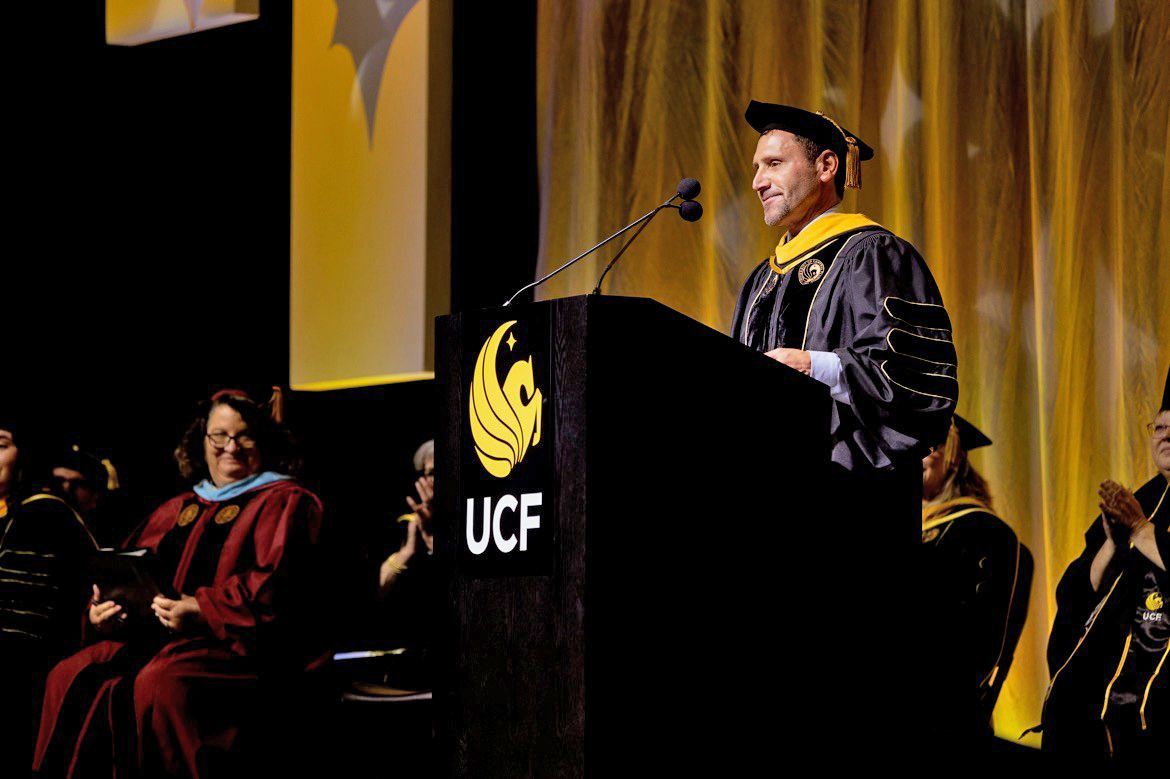
The photograph puts a neat frame around the Orlando story. Here is an executive in academic robes, standing a short drive from the downtown blocks where his mortgage company began. The costume is ceremonial; the route to the podium was anything but. It ran through loan files, acquisitions, board meetings, a recession, and the strange administrative intimacy of buying back something you had already sold.
Widening the brief
In August 2026, Acrisure Mortgage announced that Todd Boss would become its president and run day-to-day operations. Boss had spent more than fifteen years helping develop the company’s sales organization. Nunziata’s praise was specific: he called Boss a team builder, business developer, and leader who had earned trust across employees, customers, and partners.
The appointment also clarified Nunziata’s next job. As President of Acrisure Real Estate Services, he now oversees mortgage, title, and real estate businesses while remaining CEO of Acrisure Mortgage. The move converts adjacency into responsibility. A mortgage closes inside a larger journey involving agents, builders, insurers, title work, local infrastructure, and a buyer trying to make a consequential decision without losing the folder containing every document they own.
The enduring advantage is operating memory: knowing what must survive when the owner, logo, and org chart change.The lesson of the FBC loop
Nunziata’s career offers no magic card-table doctrine. Starting cheaply is not the same as operating well, and buying back a company is unavailable to nearly everyone who has sold one. The stealable idea is quieter. Treat a transaction as a change in conditions, not permission to forget the work. Keep the relationships legible. Learn what the buyer sees. Preserve enough trust that talented people might choose the next chapter with you.
FBC’s name has now left the building, replaced by Acrisure Mortgage. The card table presumably retired long ago. Yet the company’s defining habit remains visible: build through the cycle in front of you, and do not confuse a completed deal with a completed story.