The Work Now
A control layer for machines that won't sit still
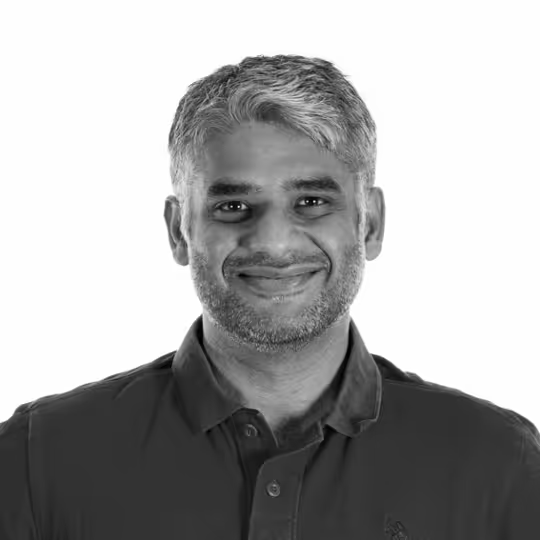
Sahil Agarwal builds the thing nobody notices until it is missing. At Enkrypt AI, the Boston startup he co-founded in 2022, the product is a security and compliance layer that sits between an enterprise and the large language models it wants to deploy. It watches the AI, audits it, and stops it before it does something a bank, a hospital, or a law firm would have to apologize for.
The pitch is simple and the engineering is not. Companies want generative AI. They also want to avoid the model leaking data, inventing facts, writing insecure code, or being talked into something dangerous by a clever prompt. Enkrypt's answer is to detect the risk, remove the threat, and monitor the system continuously - the boring, essential plumbing of trustworthy AI. Agarwal calls the mission "the equitable and safe use of AI for everyone." His co-founder Prashanth Harshangi runs the technology side. The two met as PhD students at Yale and decided, years later, that the bias and security holes they kept seeing in enterprise models were worth a company.
What makes the work land is the red team. Enkrypt does not just talk about AI safety in the abstract. It attacks models the way an adversary would, then publishes what breaks.
"AI safety must evolve alongside innovation, not as an afterthought."Sahil Agarwal
The DeepSeek Moment
The week he made a famous model look fragile
In January 2025, Enkrypt AI published red-team research on DeepSeek-R1, the low-cost Chinese reasoning model that had just rattled the industry. The headline number was hard to ignore: the model was 11 times more likely to generate harmful content than comparable systems. The team found it biased, prone to producing insecure code and toxic text, and susceptible to manipulation toward chemical, biological, and cybersecurity misuse.
Agarwal did not frame it as a dunk on a competitor. He framed it as a warning about where the AI race was heading. The cheaper a powerful model gets, the more places it shows up - and the more its blind spots matter.
DeepSeek-R1 relative harmful-output risk11x
Typical comparison model1x baseline
"DeepSeek-R1 offers significant cost advantages," he said, "but these come with serious risks." His prescription was not a ban. It was guardrails and continuous monitoring - which is, conveniently and sincerely, exactly the category of problem his company exists to solve.
"DeepSeek-R1's security vulnerabilities could be turned into a dangerous tool - one that cybercriminals, disinformation networks, and even those with biochemical warfare ambitions could exploit."Sahil Agarwal, January 2025
Before The Startup
Sea ice, exoplanets, and the physics of chaos
The strange detail that explains Agarwal is this: long before he stress-tested chatbots, his subjects were Arctic sea ice and distant planets. Trained as an applied mathematician, he spent close to a decade in academia using tools borrowed from non-equilibrium statistical physics to model systems that refuse to behave in straight lines.
He examined the dynamics and predictability of Arctic sea ice extent from satellite observations, and built a stochastic model to explain the wildly nonlinear behavior of ice velocity fields. He pointed machine learning at telescope and satellite data to hunt for exoplanets. The connective tissue across all of it - melting ice, hidden worlds, hallucinating models - is the same: take a complex, noisy, unpredictable system and find the structure hiding inside it.
The credentials stack up. A BTech in Mathematics and Computing from IIT Guwahati. A PhD in Applied Mathematics from Yale. Doctoral research at the University of Oxford. More than ten publications, three patents, and recognition from the American Physical Society, Yale Scientific Magazine, and Yale News. Then a turn to industry, leading the AI team at Accrete AI before founding Enkrypt.
The Founder's Education
PhD by night, CEO by later that same night
Agarwal is candid that academia and startups are closer cousins than people think. "You work until two in the morning whether that's PhD or a startup, and you start again," he says. As an immigrant, the company was on hold until his green card came through. When it did, he started building.
His advice to founders is delivered with the patience of someone who learned it the hard way: stop falling in love with your own technology. "Pitch a story, not technology," he tells early-stage builders, arguing that the common mistake is being fixated on the solution instead of the customer's actual need. His leadership rule fits in a single sentence: "You're accountable to everyone else in your company. That's my principle of leadership."
"Pitch a story, not technology."Sahil Agarwal, on advice for founders
When the 2am work threatens to win, he reaches for a racket. Tennis, squash, table tennis - the reset button for a mind that spends its waking hours imagining how things go wrong.