There are two maps of Sacramento. One shows the Capitol, the agencies and the short grid of numbered and lettered streets. The other is invisible. It records which community leader can make a skeptical audience listen, which office needs to be consulted before a plan is announced, and which reasonable idea will die because nobody assigned an owner. Sage Strategies sells the second map.

The company is a minority-owned, woman-led management consultancy founded in 2021 by Sonya Harris. Its public menu is broad: strategic counsel, regulatory navigation, leadership development, crisis management, campaign management and program evaluation. Its actual product is narrower and more valuable. Sage lends institutions a temporary nervous system - people who can connect policy, operations and public response while the client is still deciding where the desks should go.
Harris learned that work from the inside. She spent more than 15 years in California government, including executive assignments involving program management, crisis communications, legislative implementation and administrative oversight. During the 2020 Census outreach, she helped use trusted messengers - pastors, local business owners and PTA presidents - to reach families who might reasonably distrust an official campaign. She later carried that approach into COVID-19 vaccine outreach. The insight is simple: information rarely travels on information alone. It travels on trust.
“We are often the team behind the team.”Sage Strategies’ public description of its role
A consultancy built like a three-legged stool
Sage explains its method with three words. They sound like workshop language until you notice that each corrects the failure of the one before it.
Strategy
Agree on the vision and goals, then use data and the people affected by the decision to choose a direction.
Systems
Give the plan roles, responsibilities and lean processes. A goal without an owner is decorative.
Culture
Make participation, learning and results normal enough that the machinery keeps moving after the consultants leave.
That structure helps explain the firm’s place in the market. Sage is not merely a government-relations shop hired to open a door. It is not a large consultancy arriving with a standardized transformation program. It sits between public affairs, management consulting and community engagement. The client is likely to be a public agency, nonprofit, cause or company with a California-sized coordination problem and too little in-house capacity to solve it.
Strategic counsel
Long-range planning and decisions informed by data, stakeholders and political reality.
Regulatory navigation
Help moving through rules, agencies and the human sequence behind formal approvals.
Leadership
Executive assessment and coaching for people whose organizations are changing under them.
Crisis work
Planning and communications when the decision window is short and the audience is already watching.
Campaigns
People, partners, events and messages organized around a public objective.
Evaluation
Goals and metrics tied back to what a program was created to accomplish.
The kimchi was the strategy
The most revealing Sage project is also the most appetizing. In August 2024, more than 100 people gathered in Sacramento after the Legislature recognized November 22 as California Kimchi Day. Senator Dave Min, Assemblymembers Mike Fong and Phil Ting, Korean community leaders and a local restaurant met around a food that had once embarrassed many Korean American children and now represented a public claim of belonging.
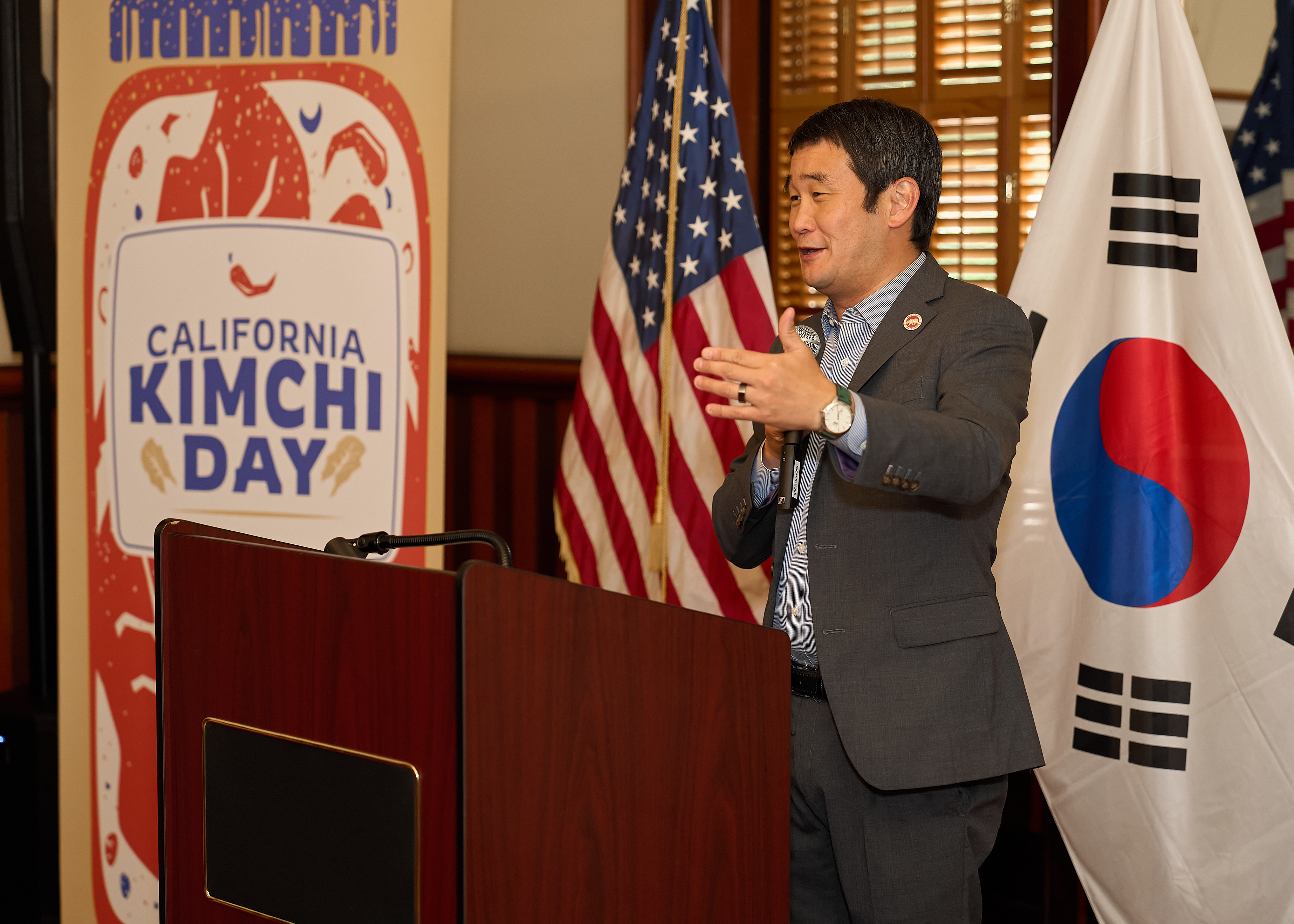
Harris, who is half Korean on her mother’s side, organized the event. Her stated theory was not that a reception would fix social division. It was that people become more empathetic when they learn one another’s culture and sit down to eat together. The campaign joined a resolution, elected officials, Blue House Korean BBQ, a kimchi demonstration and a community that could see itself in the state’s official calendar. Strategy, system and culture appeared on one plate.
This is what clients can do with Sage: make a policy legible to a community, make a community legible to an institution, or install an experienced operating team while a new organization finds its feet. The business model is fee-for-service consulting. Standard prices are not public, but government records let us see two edges of the range: a $9,950 First 5 California assignment for strategic leadership and media campaign management, and a much larger operating engagement for a new literacy nonprofit.
Then the invisible work became the story
The Strong Reader Partnership was created to help expand Dolly Parton’s Imagination Library across California. Sage did not simply advise it. Harris served as the nonprofit’s executive director, and Sage personnel supplied executive leadership, program management, administration, vendor management, board operations, statewide outreach and grant-compliance support. The intended end state, Harris later told legislators, was to build the program and hand it to permanent staff.
The assignment became a case study in the hazard of being behind the team. In 2024, lawmakers redirected the program’s larger funding mechanism toward the Dollywood Foundation. Partnership work was reported as paused, yet Sage billed 186.75 hours between September 2024 and March 2025 while the board sought clarity, managed relationships and prepared for a transition. In April 2026, a state Senate budget subcommittee asked why invoices described the work mainly as “General Consulting” rather than listing deliverables, meetings or decisions.
The partnership’s board said it had hired Sage, worked closely with the firm, reviewed the bills and authorized payment. State Library staff had previously said the board’s guardrails made them comfortable with Harris holding both roles. The committee was still dissatisfied with the documentation and the arrangement. No public finding in the reviewed record says Sage fabricated its hours. The failure was more ordinary and therefore more useful: work that may have been vivid to the people in the room was nearly invisible to anyone outside it.
What changed
The state changed the program’s structure before Sage changed its method. Funding was redirected to the Dollywood Foundation, and legislative attention shifted from building outreach infrastructure to proving what each contractor had delivered. The unit of credibility changed from relationships to records.
The useful part is easy to copy
Sage’s three-part model survives the controversy, but it needs a fourth element: evidence. A team can borrow the useful version without hiring anyone or knowing a soul in Sacramento.
- Name the decision. Write the outcome and the person empowered to choose, before scheduling the stakeholder tour.
- Map trust, not demographics. Ask who the audience already believes and let those people shape the message.
- Assign the machinery. Every promise gets an owner, date, dependency and measure.
- Keep a stranger-readable log. Record the meeting, decision, deliverable and consequence while the context is fresh.
- Design the handoff on day one. Temporary operators should leave a team, a process and an archive, not a dependency.
This approach works when judgment and coordination are the bottleneck: a new public initiative, a regulatory passage, a campaign with many constituencies or a leader entering unfamiliar terrain. It is less convincing when the buyer wants a commodity deliverable, when decision rights are deliberately vague, or when the consultant cannot expose enough of the work for an auditor to reconstruct it. In public service, discretion is useful. Opacity is expensive.
Five years after it was formed, Sage lists 15 employees on LinkedIn and continues to win public-facing work. CalABLE selected the firm for marketing services in 2025. In early 2026, Sage was named the intended awardee for California Love, California Strong, a statewide campaign built around social connection, events and culturally responsive outreach. Chief Strategy Officer Carrie Wright joined a growing leadership bench. The firm is becoming less like one expert’s address book and more like an institution.
Its lasting advantage remains the second map of Sacramento. The next stage is to draw that map clearly enough that a client, a board member and a skeptical legislator can all see the same roads.