At a costume party in 1999, Ryan Deiss introduced the world to Millennium Man. The uniform was blue spandex, accessorized with a duct-taped M. The audience included Emily, the woman he would marry. For someone who would make a career teaching people how to present an offer, it was an unusually hazardous opening pitch.
Deiss was a freshman at the University of Texas at Austin. He wanted to buy an engagement ring and needed money. The internet offered a place to try. He began making websites and selling small digital products, a practical response to a personal problem. There was no requirement, at that point, to become the public face of a marketing company.
The ring was a goal with an ending. Business proved less cooperative. Once an experiment paid, there was another experiment to run. He and Emily married in 2003; the enterprise kept expanding. More than two decades later, his professional preoccupation has acquired an almost comic reversal. Having learned how to make customers arrive, he now teaches founders how to leave the room.
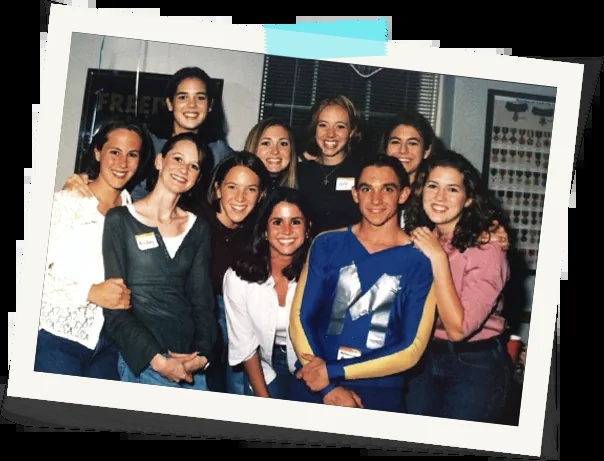
A ring, then a recurring revenue problem
His early businesses dealt in narrow interests. He sold ebooks and software through little websites, accumulating practical experience in finding an audience and getting someone to pay. When he later described those years, the romance remained attached to the economics: he had wanted enough cash for a ring, then enough dependable income to support a household.
On the 7 Figure Leap podcast, he put an early family target at $6,000 a month. Eventually he imagined $10,000 a month would be sufficient forever. Anyone who has moved a financial finish line will recognize the administrative difficulty of forever. The business was working, and he enjoyed the work. Stopping required a reason as well.
Teaching entered almost sideways. At marketing events, other attendees wanted to know how his sites worked. He described an early offer in which people could pay $500 to follow a project through email. People signed up. An activity that helped sell his own products was becoming a product other people wanted to buy.
The useful question about water filters
The range of companies associated with Deiss can sound like a shopping cart assembled by several unrelated people: makeup brushes, crossbows, industrial water filters. Yet the same question travels reasonably well between them. What does the customer value enough to choose you?
In the water-filter business, asking customers brought a specific answer. Speed mattered. The team made delivery within 48 hours central to the offer and rebranded the operation as Rapid Filter. It is a pleasingly unglamorous example from someone whose working world includes conference stages and online campaigns. A customer waiting for a filter has limited interest in the poetry of a positioning statement.
This helps explain his teaching style. The appeal lies in a problem reduced to actions somebody can perform: talk to customers, identify the reason they buy, change the promise. His experience selling physical products also keeps the story from floating entirely into clicks and conversion rates. A sale creates an obligation to deliver something.
“Pay your taxes, manage your cash flow”
Ryan Deiss, Entrepreneurs on Fire, 2017
When the classroom became a business
Traffic & Conversion Summit began in 2009. DigitalMarketer grew alongside it, offering training and tools for the people learning to acquire customers online. The arrangement gave the enterprise two places to meet its audience: a live gathering and an ongoing educational relationship.
The scale could surprise outsiders. Interviewer Andrew Warner recalled arriving at the summit expecting a chance to meet people, then discovering thousands of attendees and busy exhibition booths. In their conversation, Deiss gave some credit to the wider market. As digital marketing became ordinary business practice, the audience for practical instruction grew with it.
The event also became a separable asset. On August 29, 2018, DigitalMarketer finalized its purchase and partnership agreement with Clarion Events. The public announcement followed in January 2019. DigitalMarketer would remain presenting sponsor and help direct programming and marketing. The attraction included resources and experience for international expansion.
That distinction matters to Deiss's later thinking. A business can have a recognizable voice and still contain parts another owner can operate. The conference sale turned that possibility into a transaction. He and his partners could build something, find a suitable buyer and continue contributing without owning the whole apparatus.

After the purchase comes the relationship
DigitalMarketer's Customer Value Journey gives his marketing argument a visible shape. It moves through eight stages, beginning with awareness and continuing beyond the first transaction. Buying sits partway through the sequence. The later work includes helping customers experience value, buy again, advocate and promote.
The placement is revealing. If a company treats the order confirmation as the conclusion, it ignores much of the relationship. A satisfied buyer can return, recommend the product or become an active promoter. Those outcomes require attention after the advertising has done its initial job.
- Awareness
- Engage
- Subscribe
- Convert
- Excite
- Ascend
- Advocate
- Promote
The first purchase is stage four of eight.
In his 2019 keynote argument, Deiss urged marketers toward slower relationship building and more conversation. Even a company known for marketing automation had reasons to preserve human contact. The underlying question became how customers could succeed well enough to recommend the business themselves.
His books carried that instructional approach into another format. With Russ Henneberry, he wrote Digital Marketing For Dummies, first published in 2017; Wiley released the second edition in August 2020. Its remit stretches from identifying an audience to turning prospects into customers. The title has the cheerful indignity of the series, but the assignment is serious: make a collection of specialized practices usable.
A founder with too many answers
Being able to solve problems can itself become a problem. Deiss recounts repeatedly building businesses around his own decisions, then discovering how difficult it was to step away. In one early attempt, he replaced himself as chief executive with an outside hire. The transition went badly, and he returned to rebuild.
The lesson he now draws is about preparation. A replacement executive inherits whatever structure already exists, including the missing pieces. Knowledge held in a founder's head is difficult to transfer by changing the name on the office door.
His partners make the issue personal rather than abstract. Richard Lindner supplies operational leadership; Roland Frasier brings dealmaking and growth strategy. In a 2019 conversation with Stephan Spencer, Deiss described opening doors that Frasier could help close. He also acknowledged that day-to-day management was not his preferred work. These are complementary jobs, with different demands.
There is a reader behind the speaker, too. Deiss described returning to books such as Peter Drucker's The Effective Executive and Eliyahu Goldratt's The Goal. His interest in a manufacturing book makes sense: a customer journey has stages and constraints, just as a production process does. Finding the obstructed step can matter more than making every other step faster.
Sticky notes have no interest in charisma
The Scalable Company applies that process thinking to the founder's whole business. Its work includes playbooks, dashboards, team responsibilities and decisions that can be made without referring everything back to the owner. The firm identifies established businesses doing roughly $2 million to $20 million in revenue as its central audience.
Deiss's explanation can be refreshingly physical. Map how a customer goes from discovering the company to making a purchase. Then map how the company fulfills its promise. Identify the stages that matter and who performs each one. When the founder's name appears repeatedly, the dependency becomes visible.
A sticky note is an excellent antidote to the word indispensable. It asks for a task, an owner and a handoff. It has no particular regard for the founder's reputation. The diagram allows a team to discuss work that previously existed as somebody's instinct.
Scalable had to learn that lesson about its own delivery. A December 2025 account of its development describes customers wanting individual help implementing the system, while the company kept trying courses and group formats. In late 2023, it finally authorized the individual offer. Lindner took on early delivery while helping train others. Selling a system still required listening to the buyer.
DigitalMarketer has also announced a change of model. In a public pivot message, Deiss says it is leaving the course and certification business to pursue marketing execution combining artificial intelligence with expert input. It is a consequential move for a company identified with education, and another example of his willingness to revise the package around the work customers need done.
The next job for a cocktail napkin
Deiss continues to work in public through YouTube, his Accidental MBA newsletter and Business Lunch, the podcast he co-hosts with Frasier. The material gives him room to discuss operating decisions as well as marketing. In a May 2026 appearance on The Checkout, the conversation covered mapping a business, handing off roles and choosing whether to scale, sell or raise capital.
His announced next book, The Million Dollar Napkin, is scheduled for March 2, 2027. It uses a business fable about a founder, a mentor and a napkin to introduce a practical operating approach. The format suits a teacher who prefers a problem people can picture before asking them to absorb a framework.
There is continuity beneath the changing products. The student needed a ring. The marketer needed customers. The owner needed a company that could function when he was elsewhere. Each ambition forced the next question into view. Millennium Man's eventual assignment is surprisingly modest: help the business work well enough that nobody needs a superhero.
Follow the work
Ryan's website · The Scalable Company · DigitalMarketer · Accidental MBA
LinkedIn · X · Instagram · Facebook · YouTube
Watch: the eight-step Customer Value Journey
Listen: Business Lunch
Read: building Traffic & Conversion Summit
The conference acquisition announcement
Books and the next release