Rupa Chandra Gupta had made the dashboards beautiful. As a middle school redesign administrator, she downloaded performance spreadsheets daily, assembled the numbers, and gave staff a clearer view of their students. Children could see their grades online, too. Everything appeared to be in place for students to take charge of their learning. Then report cards arrived, and students were surprised by the results. The information had been available. Somehow, the understanding had failed to arrive with it.
In one classroom she later visited, an eighth grader completed an online math lesson. His screen announced mastery of a numbered skill. Gupta offered a high-five and asked what he had mastered. He could not tell her. The computer had an answer; its owner had a question. For someone building a career around helping schools use information, this was an awkward sort of progress.
Gupta’s response was to reconsider the machinery she had helped assemble. She would go on to co-found Sown To Grow, where students set goals, record progress, and reflect on their approach. The company began with an inversion of an ordinary school habit: let the person doing the learning do some of the interpreting, too.
Who gets to make sense of a student’s progress?
The consultant enters the classroom
Before working in schools, Gupta spent nearly a decade in management and nonprofit consulting at Bain & Company and The Bridgespan Group. Her education included a bachelor of science from the University of California, Berkeley, an MBA from Stanford, and a master’s in educational leadership through the Broad Residency. She arrived in education with considerable practice examining how organizations work.
At San Jose Unified School District, she moved into the practical business of school redesign, including personalized learning and criterion-based grading. Her previous role was redesign administrator at Burnett Middle School. This work put her beside teachers and students, where a strategy had to survive the daily traffic of assignments, quizzes, classroom routines, and children who had quite reasonable questions about their grades.
The appeal of personalized learning was clear. Different students could work through material at appropriate levels and different speeds. Gupta helped oversee the equipment, software purchases, professional development, and outside advice that accompanied the change. Yet she later acknowledged that gains in assessment scores had not consistently lasted from year to year. Buying the ingredients had proved easier than getting the recipe right.
A vocabulary quiz with the wrong lesson
One encounter sharpened her thinking. A fifth grader named Jonathan was failing his weekly vocabulary quiz. Each week brought 15 words. He copied dictionary definitions, as his classmates did, but English was his second language, and the definitions themselves could be baffling. He was spending effort on a method that gave him little help understanding the words.
When Gupta suggested changing the method, the possibility surprised him. He had understood repeated failure as evidence about his ability. Together they considered asking classmates to explain words and looking for meaning in the sentences around them. The next step was to try those approaches and examine what happened. Gupta’s account stops short of a triumphant test score. Its point is the availability of another move.
This became her objection to treating growth mindset as an encouraging vocabulary alone. Students needed practice evaluating effort, choosing strategies, and asking for help. A child told to keep trying still needed something useful to try. Her ambition was practical: give learners enough knowledge of their own process to change it when necessary.
“We can’t just tell them the link is there; they must track it themselves to believe it.”
Rupa Chandra Gupta · 2016
The spreadsheet changes hands
Her colleague Dennis Li saw the beginnings of that alternative when Gupta invited him to her school. Li worked on data integration and reporting for the district. His usual conversations about student performance were with adults, some of whom regarded a downward line on a chart with understandable dread. He came to see what happened when students handled the numbers.
Gupta’s solution to a mundane coordination problem had been individual student spreadsheets feeding a master sheet for teachers. Several learning products were in use, and teachers needed progress gathered in one place. Students entered their own scores. A clerical task began to produce an unexpected kind of interest.
Li described children who wanted another attempt at an activity before recording a disappointing result. Others could explain what they had done and what they hoped to improve next. Their records gave them something to examine and act upon. The teacher still controlled the grade book. Students had gained a working relationship with their performance, without being handed the authority to rewrite their grades.
A company with ownership in its name
Gupta and Li co-founded Sown To Grow in 2015. There is a small piece of wordplay inside the name: student ownership, or S-OWN. It makes a fairly precise statement of intent for a company whose early product was a student-owned scorebook. Even its name asks the learner to participate.
By January 2016, 25 schools and districts were using the tool, with 2,400 active students. Those are early figures, a snapshot of a young company. Students could set targets, enter results, and write about performance across activities. A school could see the numbers, but the student had work to do before the numbers reached a dashboard.
That participation introduced a useful pause. What was the goal? What happened? Which approach helped? What should change? Reflection could happen close to the learning, and teachers could respond with feedback. The routine gave a student a reason to look backward briefly before deciding where to go next.
A score gets a next step
- 01Set a goalChoose a target.
- 02Track progressRecord what happened.
- 03ReflectConsider the strategy.
- 04Try againUse feedback to adjust.
A conceptual view of Sown To Grow’s early goal-setting and reflection process.
When the average looks reassuring
Gupta’s experience also made her a pointed questioner of classroom technology. In a 2018 conversation with educator Jennifer Gonzalez, she recalled a program whose overall results looked promising. Looking more closely revealed that students entering at or above grade level were gaining while those entering below it were losing ground. The school eventually abandoned the program.
The episode complicated the cheerful assumption that more technology automatically meant more opportunity. A favorable average could conceal a pattern a school would never knowingly choose. Gupta urged educators to ask how a tool worked for different learners, observe its use, and trust the professional judgment developed through time with students.
For a technology founder, this is a demanding position to hold. It asks buyers to inspect a product’s shortcomings and sellers to answer uncomfortable questions. Gupta had already tried to apply the principle at Sown To Grow through an impact page inviting feedback about whom the tool served. Her experience gave her a reason to prefer scrutiny to a handsome aggregate.
A founder gets her own feedback
The logic of reflection reached her work as an entrepreneur, too. In 2019, at a Village Capital exercise, Gupta was marking a grid describing stages of company development. Some investors had been responding to her pitches with a frustratingly elastic phrase: not yet. The exercise made a mismatch visible.
Her understanding of product-market fit differed from the milestones laid out on the sheet, including inbound demand and validated unit economics. She wanted to take the assessment back to her team so they could decide what to prioritize. Here was the founder of a reflection company discovering that a more explicit rubric could improve her own next decision.
Research brought another form of scrutiny. A 2021 Institute of Education Sciences award named Gupta project director on a $200,000 Phase I effort. The project proposed using language processing and machine learning to categorize students’ written reflections. Its planned pilot asked whether automated insights matched the writing, whether educators understood them, and whether they were useful. Those questions kept interpretation in view as automation entered the product.
Return to the school, then return again
By June 2025, the company described a 30-person team, more than half of whom had worked as teachers, school social workers, or school and district leaders. Every team member participated in school visits at least annually. Product work involved classroom observation, interviews, prototypes, and revisions informed by the people using them.
That operating habit matters to Gupta’s story because her starting insight came from watching an intended solution behave unexpectedly. A classroom can reveal the difference between a plausible feature and a useful routine. Returning gives the company repeated chances to notice the difference. It also asks staff with very different jobs to encounter the same practical setting.
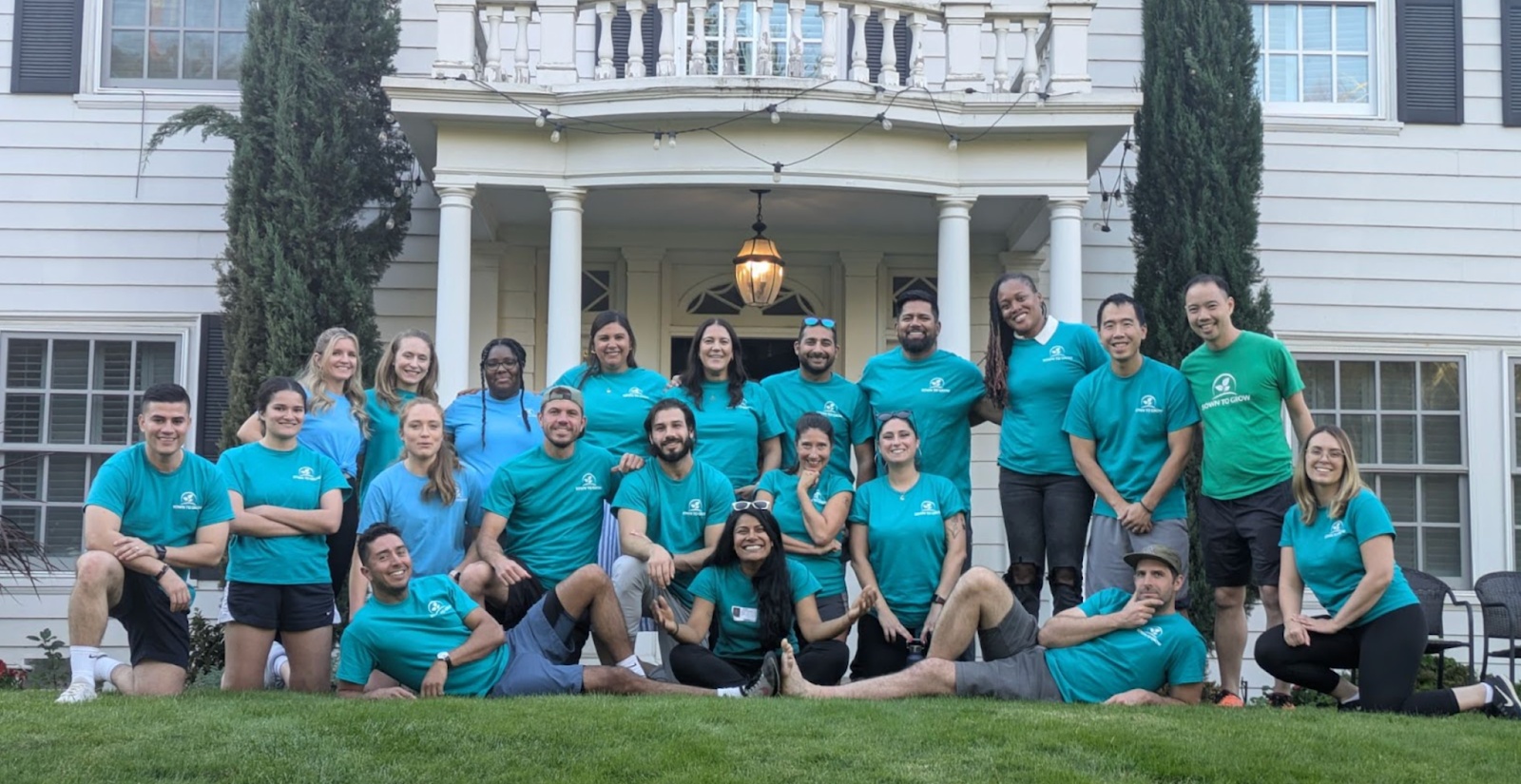
The team photograph offers a less formal view of this work: colleagues gathered on a lawn in a cheerful concentration of matching shirts. Gupta is among them, seated near the front. The company describes collaboration as a working method; the picture gives that fairly abstract noun some faces.
The question before the next absence
In January 2026, Gupta co-hosted an attendance webinar with educator and former principal Don Parker. The discussion examined belonging, relationships, and the reasons students miss school. Her focus had widened from a learner understanding a score to a school understanding the person behind an attendance record.
The thread connecting those subjects is the danger of assuming a number explains itself. A missed day records an event. A grade records an outcome. Neither necessarily supplies the next useful question. Gupta’s work has repeatedly returned to routines that invite students to contribute information adults might otherwise overlook.
There is a pleasing inconvenience in her career: each time the system appears to have collected enough information, the person using it gets a say. A student can question a strategy. A teacher can question a product. A founder can question her own definition of progress. Gupta built those beautiful dashboards. She has spent the years since making room for what they left out.