Rudy Larsen had found customers, bought equipment and started a landscaping company. Then came a question rather less picturesque than anything in the flowerbeds: was the business making money? He could not reliably say. A contractor he approached for advice told him to get his finances under control. Larsen turned to his wife, Jena, who had the household’s steady paycheck. He wanted her to leave her job and help put the business in order.
Jena joined him. She sorted out the books and the back office while he continued looking after customers. It is an unusually useful place to begin the story of Scandia Company’s founder and CEO. Before the portfolio of businesses, before the industry awards, there was a company whose service had run ahead of its accounting. Attractive grounds were visible. Financial trouble could remain politely indoors.
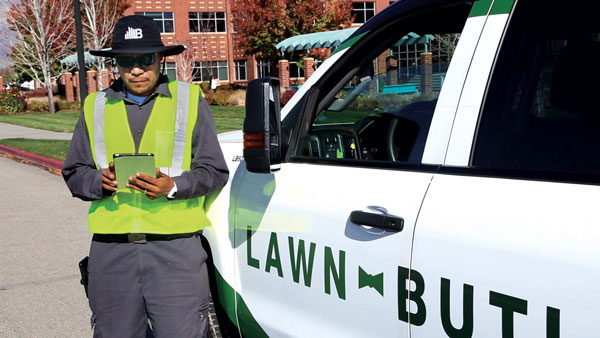
Larsen had started Lawn Butler in 2006, the year he graduated from Woods Cross High School in Utah. He went straight into business rather than college. By 2018, he and Jena were being recognized together as Scandia’s CEO and CFO. The public account of their partnership described seven companies and more than 160 full-time employees. They owned their businesses outright, with Rubicon the exception. Those are historical figures, belonging to that stage of the enterprise.
The partnership matters as much as the expansion. Larsen could pursue a customer, an acquisition or another business idea; Jena’s work helped give those ambitions a financial structure. A founder’s story gets considerably more interesting when the person keeping the books is allowed into it.
An education with invoices
Larsen’s early working life included a job at Marshall Radio Telemetry in 2004 and 2005. Landscaping work while he was still in school gave him a different attraction: the immediate, visible result of a completed job. A property changed in front of him. The business began with an equipment loan of $200,000, a substantial obligation for someone just leaving school.
He later described himself as a person drawn to the big picture. Customer service absorbed his attention, while the financial details demanded skills he still had to acquire. The name Lawn Butler reflected the service promise. The difficulty was making the promise work economically. Customers could be pleased while the owner remained uncertain about the margin.
His later advice to students was sober. Leaving college did not mean escaping the cost of education. He had paid for his learning through failed decisions and losses. That distinction gives his career a less comfortable lesson than the familiar tale of the founder who simply knew better than school. He knew he wanted to run a business. Knowing how would take longer.
By 2011, Larsen was serving as Scandia’s CEO. His interests were widening from individual jobs to the organization of companies. There was a personal cost to that move, too: he said he missed dealing directly with customers. Growth could place distance between the founder and one of the parts of work he had enjoyed.
“I had to pay through losses and failures.”
Rudy Larsen, on learning outside college
The long wait for money already earned
Lawn Butler’s financial challenge became more specific as it grew. Its customers could take 90 to 120 days to pay. Meanwhile, employees still needed their wages. Invoices recorded business already done, but the cash had yet to arrive. A busy company could therefore need more working capital precisely because its work was increasing.
The company brought in outside financial expertise through Amplēo. A basic budget was giving way to a need for a five-year forecast. The question was whether to raise capital or find a disciplined way to continue funding operations from the business itself. Larsen and his advisers discussed that choice and ultimately continued without raising outside equity.
The episode explains why financial forecasting belongs in this story beside the mowers. A forecast would not cut a single lawn. It could help determine whether the company would have enough cash to pay the people who did. For an owner accustomed to visible results, the useful work was now partly happening in a model of future receipts and expenses.
By January 2021, Larsen’s account of Lawn Butler’s beginnings still stressed how poorly the company had understood pricing and bids. He also described repeated moments when it might have failed. Success had not erased his memory of the arithmetic. His reading included Jim Collins, and he emphasized a workplace where employees felt that they mattered. The organization had to work for the people inside it as well as for the customers outside.
Pizza after the plows
Winter offered a practical test of that idea. Larsen had entered landscaping without having plowed snow, then built snow and ice management into Lawn Butler’s work. The season required employees willing to turn out in difficult weather. Keeping them supplied and appreciated became part of running the operation.
His account of the snow business included waterproof clothing, investment in equipment, bonuses and recognition. After storms, the crews gathered to review the work and eat pizza. “The pizza guys love us in the winter!” he said. Among the more elaborate theories of employee motivation, this one at least arrived in a box.
There was a business decision underneath the food and the gear. Larsen was relying on his own workforce rather than subcontractors. He also described meetings to identify employees who could advance. A request to earn more could become a conversation about another position and the skills it required. In that setting, retention and promotion were everyday operating questions.
Public recognition followed his early expansion. Utah Business included him in its 2015 “20 In Their 20s” honorees, identifying him as Scandia’s founder and CEO. In 2016, the National Association of Landscape Professionals named him Young Entrepreneur of the Year. The award puts a date on an important stage of his career: a decade after high school, the industry was recognizing his work as a business owner.
“Systems and processes are absolutely critical to a growing, successful organization.”
Rudy Larsen
The sprinkler became a software problem
Smart Rain opened another direction. The business began in 2012 as a water manager. Larsen wanted better ways to manage irrigation remotely and obtain technical support. Dissatisfaction with the available technology led him to have a controller prototype built in 2015.
By 2019, Smart Rain had hardware and firmware engineers and a software development team of its own. It operated separately from Lawn Butler, which also used its technology. That relationship gave the story a concrete connection between the service business and the product: the landscapes were places where irrigation management had to work.
The technology put site information, photographs and maps into software that could be used from an office or out in the field. A controller on the property connected to weather information. The ambition was to give landscapers and property owners more control over water management, including the ability to make adjustments without another journey to the equipment.
Larsen explained the mapping features in practical terms. A contractor could interact with an irrigation map, change a zone remotely and notify a customer about unusually high or low flow. That is a modest-sounding list until one imagines repeating the trip across many properties. Software becomes easier to understand when it saves someone a drive.
His advice to prospective technology buyers was similarly practical: understand what you are getting. It is a useful qualification from someone selling technology. A feature list only goes so far; the contractor has to understand what the system does in the workday.
In 2019, Smart Rain acquired Weather Reach and began integrating the technologies. The company later identified that decision as pivotal. Its 2022 Inc. 5000 announcement reported three-year revenue growth of 573 percent, measured from 2018 through 2021. Larsen credited his team’s commitment to the product. The figure describes that period, rather than a continuing annual rate.
His involvement also appears in the technical record. U.S. patent 12,295,298, granted in May 2025, names Rudy Lars Larsen as inventor of a cloud-based irrigation-control system. The design coordinates irrigation zones across different controllers. It addresses a familiar operational nuisance: equipment that must be programmed separately, taking time and making coordinated changes harder.
There is a recognizable line from the early business problems to that design. In both, separate activities have to fit together. In one case, work, payroll and customer payment; in the other, water supply, zones and controllers. That is a reading of his career, rather than a claim that a software diagram can explain a person. But it helps make sense of the move from service work into a product company.
A sale, then a public dispute
Lawn Butler’s next chapter included a change of ownership. In April 2020, Aero Operating, a Mill Point Capital portfolio company, announced its acquisition of the business alongside two Florida landscaping companies. Transaction terms were not disclosed. Aero also became Outworx Group. Lawn Butler therefore belongs in Larsen’s story as a business he founded and built, with a sale as part of its history.
His later public record also includes a serious legal dispute involving Rubicon. Utah prosecutors filed aggravated human-trafficking charges in 2023 against Larsen and other company leaders. The state case was dismissed without prejudice in February 2025, allowing the possibility of refiling. In that dismissal ruling, the judge described the charges as premature and the presentation as disorganized, while declining at that point to find prosecutorial misconduct.
In October 2025, Larsen, Jena, Rubicon, Scandia and Smart Rain Systems filed a federal civil action against former Utah officials. Their claims allege misconduct; filing a complaint does not establish those claims. An April 2026 Justice Department letter said the federal Rubicon investigation had closed and prosecutors had declined prosecution. Former attorney general Sean Reyes sought dismissal of the civil suit on immunity and pleading grounds. Rubicon continued seeking sanctions in June.
These developments belong alongside the business history. They are a substantial later chapter, with outcomes that must be distinguished from the competing allegations. An award, a company’s growth figure and a court filing each tell the reader something different. None can stand in for the others.

A 2016 photograph offers a quieter view: Larsen and his young son smiling inside a large transparent inflatable. At the time, his eldest sometimes accompanied him on business trips. The image gives the expanding portfolio a human scale. There was a father in the schedule, too.
His description of learning through losses remains the most useful thread. Larsen chose the business before he understood all the work it would ask of him. The subsequent years brought accounting, employee management, acquisitions, technology and legal conflict. The lawn was the first classroom. The invoices kept coming.