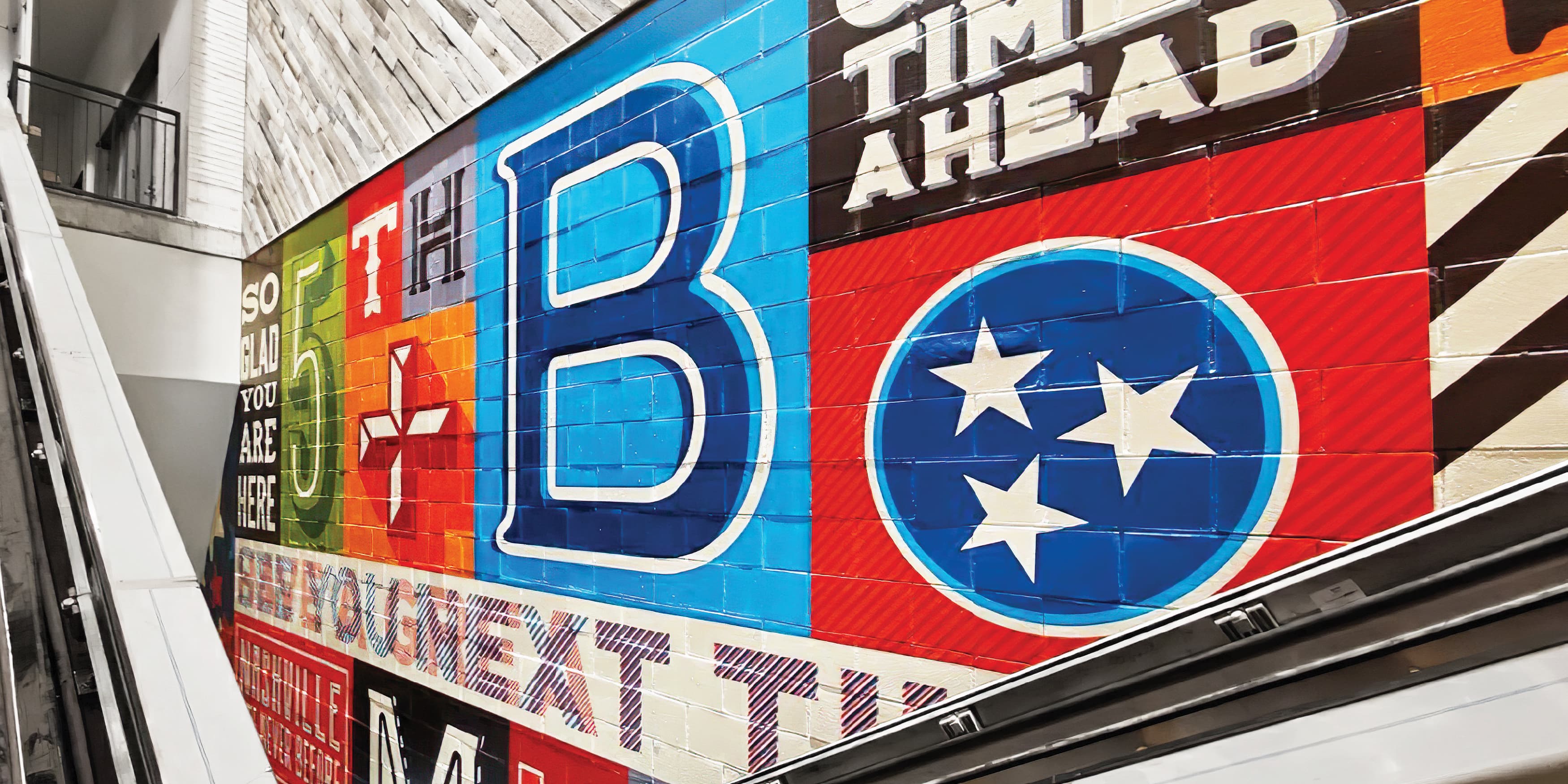
A parking garage is a peculiar place to encounter the spirit of a concert poster. At Nashville’s Fifth + Broadway, huge letters, blocks of color and a Tennessee emblem turn the trip past an escalator into something worth looking at. The visual reference is local: the letterpress tradition associated with Hatch Show Print. RSM Design helped give the development’s parking murals a voice that belongs to the city outside.
The work offers a useful introduction to an easily overlooked business. RSM designs the graphic layer of the built world: the identity above an entrance, the directions at a junction, the mural that becomes a meeting point. Its Fifth + Broadway murals earned recognition in Communication Arts’ 2024 Typography Annual. The everyday audience has a less specialized test: does this place make sense, and will I remember it?
The building has a voice
RSM occupies the intersection of graphic design and architecture. Its portfolio spans hotels, parks, campuses, retail districts, workplaces and cultural venues. Developers and institutions buy the work; people arriving for lunch, class, work or an appointment encounter it. That split matters. A client may be thinking about a district’s identity while a visitor simply wants to find the entrance.
The studio’s brand-development services extend from naming and narrative to identity guidelines, printed material, digital collateral and physical environments. Wayfinding adds the practical work of understanding movement. Public art, murals, donor recognition and exhibit design extend the vocabulary. These services can meet within one commission, giving the client a way to carry the same idea from a website into the street.
There are established alternatives. Selbert Perkins Design also combines branding, signage, placemaking and public art. RSM’s case rests on its particular projects, architectural fluency and attention to local references. A buyer can compare how each studio handles a real site, a difficult circulation problem and the people who will maintain the result.
A garage apartment with a Disney brief
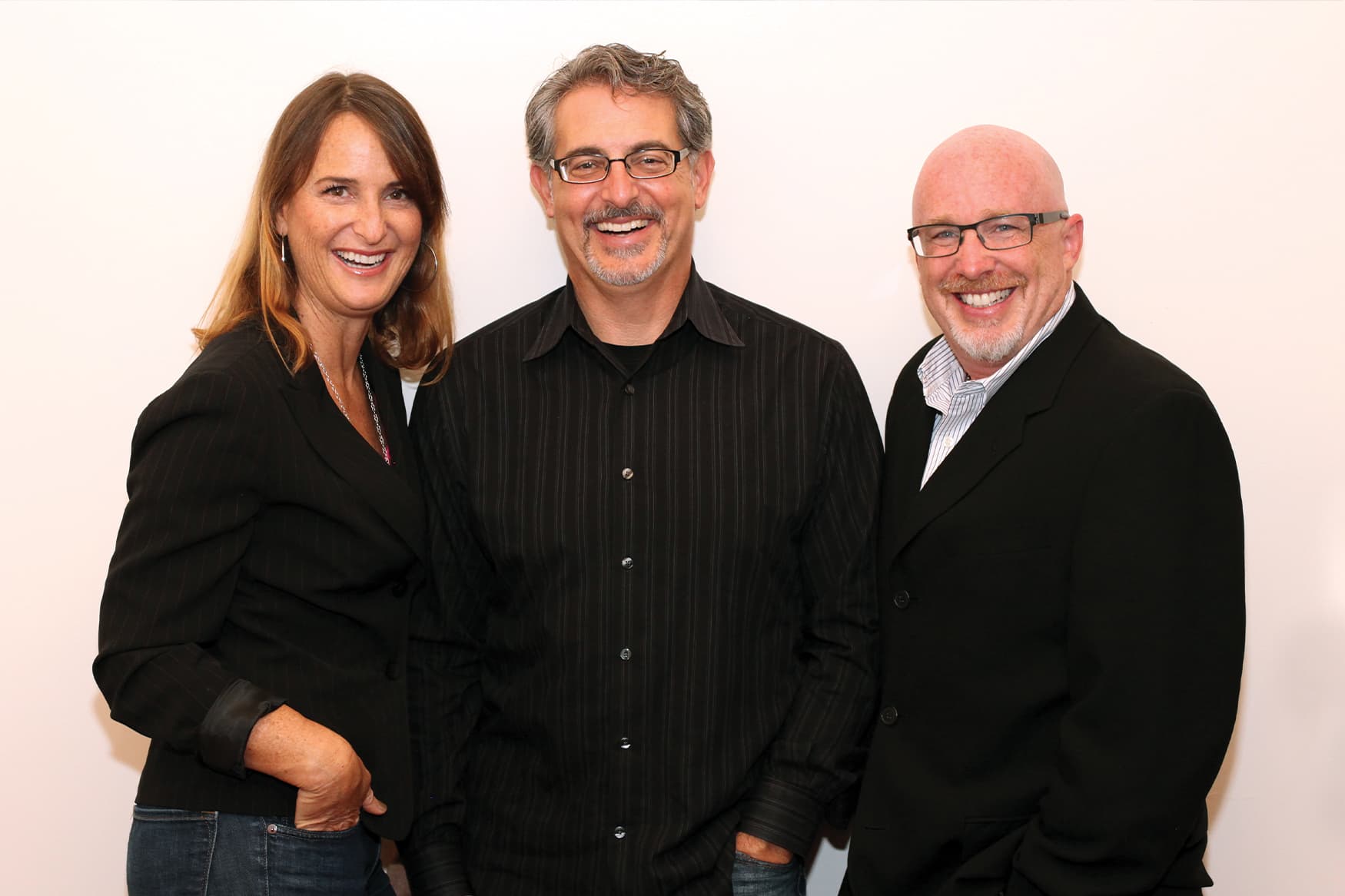
The company’s origin story begins in 1997, when Suzanne Redmond Schwartz and Martin Schwartz started working from a San Clemente garage apartment with a commission from Walt Disney Imagineering. In 1999, a merger with Harry Mark’s Dallas architectural practice formally established Redmond Schwartz Mark Design. The same year, the California team bought its studio building, a 1948 design by architect Richard Y. Lim.
The founders’ backgrounds explain the mix. Suzanne studied graphic design and packaging as well as business. Martin trained in architecture. Harry’s architectural career includes years documenting antiquities at Aphrodisias in Turkey. His biography records election to the American Institute of Architects’ College of Fellows in 2015. This is a practice whose understanding of surfaces includes what people built centuries ago.
Directions with a memory
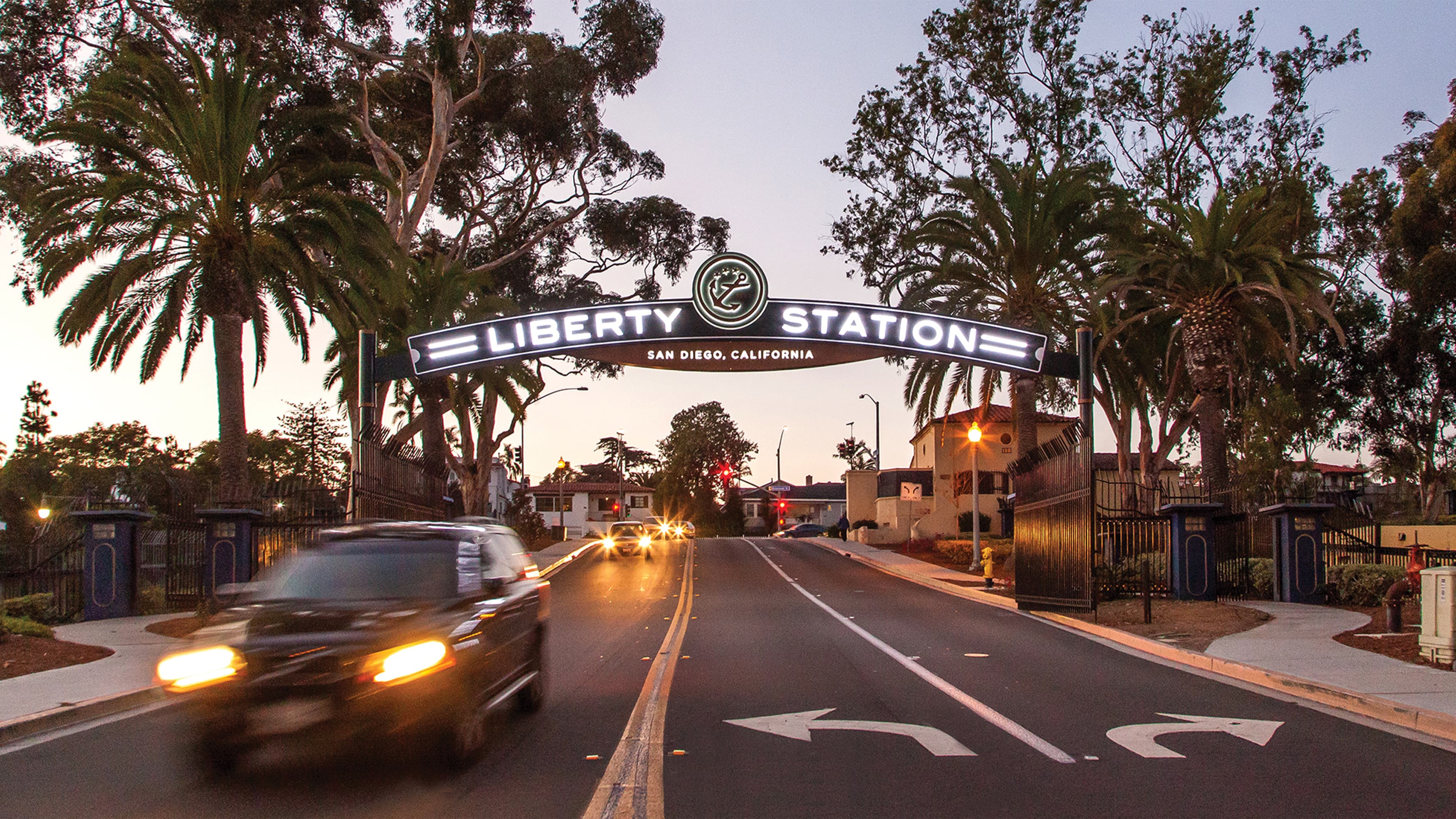
At Liberty Station in San Diego, the starting material was a former Naval Training Center occupying 361 acres. Its redevelopment brought different uses into a place with an existing identity. RSM worked on the initial vision and brand strategy, the site-wide signage system and guidelines for future expansion. Naval history supplied the strong shapes and clean edges carried through the graphics.
A district needs those rules because its identity is distributed. One tenant changes, another arrives, a new destination needs a label. The design question continues after opening day. Liberty Station makes RSM’s role tangible: it gives a large, changing place a visual grammar that later additions can use. History becomes a practical resource for consistency.
At San Diego’s Research and Development District, or RaDD, the task involved an existing brand on a six-block life-sciences development. RSM refined its identity for distance and legibility, drawing on chemistry and molecular structures. With IQHQ, Gensler and OJB among the project team, graphics, wayfinding and public art carried the vocabulary into the physical district. A logo that reads on a screen must also survive the scale of a building.
Three jobs for a place
RSM describes its method through three ideas: certainty, variety and delight. Certainty provides orientation. Variety gives different areas recognizable character. Delight introduces moments people remember. These are the firm’s design principles, a useful vocabulary for discussing an experience rather than a numerical guarantee of how visitors will behave.
The wayfinding process begins with flow analysis: how people move through the environment. The studio then develops coordinated visual components. It considers lighting, landscape and architecture alongside signs. The implication is practical: inspect what the place already communicates before adding another instruction. A distinctive feature can help someone orient themselves; an arrow is only one available tool.
“diagnose before you prescribe”
Martin Schwartz, Communication Arts
A master sign program turns these decisions into longer-term guidance for a city, campus or mixed-use development. RSM describes analyzing the different uses of a space before planning how drivers and pedestrians move into and through it. The useful output is a framework that can accommodate later work. For an owner, that changes the brief: specify how a future building, tenant or destination joins the system. Otherwise, each addition becomes a fresh design decision, with another opportunity for the place to lose its consistency.
Sometimes the answer is quieter
The BAR Center at the Beach in Venice required a particularly careful response. The Jewish Federation of Los Angeles wanted a welcoming community building with a discreet exterior identity. RSM joined while the architecture was still conceptual, collaborating with BA Collective and Mathews Development Group.
An abstraction of the Star of David informed the tessellated facade. The entrance identity was carved into Jerusalem limestone; light and shadow make the lettering visible. These choices answer a specific tension between expression and discretion. The lesson is narrower, and more useful, than a universal style rule: understand what a community needs to reveal, what it needs to protect, and how materials can carry that distinction.
Different conditions produced a very different result at Base Camp Charlie, an identity and wayfinding project for Trinity Works and the Boy Scouts of America. The signage used inexpensive, flexible components and avoided unnecessary detailing. It received a 2013 SEGD Honor Award. Here, restraint was about materials and construction. The design needed to belong at an adventure camp.
The $280,500 question
A Mansfield City Council decision provides a concrete view of the business. On January 8, 2024, the Texas city approved an RSM agreement capped at $280,500 for branding and wayfinding design for the district then called Harvest Point. The described scope included a logo, branding package, website landing page and schematic wayfinding design.
Mansfield’s approved ceiling for district branding and wayfinding design services.
A contract limit, not a standard rate or a final spending total.That is a professional-services purchase with defined outputs. It also explains why a price for “some signs” can be a misleading shorthand. The client was commissioning a district identity across several media and a design for navigating it. Anyone comparing proposals should line up the deliverables first. A concept package, detailed production documents and installed hardware represent different amounts of work.
There is also a question of who needs to be in the room. A visual identity can be reviewed on a page; a sign occupies space shared with paving, structures, landscaping and light. RSM’s stated principle-centered approach puts the people experiencing that space at the center of the work. A useful way to evaluate a proposal is to ask the team to explain the visitor’s journey, including the awkward transitions. Where does the driver become a pedestrian? What tells a newcomer that they have arrived? Those questions make the promised experience easier to inspect.
The route runs through a committee
Balboa Park supplies an unusually candid account of what can change a design team’s direction. RSM’s December 2018 masterplan summary described more than ten committee and public forum meetings over two years. Its discussions with city departments revealed a lengthy approval route for a signage overhaul, with rejection still possible after the reviews.
The resulting strategy proposed eight modifications to the existing system. Changes within the established plan offered a more manageable route. What changed the approach was an understanding of the approval machinery surrounding the design. For anyone commissioning work in a historic public place, that is a useful distinction: the most consequential discovery may concern governance rather than typography.
Another boundary appears in North County Transit District’s 2019 response to a grand jury report. The agency agreed its transit signage needed improvement and described RSM’s master plan study, awarded in April 2018. As the study approached its final design phase, funding still had to be identified to make and install the signs. The implementation schedule remained undetermined.
The immediate problem was information that did not serve riders well enough; the next obstacle was delivery. A completed design cannot help a passenger until it reaches the station. That record gives prospective clients a concrete planning task: connect design approval to fabrication funding and installation responsibility early enough for the system to become usable.
Walk the site. Then draw.
RSM’s growth has retained an emphasis on physical proximity. Its April 2025 New York studio announcement reported a team of 40 and work in more than 36 countries and 42 states. The fourth studio put Harry Mark and a local team closer to East Coast clients. The stated rationale centered on meeting people and walking sites together.
The firm also makes room for shared making. Its 2025 all-office workshop gathered colleagues for camping, creative exercises and time away from screens. That is a concrete glimpse of its culture: people who design public experiences spending time building things together.
In a May 2026 conversation about San Diego, RSM’s designers described how RaDD’s collaborators developed a shared strategy early, giving the disciplines something to return to. For a smaller team, the transferable habit is straightforward. Walk the route, agree on the experience, record the decisions and keep the practical constraints visible. Before commissioning a mural, make sure the visitor can find the door.