A political campaign had a question about Chinese voters. Ronald W. Wong had a question about the question. The campaign was uncertain where the community stood on an initiative. Wong wanted to know whether anyone had asked people in Chinese. It is a small intervention, almost comically plain. It also changes the assignment. Before interpreting an audience’s answers, someone has to establish whether the audience was given a fair chance to answer.
That habit of attention runs through Wong’s work. The founder, president and CEO of Imprenta Communications Group has moved between government, advertising, civic leadership and documentary film. Each setting has its own vocabulary and measures of success. Across them, he keeps returning to participation: who receives information, who can use it, and who gets to help decide what happens next.
“Did you poll the Chinese voters in Chinese?”
Ronald W. Wong
A request through a car window
Wong grew up in Monterey Park and attended Alhambra High School. His debate partner was Thomas A. Saenz, later president and general counsel of the Mexican American Legal Defense and Educational Fund. The two teenagers talked about society’s faults and their plans to change things. Debate club, in this case, had a fairly ambitious extracurricular agenda.
At UCLA, where he studied political science, Wong volunteered at Nisei Week in Little Tokyo. He spotted State Senator Art Torres in a car, approached him, and asked for an internship. He was 19. Torres agreed. The episode has the pleasing economy of a career story told backward: a young person wants an opening, sees someone who can provide one, and asks.
His later work would involve helping other people understand such openings. The setting might be a campaign, an appointment process or a leadership program. The early request to Torres supplies a concrete beginning for that interest.
Learning where the seats are
Wong’s professional route included legislative and field work at the ACLU of Southern California and a founding partnership at communications firm Lang, Murakawa & Wong from 1994 to 1997. He learned public communication from several sides: organizing people around an issue, advising clients, and working within political institutions. Those assignments brought him into contact with the practical limits of a message, even one its authors considered persuasive.
In 1997, he joined the U.S. Department of Justice’s Community Relations Service in the Clinton administration. His communications responsibilities connected government officials, community organizations, the press and the public. The work included racial reconciliation and hate crime initiatives. There is a difference between finding words for a policy and getting people with different experiences to discuss it. His assignments involved both.
He subsequently worked on Gray Davis’s California campaign and served as chief deputy appointments secretary from late 1998 to 2001. That meant helping screen and recruit people for boards, commissions and other appointed positions. Political representation can look abstract until someone must identify the candidates, arrange the conversations and fill the seats. Wong worked inside that process.
& Wong
of Justice
founded
on screen
Two communities, one business decision
Wong founded Imprenta in 2001. Its focus brought Asian American and Latino audiences into the same agency practice. That choice gave the company a specific position in a field where multicultural work could be organized around a single community. Wong saw a reason to serve both, including the everyday proximity of communities living alongside one another in California.
The agency’s work encompassed public relations, advertising, political campaigns, creative production and digital communication. Its stated purpose centered on reaching communities of color with attention to their cultures. That purpose also described a commercial opportunity. Public agencies, companies and campaigns needed to reach people whose daily information did not necessarily arrive in English.
Imprenta developed in-house capacity across Spanish, Mandarin, Cantonese, Vietnamese, Korean, Hmong and Tagalog. The list is useful because it makes the work tangible. A campaign described as multilingual still needs people who can produce and judge the actual communication. Someone has to know whether the words sound natural and whether the intended audience recognizes itself in the message.
Spanish • Mandarin • Cantonese • Vietnamese • Korean • Hmong • Tagalog
Languages documented in Imprenta’s published agency history.The door hanger has a job
Consider a less glamorous object than a campaign film: a notice hanging on a front door. Imprenta used door-to-door outreach for Southern California Gas’s discounted-rate program, following research to identify eligible communities. A benefit that exists on paper becomes useful when someone recognizes it, understands it and takes the next step. The door hanger had that journey to make.
The example helps explain Wong’s insistence on connecting advertising with community outreach. An advertisement can introduce a program; local participation can carry the information further. The person receiving it may have a question that a headline cannot answer. Designing the message and designing its route to the audience belong to the same assignment.
His account of social marketing also emphasizes understanding a community’s existing institutions, including its religious leaders and organizations. A campaign enters a place where relationships already exist. The people sending the information need to understand those relationships before deciding how to proceed. Wong’s political background gives that part of the work a familiar shape: learn who people listen to, and why.
A classroom instead of a podium
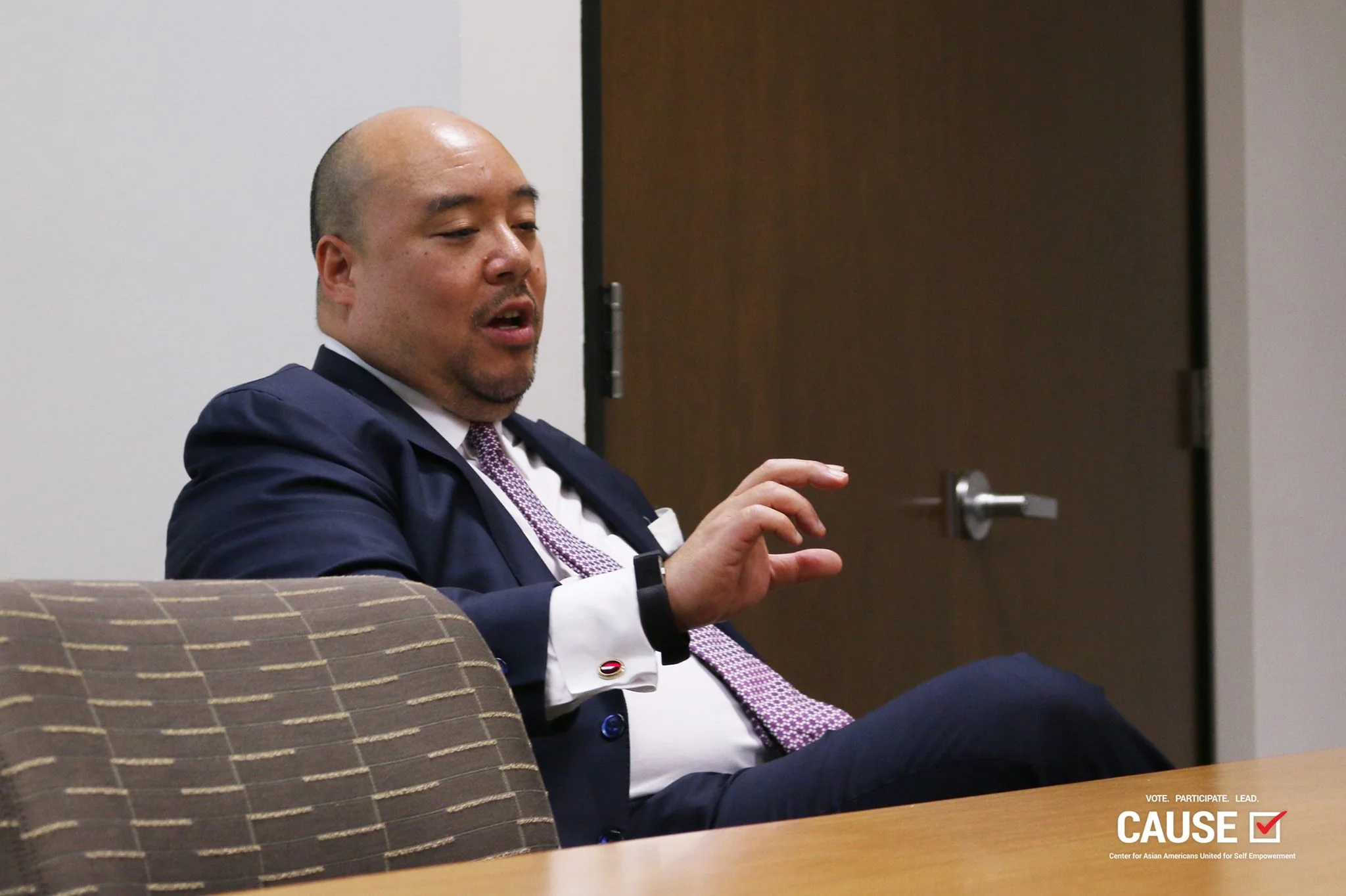
In a photograph from the 2017 CAUSE Leadership Academy, Wong sits at a conference table, gesturing as he speaks. His subject was personal branding. The fellows were working on a voter resource guide, so the workshop connected the presentation of a person’s story with the presentation of useful civic information. Both require deciding what an audience needs to understand first.
Wong also founded the Asian Pacific American Leadership Foundation. Its work prepares Asian Pacific Americans for civic leadership and public service. The foundation extends his interest in participation beyond reaching voters. It addresses the people who might eventually seek office or accept an appointment, and the preparation that can help them do so.
A fraternity presentation about Wong’s career identifies Rob Bonta and Betty Yee among the program’s successful alumni. Those connections give the training a public consequence without making it a one-person explanation for anyone else’s career. Leadership development is collaborative work. Wong’s place in it is as a founder and participant in the machinery that helps people prepare.
The World According to Ron
The published principles around Wong’s agency have an informal name: The World According to Ron. They address loyalty, people, enjoyment and the need to step back when work becomes overwhelming. The language is conversational. It sounds like advice colleagues might actually remember after a meeting, which is an advantage over a laminated statement nobody can quote.
“If it isn’t fun, don’t do it.”
One of Wong’s published working principles
There is a business record alongside that preference for enjoyment. Imprenta appeared on Inc.’s fast-growing company lists in 2015 and 2016. In December 2017, an announcement recognized Wong as the Public Relations Society of America Los Angeles chapter’s PR Professional of the Year. David Ryu introduced him at the awards, recalling a friendship of more than 20 years.
In his remarks about the recognition, Wong linked the business to a public that receives information in many languages. The award was an occasion to make the argument he had been making through his work. Diversity had consequences for how campaigns were designed, whom agencies hired and what clients needed to understand about the people they served.
When the campaign became a film
Wong’s work eventually took him into documentary production. He served as producer and writer of The Race Epidemic, with Tony Shyu as director and producer. The project began by following John Chiang’s campaign for California governor. Its scope expanded into a wider examination of racism and Asian American experience. The original political story opened onto questions that lasted beyond an election.
The film brought together public officials and other voices, including Judy Chu, Rob Bonta, David Ryu and historian Erika Lee. It received a Best Documentary Golden Angel at the 17th Chinese American Film Festival. A film offers a different relationship with an audience from an advertisement: there is room for testimony, context and the accumulation of experiences.
In May 2021, Wong joined Shyu and Ryu for a Los Angeles Chinese Film Festival discussion. In November 2022, he discussed the documentary on Ken Fong’s Asian America podcast. Those conversations extended the project beyond the finished film. Producing it was another way to put experiences before an audience and invite a response.
A new channel for an old question
AMerge Media adds a further chapter. The company identifies Wong as a founder and its chairman and CEO. It describes a media technology business serving multicultural audiences, with a partner roster that includes Korean, Filipino, Vietnamese and Asian American outlets. The channels have changed since the early years of Imprenta. The attention to language and audience remains recognizable.
Wong’s career has room for an appointments office, a workshop table and a film discussion because each involves people finding a route into public life. His work has required different tools at different moments. The question that runs through it stays close to the people involved: who has a chance to speak, who is listening, and what would make the conversation useful?