Ronald A. Kolar declined birthday gifts. His friends bought a bench anyway. The Downey Los Amigos Kiwanis Club had been considering how to mark his ninetieth birthday; a place for the public to sit became their answer. Installed between Downey City Hall and the city library, it gives an everyday purpose to an affectionate gesture. Some tributes require an invitation. This one requires only tired feet.
At the ceremony described in March 2026, local officials joined the club to recognize Kolar’s years of involvement. Steve Roberson played guitar. There were speeches, naturally. A bench dedication would hardly be a civic occasion without them. But the object itself made a quieter point: something bought in one person’s honor could be useful to people who had never met him.
Kolar is the founder and CEO of L’Abri Management. In Downey, his business life overlaps with a much longer list of associations, teams and friendships. Following those connections leads away from the executive title and into the practical arrangements that let people belong to a place.
An office on Florence Avenue
In 1972, Kolar established his property-management business in Downey. The first office on Florence Avenue contained a card table and one secretary. L’Abri Management’s incorporation followed in April 1974. The difference between those dates is worth keeping: a company begins doing its work before its paperwork becomes a convenient anniversary.
The business handles the recurring obligations of rental property, including leasing, maintenance coordination and rent administration. These are tasks whose importance becomes clear when they go wrong. An unanswered repair request has a way of making organizational theory feel rather remote. Property management puts a company’s arrangements into contact with somebody else’s daily life.
Kolar’s professional world grew to include L’Abri Enterprises and Downey Enterprises. By 2026, the organization owned or managed more than 5,900 apartments across Los Angeles, Orange and Riverside counties, alongside storage facilities and an office building. The portfolio extends across a region; the public bench stays firmly in one city.
The price of getting on the court
One account of Kolar’s influence begins with a teenager looking for a life outside the family home. Steve Le found part of that life in the year-round L’Abri volleyball club. The club carried the property company’s name, but what stayed with Le was an arrangement about fees.
In his personal recollection, Le describes Kolar encouraging players to speak to him if their families had difficulty paying. The answer Le remembers was brief: “Pay what you can, even if it’s nothing.” L’Abri also covered at least half the cost of trips to out-of-state competitions. Le presents that assistance as the reason some players could take part.
There is a whole social world inside a travel bill: transport, accommodation, a competition elsewhere, time spent with teammates. The sporting result is only one part of what a young person takes home. In Le’s memory, an adult’s willingness to absorb a cost opened up that world. Years afterward, he could still recall the words.
“Pay what you can, even if it’s nothing.”
Ron Kolar, as remembered by former player Steve Le
A name above the door
When the Downey YMCA announced in November 2023 that its new building would carry the Kolar family name, Kolar described himself as “a bit embarrassed.” Recognition can be awkward when it arrives in a room full of people you already know. The announcement placed a family name on an institution with a history much wider than one donor.
At that stage, the campaign had assembled roughly $14 million toward a $20 million goal. Board members, foundations, service clubs and public funding all appeared in the effort. A naming announcement might look like an ending from the audience. For the people organizing the campaign, it came with a substantial balance still to raise.
The proposed building included places for children to gather and people to play, alongside a retained and upgraded gym. Such plans turn an abstract fundraising target into recognizable spaces. Someone has to help pay for the room before another family can make it part of an ordinary Tuesday.
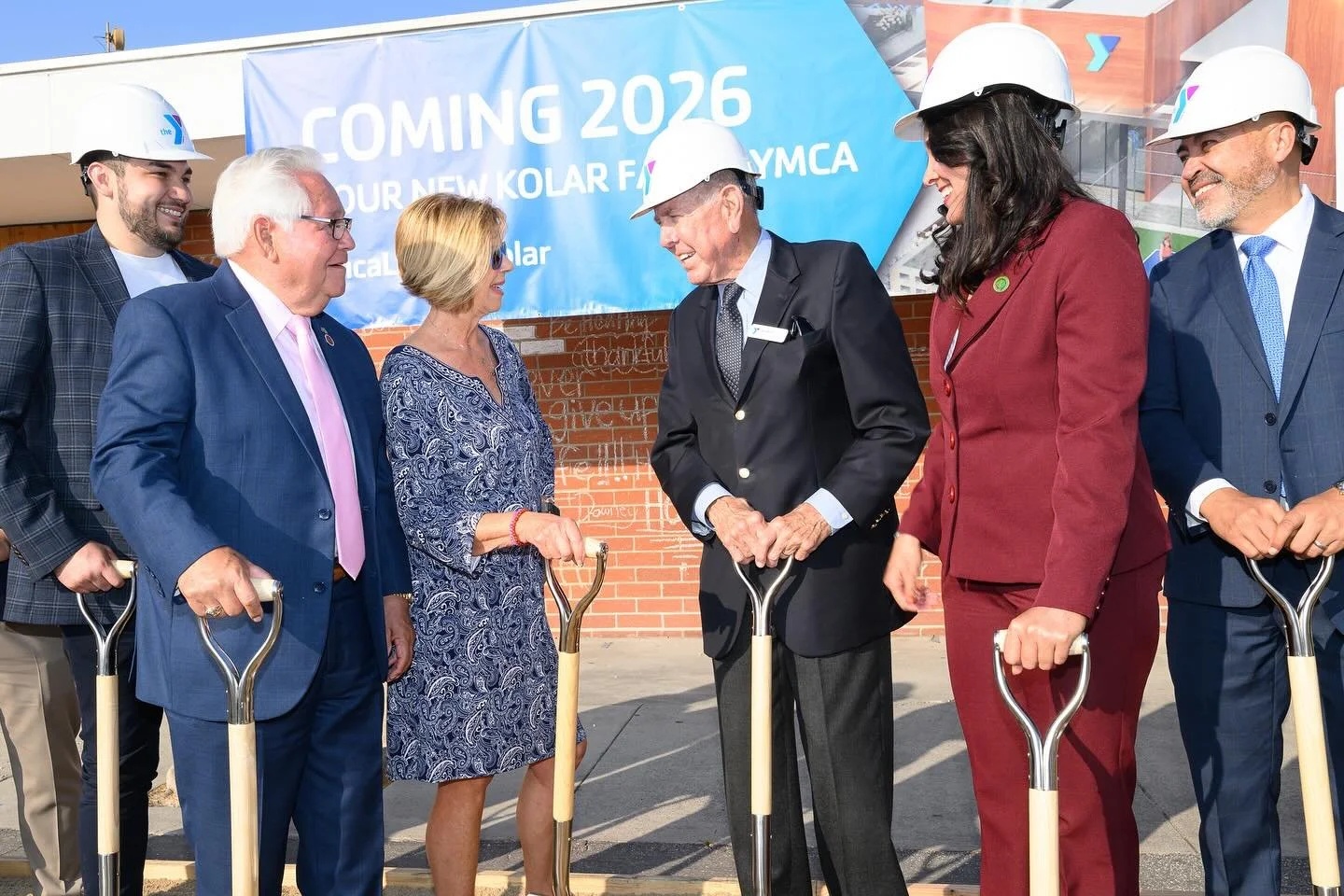
At the October 2024 groundbreaking, Kolar put his motive plainly: “My motivation was to leave something here in Downey.” He spoke about the YMCA continuing to meet the needs of other families. The occasion gathered elected officials and campaign volunteers around the same construction project. Los Angeles County Supervisor Janice Hahn announced a $2 million county commitment. Private giving and public decisions met on the same patch of ground.
The calendar keeps moving
Building a replacement YMCA took more than a naming ceremony and a shovel photograph. In January 2025, the capital campaign committee, including Kolar, asked the community to help close a $1.5 million gap. A funding opportunity could bring another $5 million, the committee said, but the remaining money had to be secured by the end of that month. It was a dated appeal with a deadline, rather than a general wish for generosity.
By July 2025, the board held a standing meeting and ceremonial demolition event. The campaign had raised more than $23.5 million; a further $660,000 remained to raise. These figures describe successive stages of the project. They are useful precisely because they show the work continuing after the congratulatory moments.
The schedule changed, too. A July 2026 visit by Representative Linda Sánchez found the facility still under construction, with an opening expected in spring 2027. Jeremy Fitzl, then chair of the Board of Managers, was among those accompanying her. Kolar’s name was already attached to the project. Its next chapter still depended on a building being completed and its doors opening.
The colleague who stayed
Fitzl’s place in this story reaches beyond the YMCA. He met Kolar through USC, then went into the restaurant business. Kolar kept trying to recruit him. The proposition that eventually worked concerned family life: property management offered a working day that seemed more compatible with raising children than the demands of a young restaurant.
Fitzl joined L’Abri and worked his way up to managing partner. In January 2025, he described a business of approximately 6,000 apartments, with on-site managers and an office team handling the bills and administration. His account makes the scale tangible. A portfolio is also a collection of people whose work must fit together.
He also became involved in Downey’s volunteer organizations. Kolar had offered him a job; the job brought him into the city. The overlap between business and community continued in another person’s working life. That is one way a founder’s influence can persist beyond the decisions made at his own desk.
A little room for mischief
There is humor among the committee names. At a tribute to his friend Bob Earl, Kolar recalled being denied his usual seat with friends at Kiwanis. Earl had announced that he would be sitting at the Bob Table, with other Bobs. Kolar pointed out the administrative flaw: his friend’s actual name was Edward Dennis Earl.
It is a small joke, dependent on knowing someone well enough to enjoy the discrepancy. The episode places Kolar among friends with reserved seats, golf games and familiar stories. The institutions surrounding him also provided places to spend time with people whose company he liked.
At a 2019 YMCA board installation dinner, Kolar discussed the future of USC football with Marge and Larry Lewis. It is the kind of conversation that gives a formal event its human proportions. There is an agenda, and there are also people catching up over dinner. An evening of service can accommodate an opinion about the football team.
At another Downey gathering, the 2011 Rose Float Association fundraiser, he won $10,000 and gave $3,000 back. The outcome had an agreeable circularity: a ticket bought to support a cause brought money back to its buyer, who promptly sent some of it around again. Civic participation occasionally comes with a cash prize. The committee minutes tend to offer less excitement.
What remains in reach
Kolar’s attachments also include faith. Capitol Ministries lists him as its treasurer and identifies him as L’Abri’s founder and CEO. His business name has its own religious connection: L’Abri, French for shelter, reflects his admiration for author and theologian Francis Schaeffer. The company and the board role belong to a wider pattern of commitments alongside his Downey work.
The visible objects are easier to point to: an apartment business, a family name on a YMCA project, a bench beside a library. Each invites a different kind of use. A resident needs the property manager to answer. A young player needs a way to join the trip. A family needs somewhere to gather. A passerby may simply need to sit down.
Kolar’s stated wish was to leave something in Downey. The useful question for anything left behind is what another person can do with it. On that measure, a public bench is an apt birthday present. There is room for someone else.