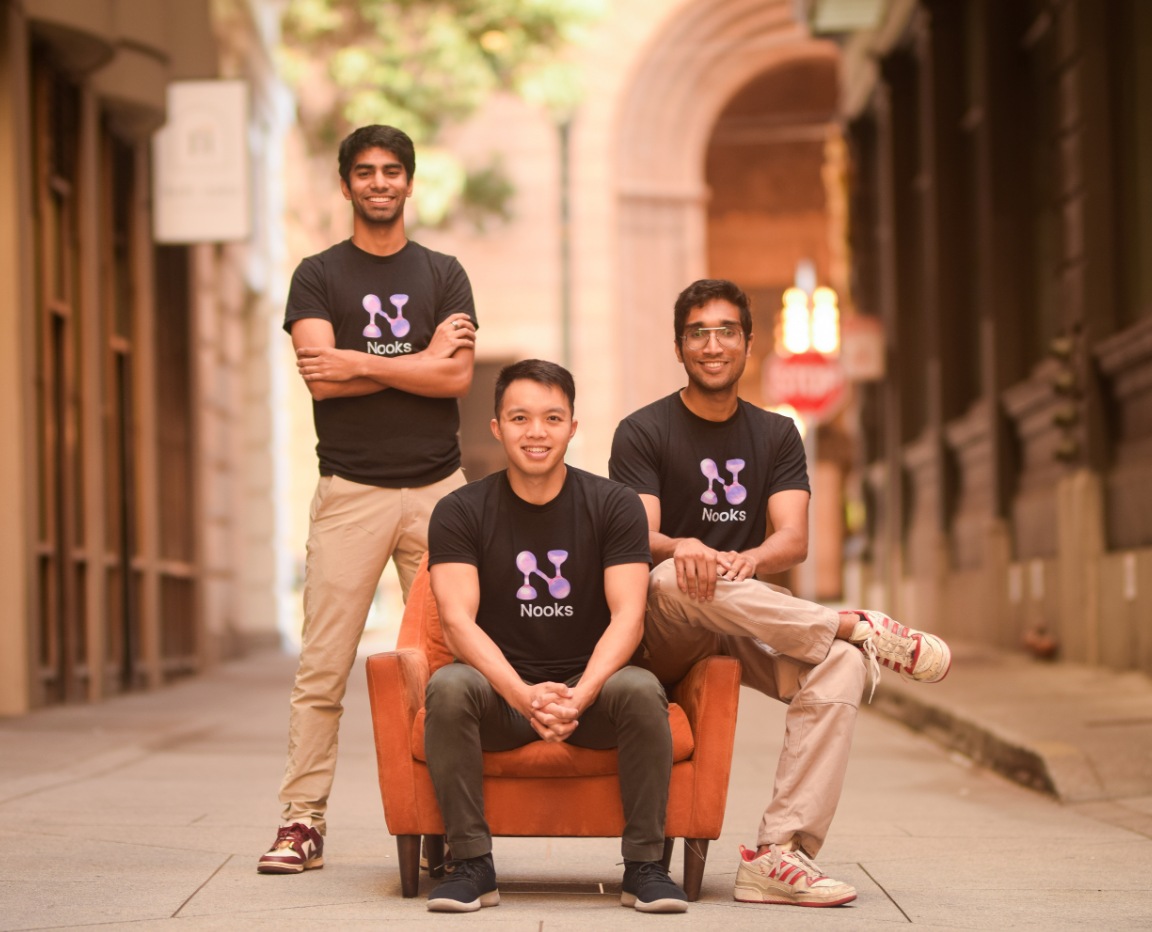
The first useful thing Rohan Suri did for Nooks may have been to dislike it. In 2020, his Stanford friend Dan Lee showed him an early prototype, a virtual workspace built for a world that had abruptly moved onto screens. Suri began listing what was wrong. Lee did not defend the work. He asked Suri to help fix it. Suri paused, then joined him and Nikhil Cheerla. The company that followed has spent much of its life repeating that little exchange: look closely, say what is not working, and rebuild around the answer.
It is an origin story with unusually little ceremony. Three friends who had studied artificial intelligence and worked on projects together started in Suri’s family basement. Their next office was Cheerla’s parents’ guest room in Cupertino. The early product tried to make remote collaboration feel more spontaneous. It offered virtual rooms and social presence, an answer to the strange loneliness of working beside colleagues who existed mostly as green dots.
Then a particular kind of customer kept turning up. Sales development teams used the product with more intensity than everyone else. Their work was social, repetitive, measurable and, on a bad afternoon, composed largely of ringing phones. They liked being able to work together. They also revealed a larger problem hiding underneath the virtual office: much of a seller’s day was administration wearing a headset.
The engineer picks up the phone
A company can learn that customers have a problem and still remain safely abstract about it. Suri chose the less comfortable curriculum. When the founders needed someone to begin selling, he raised his hand. He had worked in machine learning research and software engineering. Now he was making cold calls, running follow-ups and learning the small humiliations of a sales workflow from inside it.
His co-founder remembers Suri making a cold call during Nooks’ first sales call. Later customers remembered those early conversations too. One said Suri reached him while he was standing in his garage; the call became a booked meeting. There was no quota and no ceremonial sales title. There was simply a founder discovering that a product pitch is also a bug report delivered in real time.
Suri helped close the company’s first $1 million in annual recurring revenue and helped establish its sales, customer success and marketing functions. The experience left a mark on the product. A parallel dialer is easy to describe as software that calls several numbers at once and connects a representative when a person answers. It feels different when you have spent an hour listening to voicemail greetings. The distance between an elegant feature and a useful one is often measured in somebody else’s tedium.
A product made of interruptions
Nooks gradually became a sales platform: dialing, prospecting, coaching, call analysis and, later, sequencing and an AI assistant. The continuity is easy to miss. The original virtual rooms tried to lower the social friction of beginning a conversation. The later products try to lower the operational friction surrounding one. The screen changed. The interest in human hesitation remained.
That interest also explains Suri’s insistence that sales will remain a human job. Nooks uses AI to research accounts, surface signals, draft messages, summarize calls and recommend next steps. Its stated aim is not to remove the representative from the exchange. It is to give the representative more time for the exchange. This is a subtler promise than automation usually likes to make. It treats conversation as the valuable part, and the machinery around it as negotiable.
Following the strongest customer signal
The raw material is substantial. By the 2024 Series B announcement, Nooks said its system had been trained around a dataset of more than 100 million sales conversations. Yet Suri’s public product commentary tends to return to an almost domestic question: what should a person do next? He has written that people do not want more answers so much as fewer decisions. That distinction is a product thesis disguised as a complaint about dashboards.
A dashboard can explain yesterday with great polish and leave this morning untouched. A recommendation asks more of the software. It must understand enough context to rank attention, and enough uncertainty to leave judgment with the user. Suri’s recent work at Nooks has moved in that direction: agents that research an account, draft an email, find prospects, analyze a pipeline or surface a coaching action before the next one-to-one.
Fourteen busy days
In October 2024, Nooks announced a $43 million Series B led by Kleiner Perkins. It brought total funding to $70 million and a reported valuation of $285 million. Suri described the process with the sort of practical detail that financing announcements often remove. The company had not planned to raise. An investor approached. The founders decided that one offer was not a market, so they compressed the process into two weeks.
Those days meant investor conversations, decks, data rooms and the ordinary burden of running the company at the same time. Suri wrote that the business had six years of runway and had been growing revenue fourfold year over year. The argument for taking the money was not survival. It was time: invest in customers, pursue the product vision and build with a longer horizon.
Three Stanford friends begin with virtual collaboration and classroom ideas.
Suri leads founder-led sales and helps close the first $1 million in recurring revenue.
A $22 million Series A funds the growing dialing and prospecting platform.
A $43 million Series B backs a broader AI sales assistant platform.
Suri leads product across dialing, sequencing, prospecting, coaching and AI assistant workflows.
Funding is the cleanest number in the story and therefore the most tempting one to mistake for the story. A better measure of Suri’s route is the number of times he changed jobs without changing companies. Critic of the prototype. Co-founder. Engineer. First salesperson. Builder of go-to-market functions. Product leader. Each role corrected the blind spots of the one before it.
The company’s 2024 growth supplied the backdrop. Nooks reported that annual recurring revenue had increased fourfold during the year, that hundreds of companies had joined its customer roster and that the staff had expanded from 30 people to 90. Suri, Lee and Cheerla were also named together to Forbes’ 30 Under 30 list for AI. It was Suri’s second appearance on an Under 30 list, eight years after his first at 17. The repetition is less interesting as a trophy than as a measure of reinvention. The teenage builder had become an executive responsible for turning a wide field of possible AI features into a product sales teams could use every day.
The advantage of being corrected
Suri’s earlier record suggested the conventional technical path. At Stanford he studied computer science, including machine learning, computer vision, operating systems and probabilistic graphical models. His work included AI research and engineering internships. His public code portfolio contains data structures and machine learning projects. He collected hackathon and research awards. All of that taught him how to make things. Nooks added the ruder education of discovering what people will use.
Lee has described Suri as blunt, discerning and unusually attentive to detail. The prototype anecdote supports the description, as does Suri’s own amused reply that “this sucks” is his love language. Bluntness can be an expensive personality trait when it is used for theater. At a young company, paired with responsibility, it can be economical. The person pointing out the flaw should be prepared to help repair it.
There is play in the public version of Suri too. He writes about the five founder moods, all variations on being back or being finished. He has declared Friday boba the only startup tradition with perfect attendance. The jokes work because they shrink the mythology of company-building to its actual scale: a sequence of anxious weeks, customer calls, small rituals and decisions made with incomplete information.
His public predictions follow the same preference for concrete behavior. As AI makes email and social outreach cheaper, he expects those channels to become noisier. The phone, in his telling, regains value because a live conversation produces information and demands attention. It is a contrarian argument only if efficiency is measured by how much a system can send. Measure instead by what a team can learn, and the old instrument on the desk begins to look rather modern.
Nooks is now a much larger organization than three friends in a basement, and its product carries a larger claim. It wants to become the workspace in which human sellers and AI systems operate together. Suri’s role is to decide which actions software should take, which recommendations it should make and where a person should remain firmly in the loop. The technical questions are difficult. The social questions are harder.
The company’s beginning offers a useful safeguard. Follow actual behavior. Ask why one group cares more than another. Do the job before automating it. Build a system that removes the dull parts without sanding away the human ones. And when a sharp friend tells you the prototype is poor, ask for the list. Better yet, ask for help.