Roger Bennett had reached America. Everton, inconveniently, had stayed in England. When his club made an FA Cup semi-final, the country with hundreds of television channels could apparently find room for everything except the thing he wanted to watch. His father supplied a solution of considerable simplicity and questionable economy: call Liverpool.
For 90 minutes, Ivor Bennett held the telephone to his television. His son listened across the Atlantic as Everton won 4-1. In the family division of responsibilities, the father provided the commentary feed and Roger provided the telephone bill. Love has many languages; this one came with international charges.
The episode contains a small preview of Bennett’s working life. There is a person far from home, an attachment that refuses to fade, and a piece of technology recruited to bring the two together. Decades later, as founder, CEO and host of Men in Blazers Media Network, he is still arranging ways for people to share a match.
America, assembled in a Liverpool bedroom
Before America was a place Bennett could move to, it was a collection. Television programmes. Records. Sports heroes. In his Liverpool bedroom, the United States existed in an American flag mural and a jumble of pop-culture loyalties. His father remembered dozens of Coke cans stacked on top of the wardrobe. The room had the makings of a very small embassy with an unusually liberal refreshments policy.
Bennett came of age in the Liverpool of the 1980s, amid industrial decline and social unrest. American entertainment offered another view: the bright confidence of Miami Vice, the possibilities in John Hughes films, the lives unfolding in The Love Boat. He consumed the culture with the seriousness other children might have reserved for their homework. The Chicago Bears added shoulder pads to the dream.
There was a family story behind the fascination. A great-grandfather had intended to reach Chicago but ended up in Liverpool. Bennett has told it as a migration interrupted, a destination left waiting. His grandfather Sam kept a small Statue of Liberty ornament and returned to the thought that the family should have lived in America.
That ornament eventually reached Bennett’s desk in New York. A cheap souvenir had become an inheritance with a rather large set of instructions. His American attachment had room for television detectives and football players, but it also carried an older idea of opportunity.
A friendship with an American teenager made Chicago less abstract. Letters brought news of the Bears’ 1985 season; a summer visit let him enter the world he had been watching from across the ocean. In 1993 he moved to Chicago. The imagined city acquired ordinary streets and the practical business of living in it.
Chicago’s appeal outlasted the novelty. He remained attached to the Bears and the White Sox, carrying those allegiances alongside Everton. Being born in Liverpool did not oblige him to ration his sporting disappointments. America had supplied several excellent additional providers.
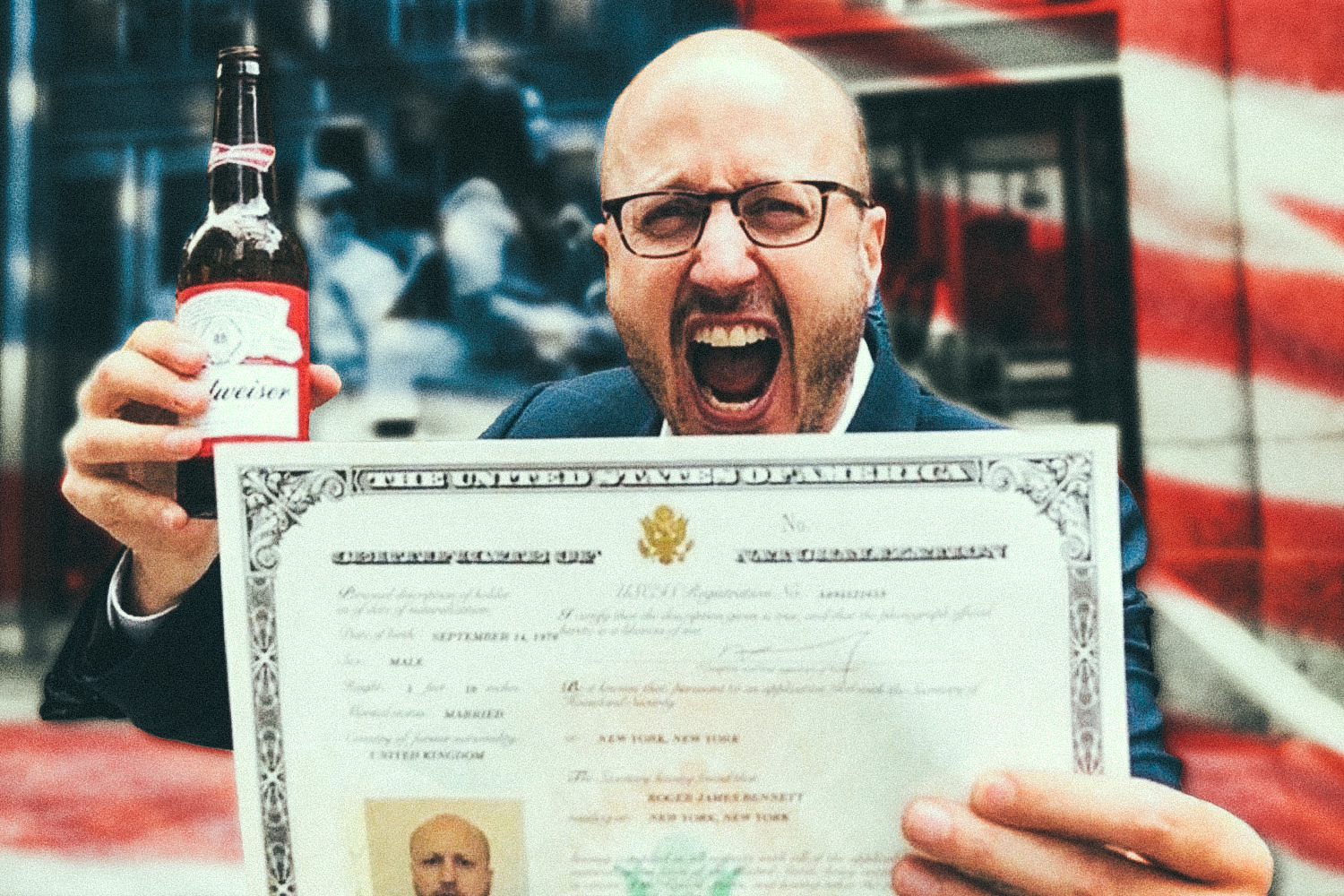
Citizenship followed in 2018. He recalled taking the oath in Lower Manhattan among people from dozens of countries, each arriving by a different route. The occasion gave a public form to an attachment he had been rehearsing since childhood. The country on the bedroom wall was now his country in law.
A wedding with an unfortunate kickoff time
In 2006, another event required him to be somewhere he would rather not have been. A wedding had been scheduled during the World Cup final. Worse, the wedding was on a boat. A late arrival would require more than an apologetic entrance.
As France and Italy’s match went into extra time, Bennett had to leave. At the wedding he encountered another British expatriate with much the same grievance: television producer Michael Davies. Bennett later described his own mood as adolescent. Davies recognized the other sulking football fan because he was one himself.
It is a pleasingly unceremonious origin for a media partnership. No grand declaration, just two guests whose thoughts were elsewhere. ESPN brought them together for the 2010 World Cup, giving them a shared outlet for writing and podcasting. The conversation became Men in Blazers.
They brought an affection for American sports broadcasting into the project. George Michael’s Sports Machine, with its highlights and exuberant presentation, had impressed them both. When their own television opportunity arrived, they sought out a piece of its old signage. The future set would contain a little of the television that had helped draw them here.
The duo joined NBC Sports in 2014. Their television show debuted that September. An audio conversation had found another room to occupy.
A place for the people who care
Bennett’s football work has included going behind the public performance. With filmmaker Jonathan Hock, he worked on Inside: US Soccer’s March to Brazil ahead of the 2014 World Cup. His interview subjects have included Pep Guardiola, Jürgen Klopp and Mauricio Pochettino. The appeal is partly access, but also the chance to hear how people explain the work of leading and playing.
He has been equally interested in what happens when a sporting story goes wrong. American Fiasco, his 2018 series with WNYC Studios, returned to the United States men’s 1998 World Cup campaign. Ten episodes gave an unsuccessful tournament the attention usually reserved for a triumphant one.
The episode subjects tell you something about the method: selection decisions, the captaincy, the team’s accommodation, the matches and the aftermath. Results are easy to print in a table. A team’s internal life requires time, voices and patience. Bennett let the disappointment become a story with people inside it.
His interest in belonging predates the football network. He cofounded Reboot, a Jewish cultural organization concerned with how generations approach identity, community and meaning. He also edited Unscrolled. The subjects differ, but the recurring questions are recognizable: what do people inherit, what do they keep, and how do they make it speak to their own lives?
In 2021 he hosted HBO’s official Band of Brothers podcast, revisiting the series with cast members and collaborators. Tom Hanks joined him for the prologue; Damian Lewis was among the subsequent guests. Once again, Bennett was interviewing people about a story that had acquired a life in other people’s memories.
“I dream of an America where we’re lifting the World Cup.”
Roger Bennett, 2021
His own memories became a book that year. Reborn in the USA: An Englishman’s Love Letter to His Chosen Home followed the Liverpool teenager looking west through music, movies and sport. It debuted at No. 1 on the New York Times bestseller list. The personal history had found readers beyond the match recap.
The microphone gets more company
For years, Men in Blazers meant Rog and Davo. In April 2024, Davies stepped back from regular weekly appearances, retaining a consulting role and occasional appearances. His other television responsibilities had grown, and the network had developed beyond dependence on its original pairing.
For Bennett, that meant continuing a familiar conversation inside a changing organization. A network needs room for people whose attachments and expertise differ from the founder’s. The company’s coverage now includes The Women’s Game, VAMOS and other shows alongside its original Premier League conversation. His current cohosts include Rory Smith.
A financing round made the business ambitions more explicit. In January 2025, a $15 million Series A was reported, led by Marc Lasry’s Avenue Sports Fund. Participants included the investment company of Ryan Reynolds and Rob McElhenney. Bennett remained the majority shareholder.
The plans included expanding women’s football coverage, building VAMOS as a dedicated vertical for Hispanic soccer fans, and developing a travelling show. Those choices gave different communities their own places within the business. A founder accustomed to being on the microphone also had to think about who else should be heard.
Series A reported in January 2025, supporting the network’s expansion.
97Full-time employees reported in June 2026. A dated snapshot of a growing operation.
By June 2026, the operation was reported to have 97 full-time employees and 15 additional podcasts. Bennett described culture building as a substantial part of his role. He pointed to colleagues who had taught themselves new skills and taken on larger responsibilities: an audio editor becoming a video editor, writers becoming showrunners.
There is a practical demand beneath the amiable public manner. Brand partnerships have to deliver. People need to grow into their jobs. A show can survive a joke at its own expense; a company still has to do the work it promised.
A life with a four-year calendar
Bennett’s 2026 book, We Are the World (Cup), gives his history a different organizing principle. It revisits the tournaments he experienced from 1978 through 2022, using the competition to connect personal recollection with football’s wider world. Every four years, another occasion to remember who you were and what you thought might happen.
The early memories include supporting Scotland in 1978 because England had failed to qualify. Later chapters follow a life increasingly rooted in America. The book makes room for comedy, frustration and the uncomfortable questions surrounding the competition. Loving the event does not remove the need to look closely at it.
His American enthusiasm has never required him to stop being an Evertonian. Nor has leaving Liverpool erased his attachment to the city. He has said he named children after its neighborhoods. The place he left remains part of the vocabulary of the home he made.
That combination gives his work its particular voice: a Liverpool sense of the ridiculous beside an immigrant’s willingness to take possibility seriously. He can make fun of the performance while caring about the result. A football match offers ample opportunity to practice both.
The receiver Ivor held against the television has long since been overtaken by easier ways to follow a team abroad. Bennett’s work keeps returning to the wish behind that call. Somewhere, a person wants to hear the match. Somewhere else, another person understands exactly why.
More time with Rog
Read, watch and follow the conversation.