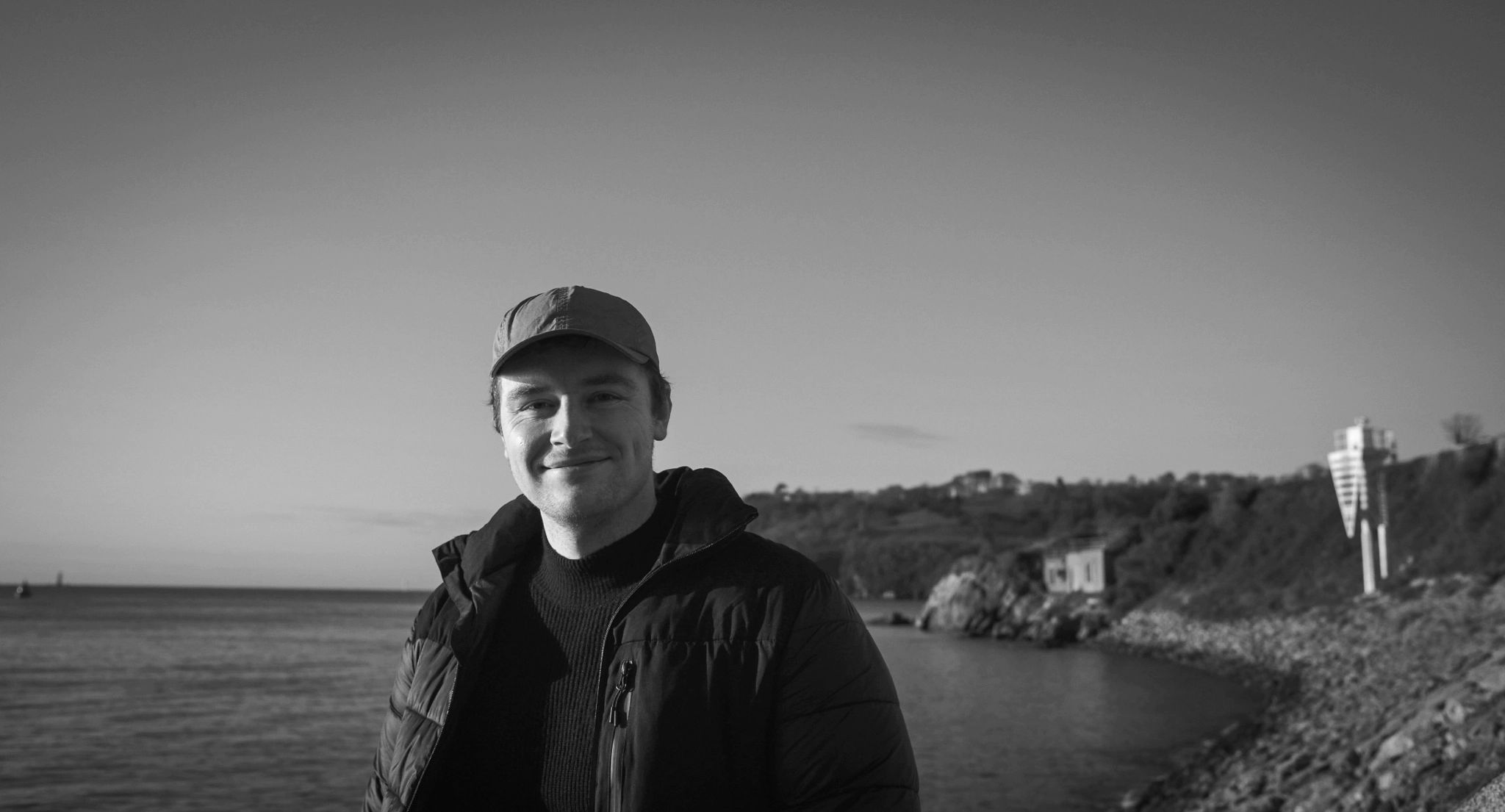
Who Is He
The Man Who Thinks CSS Is a Liberal Art
Robin Rendle is a designer at Apple, a writer of unusual range, and the kind of person who will stop mid-conversation to argue - convincingly - that the way a paragraph sits on a screen is a moral question. He does not treat type as decoration. He treats it as argument. Every letter-spacing decision, every line-height, every choice of serif or sans is, for Robin, a position staked in the ongoing negotiation between ideas and the human beings who receive them.
He grew up in Britain, made his way through an English Literature degree at Plymouth University, then discovered that what he actually wanted to do with words was not just read them but arrange them. Beautifully. Precisely. Defiantly. That led him to the University of Reading's Department of Typography and Graphic Communication - the closest thing to a typographic monastery that exists in the English-speaking world - where he earned an MA surrounded by metal type, wood engravings, type posters, and artifacts from the Bauhaus. He describes the experience as "like stumbling into a typographic time machine." He never really left that room, even after he graduated.
The web caught him next. Not as a medium for displaying content, but as a medium for publishing - for owning the writing, the design, the domain, the whole chain from thought to reader. He launched robinrendle.com in 2014 and has published on it with remarkable consistency ever since, accumulating more than 900 notes on subjects that range from CSS architecture to the texture of afternoon light to the strange melancholy of a poorly set page. The site runs on Eleventy and deploys in about a minute. He considers this a point of principle, not a technical convenience.
"Typography is difficult and beautiful, and on the web it is so very fragile."- Robin Rendle
The Career
From CSS-Tricks to Apple
In 2014, CSS-Tricks founder Chris Coyier gave Robin his first writing opportunity on the site. What followed was eight years as a staff writer - hundreds of articles, a widely-read newsletter, and a reputation as someone who could explain the most abstract front-end concepts with the fluency of someone who actually enjoys thinking out loud. Robin credits this period with shaping his entire professional identity. "CSS-Tricks shaped my twenties and early thirties," he has said, "and I am endlessly thankful."
Alongside the writing, Robin built a product design career that moved through the most interesting corners of San Francisco's tech landscape. Gusto, where he arrived in 2016, gave him a first serious taste of product work at scale. Sentry followed in 2020, where he spent three years thinking about developer tools and the peculiar challenge of making technical interfaces feel like they were built by someone who gave a damn. Retool came next in 2023 - another designer-tool problem, another set of constraints to work against.
Then, in 2025, Apple. The company that has, for decades, had more opinions about typography than nearly any organization on earth. For someone who earned an MA in type and spent a decade arguing that CSS is a liberal art, the posting feels less like a career move and more like a logical conclusion.
In parallel with all of this, Robin launched The Cascade in 2024 - a member-supported newsletter and blog at csscade.com dedicated to the past, present, and future of CSS. Priced at $10 per year, it is less a business than a statement. The first issue opened with the thesis: "CSS is a liberal art." The subscriber who reads that and doesn't understand what he means probably won't subscribe. The one who does will subscribe for years.
The Writing Life
Writing to Think, Not to Communicate
Robin makes a distinction that not enough writers make. He does not write primarily to communicate. He writes to figure things out. "The best writers I know don't care much for writing as communication as much as they do writing for figuring things out," he has said, and this is not a clever paradox - it is a description of his actual process. He takes notes constantly through the day using iA Writer, accumulating what he calls "a ton of terrible notes," then edits them later: early mornings, noisy cafes, the gap between the idea and the version that gets published.
This process has produced over 900 notes since 2014, along with essays that circulate long after publication. "The New Web Typography," published in 2016, remains one of the sharper arguments for taking type seriously on the web. It opens against the backdrop of Jan Tschichold's 1927 work and arrives at a conclusion both practical and defiant: "The new web typography demands to be seen. Bad typography is better than none at all." Which is to say, commit. Half-hearted type is its own failure mode.
The writing is never purely technical and never purely personal. It holds both. A piece about CSS custom properties might turn, without warning, into a meditation on craft. A piece about a book he's reading might suddenly illuminate something about design systems. The range is not restlessness - it is coherence from a different angle. Everything connects to the same underlying obsession: how ideas become visible, how words find form, how the interface between thought and reader is made and unmade by every decision a designer makes.
He maintains his blog as what he calls a "me-space" - a live journal in the original sense, a place to think in public without the performance that social media demands. He is active on Bluesky as the traditional platforms have faltered, but the personal site remains the canonical version of Robin Rendle on the internet. It does not have a comments section. It does not have a share count. It does not have ads. It has writing, and it has been updated, on and off, for more than ten years.
"The best writers I know don't care much for writing as communication as much as they do writing for figuring things out."- Robin Rendle
The Philosophy
CSS as a Liberal Art
There is a version of web design that treats CSS as a necessary annoyance - a set of declarations you type until the thing looks right, then stop thinking about. Robin is not from that tradition. His MA at Reading gave him a different baseline: type has history, weight, argument. Every typeface carries within it the decisions of the person who drew it and the context in which it was first used. That same logic applies to CSS. The cascade is not a bug you work around. It is a system of thought, and it rewards thinking about.
"CSS is a liberal art" is not a provocative claim for its own sake. It is an observation that the skills CSS demands - understanding context, managing inheritance, reasoning about systems, attending to visual rhythm and hierarchy - are the same skills a well-educated person brings to any domain. Typography is difficult and beautiful; on the web, it is fragile. Fragile things require care. Care requires attention. Attention requires thinking of it as worth your time.
His contributions to Fonts in Use, the definitive resource for typographic attribution on the internet, place him in a community of people who believe that documenting what typefaces have been used and how is an act of cultural preservation. His years at CSS-Tricks built a public record of how CSS thinking evolved through the 2010s and into the 2020s. The Cascade is where that record continues, now free from the editorial constraints of a larger publication, written on his own terms at $10 per year for anyone who shares the interest.
Achievements
What He's Built
Published 900+ notes and essays on robinrendle.com since 2014 - one of the most sustained personal publishing projects on the independent web.
Staff writer at CSS-Tricks for eight years, writing hundreds of articles on CSS, design systems, and front-end craft.
Founded The Cascade (csscade.com) - a member-supported newsletter and blog dedicated to CSS as a discipline.
MA in Typography & Graphic Communication from the University of Reading - one of the world's leading programs for type design.
Maintained an ad-free personal website for over a decade - a rare act of principle in an era of monetization pressure.
Contributor to Fonts in Use, the definitive typographic attribution and reference site.
Career Path
How He Got Here
English Literature, Plymouth University. Found the web as a publishing platform and never looked back.
MA in Typography & Graphic Communication, University of Reading. Surrounded by metal type, Bauhaus artifacts, and people who argued about letterforms for sport.
Launched robinrendle.com. Began writing for CSS-Tricks after Chris Coyier offered him his first opportunity.
Joined Gusto as Product Designer. Published "The New Web Typography" - widely cited essay on type and the web.
Joined Sentry as Product Designer, eventually becoming Senior Product Designer.
Ended eight-year run writing for CSS-Tricks after DigitalOcean's acquisition.
Joined Retool as Senior Product Designer.
Launched The Cascade (csscade.com) - a member-supported CSS publication at $10/year.
Joined Apple as Software Designer. The company most famous for caring about type, and the man most famous for caring about type, in the same building.