Rob Coppedge started learning venture capital in a file room. He was an undergraduate intern at Capitol Health Partners in Washington, D.C., with little understanding of the business he had entered. The familiar investor origin story tends to begin with a brilliant prediction. His begins with paperwork. It is a useful introduction to someone whose later work would depend on understanding how organizations function when the presentation is over.
He stayed to learn. Instead of leaving for business school, he studied for the Chartered Financial Analyst exams and earned his charter. Some of his education came from difficult investments, working alongside management teams and boards as companies attempted turnarounds and changed direction. Those assignments put him close to the awkward part of investing: what happens after money has arrived and the original plan needs repair.
Today, as chief executive of Echo Health Ventures, he has made the relationships around an investment central to the business. He helped found Echo in 2016. Ten years later, the firm’s structure offers a revealing portrait of its leader. It brings multiple corporate partners into the work, gives their executives a place in decisions, and spends effort making the connections useful. Coppedge has chosen a crowded table.
A history student meets the committee
Before the investment committees came student organizing. Coppedge graduated from Georgetown University in 1997 with a degree in history. During his undergraduate years, he participated in an effort to revive the Yard, a student organization intended to give campus groups a stronger collective voice. Members were frustrated with administrative obstacles and the limits of existing student representation.
“They’ve had to deal individually with the administration,” he said of student organizations. The proposed remedy was to bring them together. The coalition included publications, sports clubs and the Student Activities Commission. Its initial ambition was to work alongside the existing student association as an advocacy group. A university, apparently, can provide a thorough introduction to organizational politics without charging for an MBA.
The attempt did not achieve the reform its participants wanted. Coppedge later identified leadership succession, rivalry and insufficient power among the reasons the movement dissolved. That detail matters. His early involvement in collective action includes an account of its failure, rather than a tidy victory. Bringing people together leaves a second problem: how to give their assembly enough continuity and authority to accomplish anything.
There is no need to claim that a campus campaign produced his investment philosophy. The resemblance is interesting enough. Across both episodes, separate groups seek a way to act together, and the structure of their relationship becomes part of the problem. For Coppedge, the subject of who gets represented at a table appeared well before he became responsible for one.
“It was a priceless education in the hands-on side of venture investing.”
Rob Coppedge, reflecting on his early career, 2020
The work between the transactions
Coppedge’s early career at Capitol ran from 1997 to 2008. His responsibilities included watching portfolio companies’ operations, finding investments, building strategic relationships and helping with fundraising. He subsequently became the founding partner of Seattle-based Faultline Ventures, working with early-stage businesses and strategic investors. The sequence put both company operations and investor relationships within his working range.
His interests also extended into the arts. He chaired the Phillips Collection Contemporaries Steering Committee from 2001 to 2003 and served on the development committee of the museum’s Board of Trust. The museum connection adds a different institution to a career usually described through companies and capital. Here was another organization with a constituency to engage and relationships to maintain.
In 2010, he joined Cambia Health Solutions to build a direct investment program. Its first investment followed in 2011. He later became president of Cambia’s diversified business unit, responsible for wholly owned operating companies as well as venture and private equity investing. Under his leadership, Cambia invested in nearly 20 companies. His remit included the businesses themselves, extending beyond the transaction that put them in a portfolio.
- 1997Graduates from Georgetown; begins his Capitol career.
- 2010Joins Cambia to build its direct investment program.
- 2015Co-founds the Cambia Grove in Seattle.
- 2016Becomes CEO at Echo’s founding.
- 2026Reflects on Echo’s first decade.
A place to meet before there is a deal
In 2015, Coppedge co-founded the Cambia Grove, an innovation hub in Seattle. Its design gave entrepreneurs and established organizations a place to encounter one another. Before its opening, he described a space that would be accessible and open, with room for meetings, events and some resident startups. It would operate as a shared gathering place.
The distinction was practical. A startup could talk to an established organization about a problem, explore a possible answer and, where interests matched, find a setting to test it. An introduction could lead to useful work. The idea placed conversation before commitment, allowing people to discover whether they had something worth doing together.
That seems modest until one considers how many business relationships begin at the wrong end: a polished solution looking for someone to buy it. The Grove’s arrangement started with the people who understood a problem and the people who might build an answer. Coppedge’s contribution was partly architectural. He helped create a place where that exchange could occur.
Two coasts, one operating model
Echo brought a related idea into investing. Founded in November 2016 by Cambia and Mosaic Health Solutions, the strategic investment arm of Blue Cross and Blue Shield of North Carolina, it combined programs from opposite sides of the country. Coppedge became its chief executive. Separate teams needed to develop a shared strategy and a common way of working.
At Echo’s fifth anniversary, he remembered the excitement of setting out together and acknowledged how much the team had needed to learn. He credited its members for pulling together and executing, and thanked board and investment committee members for their involvement. The recollection gives the founding some texture. A joint venture may arrive with signatures; a working organization has to be built afterward.
Echo’s founding investment charter addressed familiar reservations about corporate investors: slow decisions, uncertain incentives and the risk that an entrepreneur becomes subordinate to a corporation’s acquisition plans. Its proposed response involved rethinking structure, objectives and commitments. Corporate partners could bring market knowledge and opportunities to test ideas, alongside money. The obligation was to make those advantages usable.
Invest in a company and support its development.
Connect portfolio businesses with corporate partners.
Include partner executives in governance and investment work.
The crowded table is deliberate
As Echo approached its tenth anniversary in 2026, Coppedge explained how closely the venture platform had been woven into its partners’ organizations. A professional services arm places resources inside those businesses. Chief executives and chief financial officers participate in the investment committee. The board includes partner executives and independent directors drawn from the participating organizations.
That arrangement invites complications. More participants bring more calendars, more priorities and more opportunities for disagreement. But participation also gives those people a direct relationship with the venture operation. They can understand its work through involvement in it. Coppedge describes the number of people in Echo’s governance as an intentional advantage.
“We built a governance model that involves a lot of people… it’s a feature, not a bug for us.”
Rob Coppedge, 2026
The organization expanded to include partners associated with Arkansas Blue Cross and Blue Shield and BlueCross BlueShield of Tennessee. By 2026, Echo was describing an alliance of four corporate partners. Coppedge’s job consequently involves maintaining a common enterprise among organizations that retain their own leadership, priorities and responsibilities. Agreement must be renewed as those circumstances change.
The emphasis on relationships has a patient quality. In his 2020 reflections, he described trust between investors and corporate colleagues as something requiring continued attention as executives, priorities and politics shift. The formulation recognizes a familiar business reality: yesterday’s enthusiastic sponsor may have a different job tomorrow. An investment model needs a life beyond one person’s enthusiasm.
A relationship has to become useful
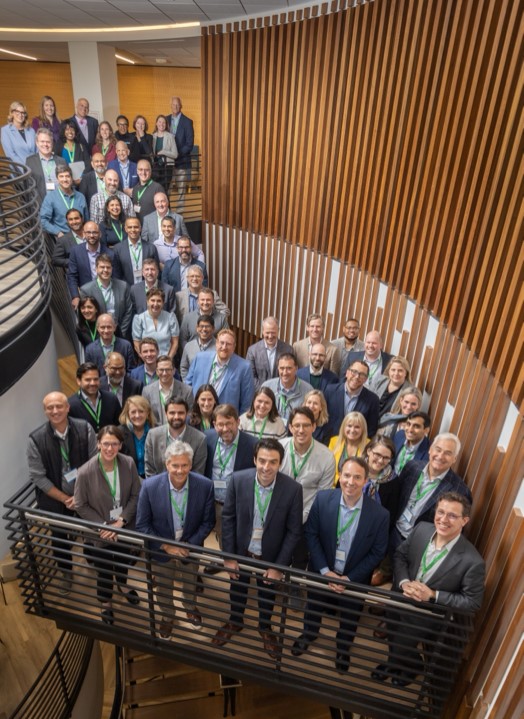
Echo’s 2024 Summit in Durham brought together about 90 leaders over two days. Attendees included portfolio company leaders, representatives of the four corporate partners and Echo’s team. The program allowed time for one-to-one discussions about potential partnerships, while organizations already working together discussed their successes and difficulties. The gathering gave the model a physical form.
Coppedge urged participants to invest in relationships early so they would have trust when they began working together. There is an unglamorous demand inside that advice. An investor has to help people navigate organizations, find the relevant colleagues and understand what a prospective partner actually needs. A contact list is only the beginning of that work.
His interest in making professional knowledge transferable extends beyond Echo. In a 2021 discussion about the GCV Institute, he argued for corporate investors to learn together and share approaches rather than develop their programs separately. The ambition included stronger networks and shared working methods. It made room for a profession to improve through collective learning.
Recognition has accompanied the work. In 2024, Coppedge appeared on Global Corporate Venturing’s Powerlist for the fifth consecutive year. In 2026, he was included in its CVC Titans recognition. The longer-running story, however, remains the organization he has helped keep operating. Echo’s tenth anniversary offered a chance to examine whether choices made at the beginning had held up over time.
What survives the anniversary
In his letter accompanying Echo’s 2025 impact report, released in 2026, Coppedge described expanding commercial relationships across all four partners for a third consecutive year. The report counted more than 20 new or expanded relationships during 2025. He also looked ahead to Echo’s second decade, with plans to extend its capabilities and practices. The next chapter involves improving an existing organization.
Seen across his career, the continuity is striking: student groups looking for representation, portfolio companies needing operational help, entrepreneurs seeking a place to meet established organizations, and corporate partners developing a shared investment platform. Each episode turns on how people gain access to one another and how that access becomes productive. His history degree and CFA charter sit comfortably beside that recurring organizational question.
The file room offers an apt starting point. Coppedge learned the business close to its records and then closer to the companies when circumstances became difficult. He now leads a firm whose design asks its partners to remain involved. A crowded table can be inconvenient. His career makes a considered case for doing the work of keeping people at it.