Rishi Yadav was writing a book, and someone at home was keeping score. In the acknowledgments to his 2015 Spark Cookbook, he thanked his eight-year-old son, Vedant, for tracking his progress every day. The book concerned distributed computing. Its author had acquired a rather concentrated system of supervision.
He also thanked his wife, Anjali, for tolerating the extra hours, his business partner Sudhir Jangir for leading the big data work, and colleagues who kept operations moving while he wrote. A technical book arrives with one name on its cover. Yadav's thank-you list offered a useful correction to that accounting: there were people making the time, checking the work, and keeping the business running.
That small domestic detail is a good entrance to a career usually described through company names. Yadav is the founder and CEO of InfoObjects, a software and AI consulting business. He has written two Apache Spark books, co-founded Roost, and joined the founding community of Plaksha University. His work repeatedly lands in the space where technical ambition acquires obligations to other people.
The mathematics was for fun
Yadav graduated from the Indian Institute of Technology Delhi in 1998 with a bachelor's degree. His education did not stop at the point where a qualification could be framed. He later took PhD-level courses at Stanford in probability, randomization, and advanced mathematics. His Roost biography supplies a particularly pleasing explanation for the additional coursework: he did it for fun.
There are easier recreational activities than advanced probability. Still, the detail makes sense alongside his work in algorithms and analytics. It suggests a taste for the machinery beneath an answer, rather than satisfaction with the answer alone. Coursework of that kind asks how a result behaves when conditions change, or when certainty is unavailable. Those are useful habits to bring into software businesses.
His early jobs also placed him close to the plumbing. He worked on enterprise data integration at Fiorano Software, performance optimization at Cisco, and payment integration at Wells Fargo. At Netflix, his work was in algorithms and analytics. These were different settings for a related class of problem: information has to move, systems have to respond, and someone eventually has to check the result.
It is easy to give this sequence a glamorous retrospective gloss. The job descriptions themselves are more interesting. Payments, integration, performance, analytics: each puts an engineer in contact with constraints that a polished demonstration can conceal. Yadav's later businesses would keep dealing with those constraints, even as the vocabulary around them changed.
A cookbook for an industrial kitchen
InfoObjects was founded in 2005. Its early identity centered on helping businesses work with data, including open source tools and Apache Spark. The company gave Yadav a setting in which the questions were practical: how to get a system working, how to make information useful, and how to fit new technology into an existing business.
In December 2014, he appeared in the Silicon Valley Business Journal's 40 Under 40 class. The following year came Spark Cookbook, published by Packt. Its format suited the work. A cookbook promises procedures someone else can use. The reader is allowed to arrive hungry for a solution, without first becoming a disciple.
The 2015 volume covered Spark Core, SQL, streaming, machine learning, and graph processing through more than 60 recipes. Among its tasks were setting up development environments, running interactive queries, and building a recommendation engine. Those subjects connect the abstract appeal of data analysis to things a developer can actually attempt at a keyboard.
Consider the recommendation engine. As a phrase, it can sound like the intelligent heart of a consumer product. In a cookbook, it becomes a sequence of decisions and instructions. The change in scale matters. Readers get a way to inspect the work, repeat it, and discover where their own implementation differs. Explanation becomes a tool rather than a performance.
In May 2017, Yadav followed with Apache Spark 2.x Cookbook. The 294-page book expanded the practical territory, from cloud deployment and development tools to security and operating distributed applications. Its contents included Databricks, Amazon EMR, and the working parts of a Spark environment. Even the table of contents has the feel of someone opening the cupboards before dinner.
There is a quiet discipline in returning to a subject for a second book. Software changes; the instructions must change with it. A reader who succeeded with an earlier version still needs help with the next one. The follow-up places Yadav in that ongoing exchange between a technology and the people responsible for using it.
The acknowledgments grew more entertaining, too. Vedant and Yadav's niece, Kashmira, helped keep the book on track. Jangir contributed recipes on enterprise security. And Sparky, the family dog, received thanks for keeping the author company on late nights. Distributed systems had, apparently, found a local support team.
The awkward interval before release
Roost, founded in 2019, moved the focus toward software development and testing. Yadav co-founded it with Jangir, who served as CTO. Their partnership connects the data engineering work of InfoObjects to a product concerned with what happens when a change in code needs to become a usable release.
Roost's testing platform uses generative AI to turn user stories into test cases and supports contract and acceptance testing. It also offers preview environments. These are modest-sounding jobs with considerable influence over a team's day: a change needs somewhere to run, someone needs to inspect it, and the release needs evidence that it behaves as intended.
A test has an unromantic social role. It asks a proposed improvement to keep its promises. The feature may look persuasive on its own, but its neighbors in the application also have a vote. Building tools for that process puts the founder close to the inconvenient questions that appear after the initial excitement.
Roost's leadership group includes Jangir alongside Yadav; its board also lists Mayfield Fund's Patrick Salyer. The long-running engineering partnership is a visible connection across their ventures. It gives the career a human continuity beyond the succession of technical subjects. Data processing, testing, and AI may change the agenda; collaborators carry experience from one setting into the next.
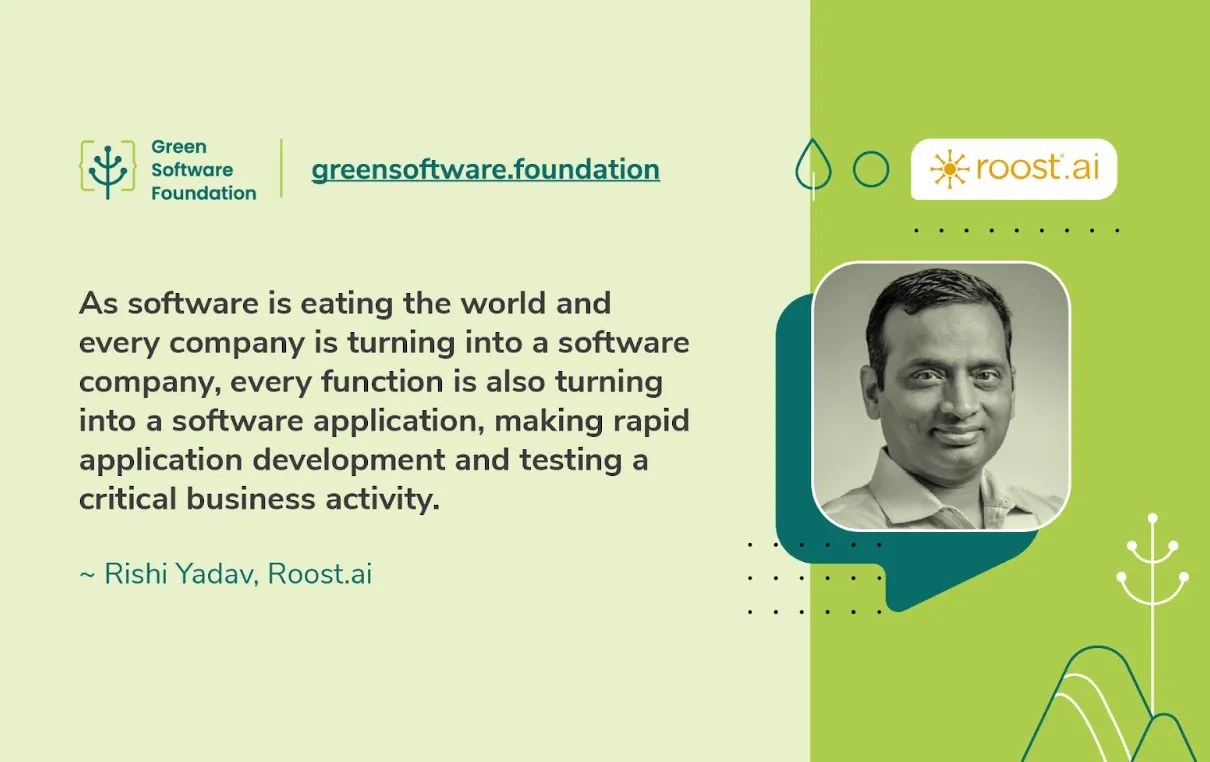
In a February 2023 interview about green software, Yadav explained how Roost's environments worked on demand. Testing could run when required, rather than leaving computing resources continually active. He described the goal as reducing the friction before release, with lower resource use accompanying the shorter process.
“These environments wake up, do their job, and then go back to sleep.”
Rishi Yadav, February 2023
The appeal of the description is its plainness. Servers are given a working day and permission to leave. Yadav connected that design choice to a broader wish for engineering teams to consider resource use while creating software. His argument reached beyond efficient code to the routines and incentives around development.
Leaving room for the next engineers
Plaksha University lists Yadav as a founder and identifies him as Roost.ai's founder and CEO. It also records his IIT Delhi education. His participation places him in a collective institution-building effort alongside other entrepreneurs and business leaders, including Jangir, who is also part of Plaksha's founding group.
A book lets an engineer share a method with readers he may never meet. A university extends that relationship into a place where people can learn, question, and work together. The two forms have different timescales. They also share a dependence on what learners can eventually do for themselves.
For Yadav's story, the university connection broadens the cast. His professional life includes customers and collaborators, but also future engineers. There is a satisfying symmetry between a graduate returning to mathematics for enjoyment and a founder helping build an institution devoted to learning. Neither activity fits neatly into a product release calendar.
When the answer needs an examiner
InfoObjects now describes Yadav's work around AI transformation, data strategy, and enterprise delivery. He works with customer executives and engineering leaders on architecture, governance, and the operating arrangements for production AI. The responsibilities sound familiar beside his earlier career, even when the models are new.
Cogence.ai also lists him as founder and CEO, with Jangir as founder and CTO. Its focus is the data behind reliable AI: synthetic datasets, benchmarks, evaluation frameworks, and expert-validated training data. That work asks how an AI system's behavior can be measured and improved before people depend on it.
Read together, the ventures suggest a continuing interest in the conditions around a result. A data pipeline needs useful inputs. A release needs testing. A model needs evaluation. These are separate technical tasks, but each resists the temptation to declare success after the first convincing output.
His public writing has followed the move into generative AI. On Medium, he describes a blog focused on that interest and on Roost's testing platform. His LinkedIn newsletter, Agentic AI Showdown, ranges into questions about the industry itself. In July 2026, an edition on open weights considered the competing claims of inventors and the public over distribution.
That is a broader question than how to configure a cluster. It still concerns the terms under which technology reaches other people. Who can use it? Who sets the conditions? What keeps the next invention worth making? Yadav's writing has moved outward from instructions to arguments, while retaining an interest in what happens after something has been built.
The career has its dates and titles. Its more memorable details are smaller: mathematics taken for pleasure, a child checking a manuscript's progress, colleagues protecting writing time, a dog sharing the late shift. They make the work legible as a human undertaking. Somewhere between the breakthrough and the finished product, people still have to help one another get the job done.