Late in the 2020 Gator Bowl, Riley Lovingood fired the snap for the extra point that put Tennessee ahead of Indiana. The ball went up. The kick went through. Lovingood hurt his knee at the end of the play. Then, with the game still requiring one more clean exchange, Tennessee needed him again. He returned for a crucial punt snap in the final minutes. The record book gives the episode a few spare words. The image it leaves is much larger: a specialist finishing the sequence after his part was supposed to be over.
That sequence makes a useful introduction to Lovingood's second career. He is now the CEO and co-founder of PAYRA, a Nashville payments company that handles another underappreciated exchange: the distance between an invoice going out and money arriving in the right account. Its customers are construction suppliers, distributors and trade businesses whose accounting software may be decades old. Their systems are rarely pretty. They are also too important to replace on a whim.
Lovingood's route from Neyland Stadium to accounts receivable passed through professional football, a U.S. Senate office and local public service. It can look like a collection of sharp turns. Read by responsibility rather than job title, it has a steadier rhythm. He keeps choosing positions where one reliable handoff allows a much larger system to work.
01 / SpecialistThe job designed to disappear
Lovingood grew up in Hendersonville, Tennessee, in a football family. His father, Jeff, had served as chaplain for the Volunteers under Phillip Fulmer. At Beech High School, Riley snapped for the 2012 state championship team and played alongside future Tennessee running back Jalen Hurd. In March 2014, he announced that he had committed to Tennessee on a full scholarship. Long snappers do not often receive that treatment. The offer said something about how seriously the program took a job spectators tend to notice only after a mistake.
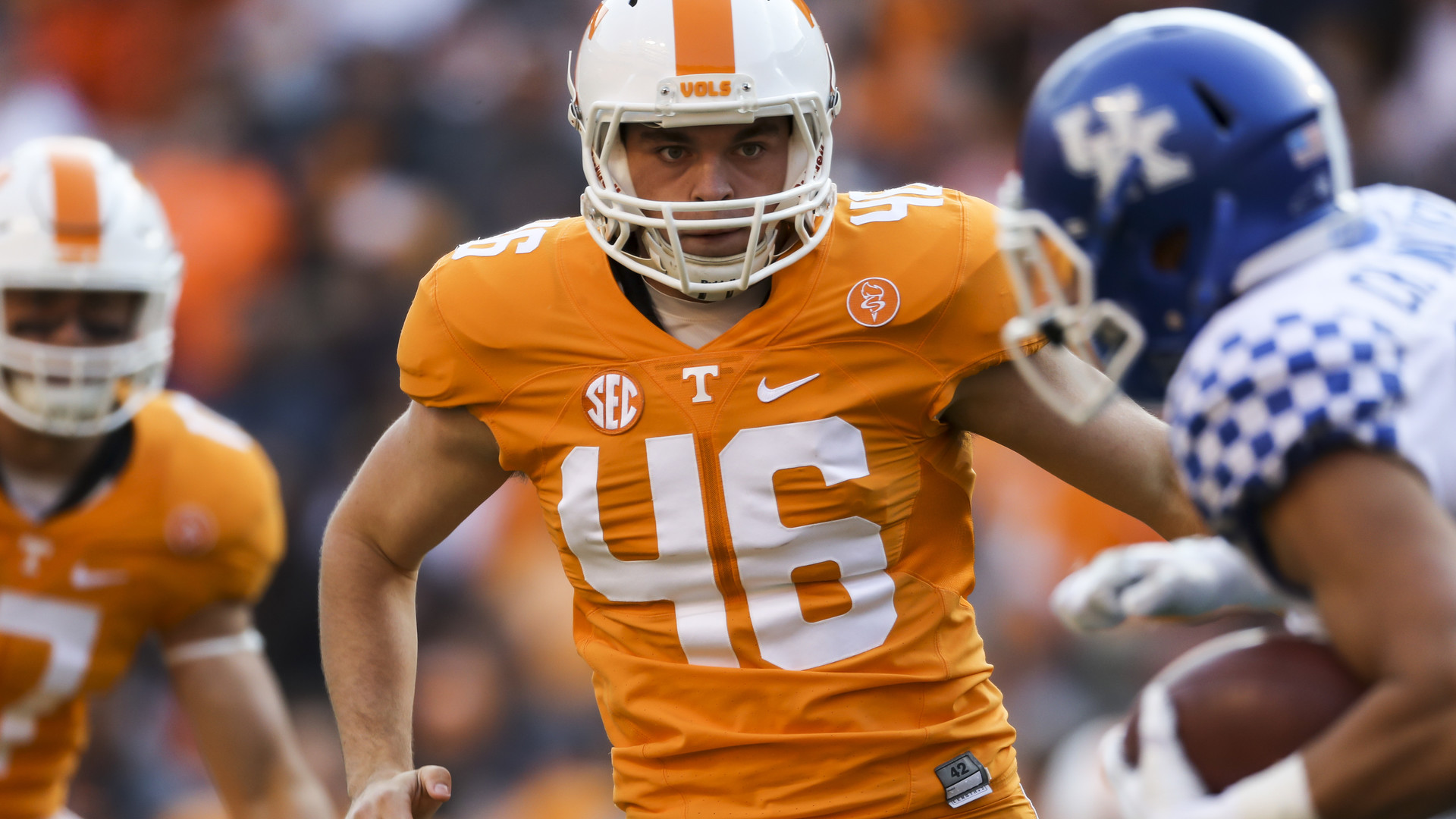
He redshirted in 2015, then became Tennessee's primary long snapper for punts. Against Georgia in 2016, he released after the snap, raced downfield and downed the ball at the six-yard line. The play earned him SEC Co-Special Teams Player of the Week. He started on punts again in 2017 and, as a senior in 2019, handled every game while working with two punters and kicker Brent Cimaglia. He also served as a captain against Georgia.
The academic work moved alongside the football. Lovingood earned a bachelor's degree in sport management in 2018 and completed a master's degree in communication studies in December 2019, before his final college game. He represented Tennessee athletics at SEC student-athlete meetings and later entered the National Football Foundation's Hampshire Honor Society, which recognizes players who distinguish themselves academically while completing their college careers.
The long snapper's paradox is that excellence looks uneventful. A punter catches the ball without adjusting. The protection forms on schedule. The crowd's attention travels downfield. The specialist learns to take satisfaction in an outcome that directs attention elsewhere. That is not a bad apprenticeship for infrastructure.
02 / Field workFrom game days to constituent days
After Tennessee, Lovingood went into politics. He worked as a regional field director in Knoxville for Bill Hagerty's 2020 U.S. Senate campaign. When Hagerty took office in 2021, Lovingood joined the senator's Knoxville office as a field representative. He carried that role until late 2023, serving an East Tennessee territory and showing up at the sort of local events where a federal office meets everyday civic life.
In November 2023, the Knox County Commission appointed him to the county Board of Zoning Appeals for District 4. The board hears requests about property variances, enforcement and stormwater decisions. Its work is procedural and local, measured in setbacks, maps and the particulars of a parcel. Lovingood resigned in 2024 before the end of the term. The episode adds another kind of system to the résumé: one where rules, trust and precise judgment matter more than performance.
Football had one more chapter. In 2023, Lovingood signed with the Pittsburgh Maulers and played all 10 USFL games at long snapper. The Maulers reached the league championship game. By then he had moved between the compressed pressure of a snap and the patient work of regional public service. PAYRA would combine the pace of one with the institutional constraints of the other.
03 / The overlooked exchangeWhere the invoice gets stuck
Lovingood founded PAYRA with Thomas Cecil in 2024. Cecil brought years in payments and product; Lovingood became chief executive. Their early search moved across business verticals before they concentrated on a stubborn B2B problem. Construction companies and material suppliers could send an invoice, and they could sometimes take a card, but connecting that payment back to the right customer, job and open invoice often required people, spreadsheets and follow-up.
“We're providing more access to make it easier for them to pay ... straight from the invoice on their phone, on their computer, right there.”Riley Lovingood, on PAYRA's customer problem
The obstacle was not merely a missing pay button. Many of these businesses run enterprise resource planning systems the wider software world has barely heard of. Concrete producers, lumber yards, HVAC companies and electrical suppliers organize purchasing, inventory, jobs and accounting inside those systems. Replacing one can be expensive and disruptive. Teaching employees a second system creates its own tax.
PAYRA's answer is to live inside the existing ERP. It sends invoices by email or text with a payment link, accepts card or bank payments, applies the cash to the open invoice and synchronizes the result back to the accounting record. The company also offers reminders, customer portals, credit management and terminals. The interface matters. The missing connection matters more.
There is a practical respect in that design. PAYRA's customers have spent years making their businesses work around imperfect tools. A founder can treat those habits as backwardness, or as accumulated knowledge. Lovingood and Cecil chose the second reading. Their product promise is not a grand reinvention of the finance department. It is fewer days waiting, fewer overdue balances and fewer hours reconciling payments by hand.
04 / Large ticketsThe strange scale of an ordinary payment
The trades make familiar payment products behave strangely. PAYRA's co-founders have said its average credit-card payment is about $3,500. Lovingood added that transactions above $400,000 were not unusual to see. A lumber order or concrete job can turn an everyday card swipe into a serious underwriting event. Consumer-oriented risk controls may pause or reject a transaction that is entirely normal for the buyer and supplier.
Card transactions at a scale PAYRA encountered in the construction market.
That specificity is PAYRA's wedge. The company is not trying to serve every merchant. It is learning the payment behavior, old software and regional structure of particular trades. Lovingood has pointed to ready-mix concrete as an example: thousands of producers dominate compact territories because wet concrete cannot travel indefinitely. The market is fragmented by physical reality. Software built for it has to understand the map as well as the money.
The founders financed the company themselves for roughly two years. In February 2026, PAYRA announced a $15 million growth-equity investment from Edison Partners, its first outside capital. The money was aimed at expanding the sales organization and reaching more verticals. Months later, Lovingood announced new Nashville hires across implementation, customer success and sales development, followed by Leigh Gross joining as chief revenue officer.
Taking growth capital changes a founder's snap count. The company has more people, more customers and more integrations depending on the exchange. Lovingood has written that PAYRA operates on “trust and execution” because that is what its customers deserve. The phrasing could have come from special teams. It also fits a finance department where a failed handoff can tie up cash needed for payroll, inventory or the next job.
05 / Follow-throughBuild where attention runs out
Lovingood's public ambition is plain: improve cash flow for the businesses that run America. PAYRA's site gives those businesses concrete form - lumber yards, ready-mix plants, mechanical contractors and distributors. They occupy the industrial road outside the glossy startup map. Their back offices carry decades of workarounds. Their invoices are large. Their patience for a fashionable migration is small.
The opportunity is to notice where everybody's attention stops. A customer sees a bill paid. The finance team still has to match it. A crowd sees a punt. Somebody had to send the ball through a narrow window before the play could exist. Neither task is romantic up close. Both become valuable when the surrounding system depends on them.
At Tennessee, Lovingood's defining plays began with the snap and continued downfield. The Georgia punt ended at the six because he followed the exchange. The Gator Bowl ended with another clean snap after he returned. PAYRA is built on a similar refusal to treat the first motion as the finished job. Sending an invoice is not collecting it. Accepting a payment is not reconciling it. The work is complete when the whole chain holds.
There are louder positions in football and shinier corners of fintech. Lovingood has spent his career in the consequential space between them, where precision earns trust and the desired result is that everyone else can keep moving.