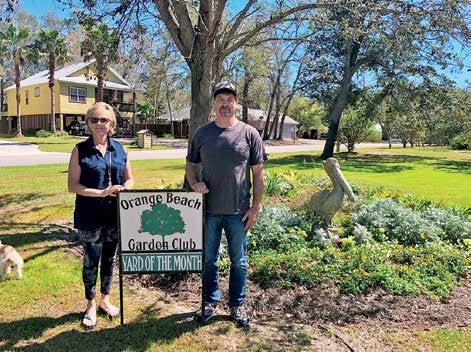
The photograph is pleasantly ordinary. A large tree makes a pool of shade. A yellow house sits across the street. Flower beds occupy the foreground with the confidence of plants that have survived both weather and human enthusiasm. Near the center stands Ricky Deblieux, beside a sign from the Orange Beach Garden Club. In March 2021, the yard he shared with his wife, Audra, had been named the club’s residential Yard of the Month.
It is a domestic scene, sunny and settled. Yet Deblieux’s professional life points in the opposite direction, away from the trimmed beds and out toward the industrial Gulf. His profile identifies him as a Chief ET at Rowan, the offshore drilling company, with work connected to the Gulf of Mexico. The initials are compact because technical work tends to prefer compact things: ET means electronic technician, and “Chief” marks responsibility rather than corporate ceremony.
Those two pictures, the offshore specialist and the gardener in a dark T-shirt, provide the outline of a life built around upkeep. A garden and a rig have almost nothing in common as objects. As demands on attention, however, they recognize each other. Both contain systems. Both answer neglect with consequences. Both improve when somebody notices small changes before they become large ones.
A title built for emergencies that never arrive
Offshore drilling is crowded with titles that sound like they were forged along with the machinery: toolpusher, derrickhand, motorman, subsea engineer. Chief ET belongs to this blunt vocabulary. It places electronics inside a chain of operating responsibility. Modern rigs depend on controls, communications, sensors and electrical interfaces. Every part has its own manuals and tolerances; every part also lives inside a larger machine whose appetite for continuity is considerable.
Deblieux’s precise daily duties are his own, but the professional world named by his title is easy to recognize. A technical fault offshore is rarely just an interesting puzzle. Distance changes its cost. Salt, vibration and continuous operations make poor companions for delicate equipment. Diagnosis must be methodical, repairs must be documented, and the line between an electronic symptom and a mechanical cause may refuse to behave politely.
That is the peculiar bargain of maintenance. Failure produces a story immediately; prevention often produces a normal Tuesday. The experienced technician works toward an absence: no alarm, no stoppage, no frantic search for a part when the weather is turning. Competence becomes visible indirectly, in continuity.
Three years in Crossett
The trace begins in 1992 at Forest Echoes Technical Institute in Crossett, Arkansas, where Deblieux studied through 1995. The school was designed around occupational education, the practical territory where theory has to meet a meter, a motor or a panel. Forest Echoes later joined the University of Arkansas at Monticello and became its College of Technology-Crossett. The old name survives in the résumés of people trained there.
The institution’s history matters because it locates Deblieux in a particular American pathway. This was education attached to regional industry and to the prospect of advancement through technical command. Crossett sat in a manufacturing landscape shaped by pulp, paper and process systems. The school taught for workplaces where controlled systems were not abstractions. A circuit diagram eventually had to correspond to a working circuit.
Three years is a substantial foundation, but technical education never truly stops at graduation. Equipment changes. Interfaces are replaced. Manufacturers revise their procedures. A person who began training in the early 1990s and later carried a chief title would have worked across generations of electronics. The durable skill is not memorizing one panel. It is learning how to approach the next one without bluffing.
Rowan, before the name changed
The company name on Deblieux’s profile requires care. Rowan Companies was a Houston-based offshore driller, not the New York ear-piercing retailer that now owns the convenient web address. The older Rowan operated jackups and ultra-deepwater drillships. Its name belonged to steel, sea and contract drilling.
In April 2019, Ensco acquired Rowan’s issued share capital through a court-sanctioned transaction. The combined business took the name Ensco Rowan. At closing, the legacy fleets included high-specification floaters and jackups, machines designed for different water depths but united by their reliance on crews who could keep layered systems operating far from shore.
Corporate language describes such events in shares, exchange ratios and synergies. Working lives experience them differently. A logo changes. Reporting lines move. An email domain may be retired. The equipment still presents its fault codes, and the day’s work continues under a revised name. Deblieux’s profile preserves “Rowan,” a perfectly legible marker of the organization in which his role was formed.
The merger also explains why a contemporary search can produce several Rowans and very little clarity. Here the geography supplies the correction. Gulf of Mexico experience, a Chief ET title and a technical-school education belong naturally to the offshore driller. Jewelry keywords do not. Sometimes biography begins with the clerical virtue of putting the right person in the right company.
The shore-side photograph
Two years after the corporate combination, Deblieux appeared in a local newspaper for a gentler reason. The Orange Beach Garden Club selected the home of Audra and Ricky DeBlieux as its residential Yard of the Month for March 2021. Club member Susan Grant joined him in the picture. The sign, with its hand-painted tree, occupies the foreground like a cheerful certificate.
There is no need to turn a garden prize into a theory of character. It is enough to look at what the photograph records. The lawn is green. Beds curve around established trees. Yellow and orange flowers interrupt the foliage. A pale dog appears at the far left, partially committed to the frame. Deblieux stands easily, one hand near the sign, wearing jeans, work boots and a baseball cap. Nothing strains for effect.
The award is small in scale and exact in meaning. Somebody had cared for this place. More than one person, certainly; the recognition belonged to Audra and Ricky together. A yard is collaborative even before the humans arrive, an unruly agreement among soil, weather, plants, animals and plans. The title “Yard of the Month” adds the neighborly pleasure of being noticed by people who understand the labor involved.
Maintenance as biography
Public profiles often favor beginnings and breakthroughs: the first company, the promotion, the grand unveiling. Deblieux’s outline suggests another organizing idea. His story is most coherent in the middle, among the repeated acts that keep systems sound. Technical school led toward industrial electronics. The Gulf made those skills operational. A chief title indicated accumulated responsibility. The garden supplied a quiet after-hours rhyme.
This is not the biography of a corporate celebrity. It belongs to the broad and consequential class of working lives that appear online as a few dates, a job title and perhaps one photograph. Their brevity should not be confused with smallness. Offshore drilling companies can announce billion-dollar combinations; their rigs still depend on named roles filled by individuals who understand what to inspect, what to question and when to stop pretending a troublesome signal will correct itself.
Deblieux’s record also crosses a familiar Gulf Coast boundary. Work lies offshore; life gathers onshore. Gulf Shores is both address and vantage point, a city whose name already describes its relation to the water. The industrial Gulf and the domestic coast coexist, close enough to share weather but separated by the rituals of departure and return.
In the garden photograph, the offshore machinery is absent. Its habits may be there in subtler form: observation, timing, the acceptance that maintenance is never finally complete. A plant grows past its border. A component ages. The next season arrives with a fresh list. Upkeep offers no concluding trumpet. It offers another morning in which the system, broadly defined, is still alive.
The record in four dates
Deblieux attended Forest Echoes Technical Institute in Crossett, Arkansas.
His professional profile lists Rowan, a Chief ET title and Gulf of Mexico work.
Rowan combined with Ensco, closing the chapter of Rowan as a standalone company.
Audra and Ricky DeBlieux received Orange Beach’s residential Yard of the Month recognition.
The dates do not pretend to supply a whole life. They do something more useful: they show a line without decorating it. Training. Responsibility. Institutional change. Home. In each setting, value accumulates through attention.
That may be why the ordinary photograph lingers. It catches a technical professional outside the technical world, beside the kind of result maintenance people know intimately. The work has already happened. The proof is standing there, quietly functioning.