Richard Williams remembers his house shaking when rocket engines were tested at NASA’s Marshall Space Flight Center. For a child growing up in Huntsville, the space program could announce itself through the walls. Long before it became part of his working life, it was part of the place he called home. It is an unusually physical beginning for a career in communication: the subject arrived before anyone had to explain it.
Williams eventually studied marketing at Auburn University. His route back to the space industry ran through exhibitions, account management, and marketing leadership. Today he is CEO of Media Fusion and president of its sister company, PCI Productions. The connection to NASA remains, though his working world concerns the people, messages, images, and support services surrounding technical achievement. A rocket can make itself heard. Explaining what it does requires another kind of work.
A deadline with 300 people attached
One revealing episode comes from the year Williams joined Media Fusion, 2007. Kate Gray, a client, recalled hiring him and the company to produce a short film for a statewide awards ceremony. Up to 300 executives were expected. Much of the material reached Williams late, while the organizers were occupied with other preparations. Anyone who has helped stage an event will recognize the arrangement: the date stays fixed while the ingredients acquire a lively independence.
Gray’s account emphasizes his contact with the organizers as the film was being made. They could carry on with their other tasks without worrying about the production. Her recommendation praises the result, but the communication along the way is the more telling detail. Before the audience saw anything, the customer needed confidence that the work was moving. A production assignment had become a test of whether another person could safely stop thinking about it.
That small episode gives the executive title some texture. It places Williams in a recognizable working relationship, receiving information, responding to a deadline, and keeping someone informed. There is no need to supply a dramatic meeting or an invented exchange. The circumstances are sufficiently familiar. The glamorous object is the finished film; the useful service also includes all the updates that never make it onto the screen.
Marketing, with an operations background
Williams’s earlier jobs help explain the range of his later responsibilities. His career includes vice president of operations at American Exhibition Services, senior account manager at Benton Newton & Partners, and director of marketing at Three Springs. Exhibitions, agency accounts, and a marketing department involve different settings, but each puts an idea in contact with practical constraints. Someone has to organize what will be delivered, understand who wants it, and keep the relationship functioning.
His Auburn education appears on his LinkedIn profile as 1985 to 1989, with Sigma Nu among his activities. The degree was a Bachelor of Science in Marketing. The subsequent work moved between the organization of a service and the presentation of a message. By the time Media Fusion became his professional home, he had experience on both sides of that connection. The career is easier to understand as an accumulation of responsibilities than as a single sudden reinvention.
In March 2018, he received the American Advertising Federation of North Alabama’s Silver Medal. The distinction recognizes contributions to advertising and the industry’s standards, alongside wider community responsibility. It belongs to Williams personally. The company’s awards and growth record are collective achievements, which matter for understanding the setting in which he worked. Keeping the two in view makes the portrait more accurate: a recognized advertising professional working within a business made of many specialties.
He joined a story already in progress
Media Fusion opened in 1995, with Tim McElyea among its founders. Its initial purpose was storytelling using the technology available at the time. A NASA assignment followed in 1999, when the company worked on explaining the X-37 aircraft. Those chapters preceded Williams’s arrival. He joined in 2007, the same year Media Fusion won its first prime contract supporting communications at NASA Headquarters. The organization he entered already had a creative identity and a developing federal business.
During 2012 to 2014, Media Fusion grew from 25 employees to 125 and appeared on the Inc. 5000 list three consecutive times. Williams was an owner and part of the leadership team before the eventual sale. The numerical change is substantial enough to stand without decorative adjectives. Twenty-five colleagues and 125 colleagues create different demands for coordination. Growth gives a company more capacity, along with more people whose work must fit together.
Five times the workforce across the growth period. Three consecutive Inc. 5000 appearances.
In 2018, the Poarch Band of Creek Indians acquired Media Fusion. Williams, then president, and McElyea, then CEO, continued in leadership and day-to-day operations. The acquisition gave the business a place within a wider portfolio of tribally owned enterprises. It also preserved relationships with the people already running it. An ownership change is a formal event; continuity is what customers and employees encounter on the following working day.
PCI Productions was formed after the acquisition, drawing on Media Fusion personnel and past performance. Williams’s official biography dates his appointment as Media Fusion CEO to 2019. He also became president of PCI Productions. Those roles now place him across two related companies, each with its own responsibilities. The story broadens through a combination of existing experience, new corporate structure, and the teams needed to deliver the work.
The story gets first choice
Williams has described his approach to production in a useful order: establish what needs to be communicated, then select the technology. The possibilities include augmented reality, virtual reality, interactive touch platforms, video, animation, and web or app development. A catalogue like that can easily become the center of attention. His stated method instead asks which format gives the client a workable way to share the particular story.
“We nail down the story and then choose the technology”
Richard Williams, discussing Media Fusion’s approach in 2021
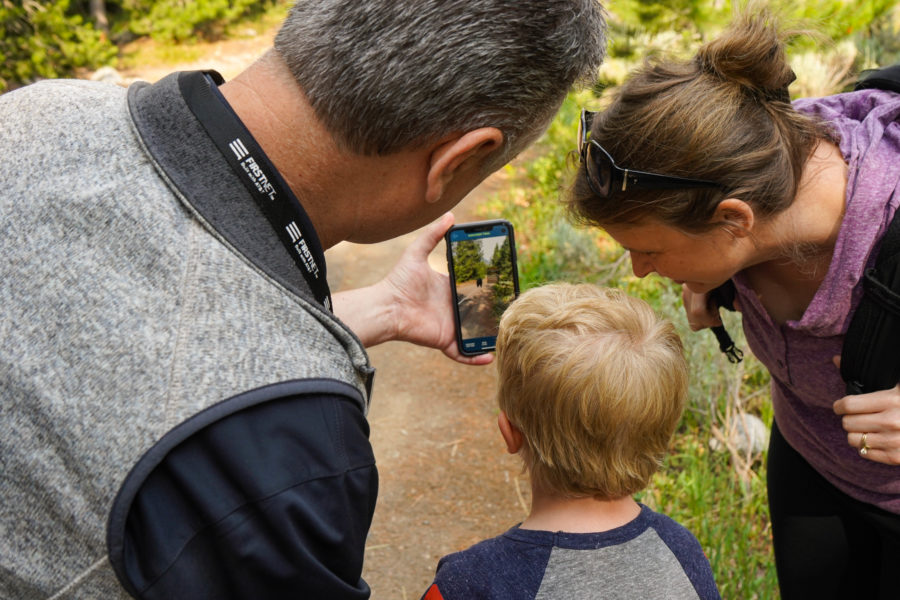
A National Park Service assignment illustrates the choice. In 2021, Media Fusion received a contract worth just under $300,000 to develop an augmented-reality framework and two prototypes. One proposed use would let a visitor view a historic building where it once stood. Another would identify nearby features through an AR view. The project’s purpose was concrete: help people understand the place in front of them, including parts that were no longer visible.
The assignment was described as development and testing, with no launch date established in the announcement. Its interest lies in the proposed experience. A vanished building creates an obvious question: what was here? A phone can offer a visual answer. For Williams’s business, the technical work and the communicative purpose occupy the same assignment. The format earns its place by doing something useful for the visitor.
A NASA contract with a library inside it
In March 2023, NASA selected PCI Productions to manage communication services across its centers, headquarters, and mission directorates. The contract began June 1. Williams participated in the proposal team. Its maximum potential value was approximately $217 million, and its structure combined core communication services with an indefinite-delivery, indefinite-quantity component. A contract ceiling expresses potential scope over time. The human achievement here is the team’s successful proposal and the responsibility that followed.
Approximate maximum potential contract value, announced in March 2023. Includes the IDIQ component.
The description of the work is instructive. Strategic communications and public engagement sit alongside media relations, history and archives, library services, and support for Freedom of Information Act requests. The list gives communication a larger meaning than publicity alone. An organization also needs to preserve what happened, retrieve information, respond to questions, and give different audiences a route into its work. The camera is only one item in a much longer inventory.
A separate NASA award in July 2023 selected PCI Productions for administrative and technical support at Armstrong and Ames, with Media Fusion named as a major subcontractor. Its functions included technical publications, research-library work, reproduction services, strategic communications, and business-system support. This combination helps explain Williams’s professional territory. Production and administration coexist because institutions need both the visible material and the organization that keeps it available.
The hometown, beyond the office
Williams’s ties to Huntsville also extend through Leadership Huntsville, the Committee of 100, and Energy Alabama. He graduated from the leadership program, belongs to the Committee of 100, which promotes the city’s economic growth, and serves on Energy Alabama’s board. These are specific forms of participation in the place where he grew up. They put local concerns beside the national reach of the companies he helps lead.
Outside work, his biography describes him as a competitive sailor and a hike leader. The details are appealing partly because they are ordinary enough to resist a grand business lesson. A sailboat need not become a metaphor for a contract, and a mountain need not furnish an executive slogan. They tell us that the person with the job title spends time on the water and helps people get out into the hills.
The house that shook belongs to the beginning of this story. The later chapters involve deadlines, ownership changes, proposals, colleagues, and audiences trying to understand technical work. Williams’s route connects those scales without requiring a childhood prophecy. He grew up around the space program, studied marketing, gathered practical experience, and found a working place in its communications. The rumble was easy to notice. His career concerns what people can understand after it.