Rich Doyle had a suggestion for a brewery that was having trouble staying in business: throw a party. There is a certain elegance to this kind of contingency planning. If the accounts refuse to cheer up, perhaps the customers will. Harpoon put up tents, brought out the kegs, and welcomed about 2,000 people to an early Octoberfest. The gathering made money. More usefully, it gave the founders evidence that the thing they were building had an audience.
His co-founder Dan Kenary later recalled Doyle’s reasoning: “we’ve got to at least have a big party before we go out of business.” The line was a joke with a commercial proposition tucked inside it. People might struggle to understand an unfamiliar ale at a bar. Put them together at the place where it was made, and the appeal became rather easier to explain.
Doyle wanted a brewery with a place in people’s lives. The party offered a way to see whether anyone else wanted one, too.
The education before the ale
His route into brewing included institutions better known for producing people who finance factories than people who clean them. Doyle graduated from Harvard College in 1982, worked at Lehman Brothers in New York, and earned his Harvard Business School MBA in 1986. He co-founded Harpoon that same year. Beforehand, his professional experience with beer amounted to bartending in New Zealand.
He had also traveled in Europe, where local breweries occupied a place in community life that he wanted to bring home. A brewery could give a town somewhere to gather and something of its own to take pride in. With Kenary and George Ligeti, he set about giving that idea a Boston address. Massachusetts Brewing Permit #001 was an unusually neat number for a considerably less tidy undertaking.
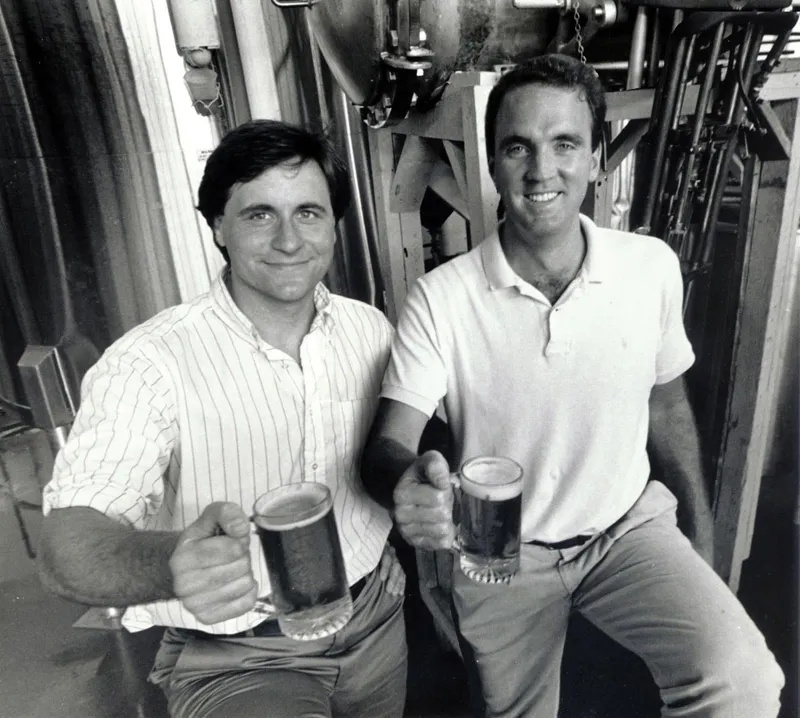
A brewery needs people who can make the beer, move it, and persuade someone to order it. Doyle’s history includes a particularly good reminder of the middle task. In 1991, Al Marzi came to Harpoon through a friend’s introduction. There was an opening for a delivery driver. Marzi also wanted to be assistant brewer. In his recollection, Doyle accepted the additional title and issued a more immediate instruction: “Yeah, fine, you’re the assistant brewer. Now get in the truck.”
Marzi eventually became Harpoon’s chief brewing officer. The story is funny because the promotion and the instruction arrive together. A young company could offer room to grow, provided somebody still delivered the kegs. There was work to do before anyone could become a brewery legend.
A summer beer gets a permanent job
Harpoon Ale reached customers in 1987. The brewery’s later growth involved making tastes familiar that had once required an explanation. IPA was one of them. In 1993, Harpoon introduced its version as a summer seasonal, a cautious arrangement for a hoppy beer whose reception the founders could not take for granted.
By 1994, it had become a year-round offering. Two decades after its introduction, Harpoon IPA remained the flagship. When Doyle looked back on that first batch, he remembered the entire ten-person brewery team being involved. The beer that became a recognizable fixture began as a job for everyone available.
The scale changed around it. Harpoon bought a second brewery in Windsor, Vermont, in 2000. By 2012, production across its facilities totaled 193,000 barrels. For Doyle and Kenary, growth meant making decisions about facilities and a widening beer range while continuing to support the beer that customers already knew. A successful experiment can become a demanding permanent resident.
There were invitations outside the bottle as well. Harpoon cultivated its Friends of Harpoon program and offered group visits through its 5:30 Club. By 2001, the friends program counted more than 25,000 members. The company had ways to keep talking to drinkers after the first purchase. Its festivals gave those conversations a date, a place, and other people to meet.
A seat at a different kind of table
By September 2010, Doyle was carrying the small brewer’s concerns to Congress. He submitted testimony on behalf of the Brewers Association at a House Judiciary Committee hearing on H.R. 5034. Harpoon then employed 135 people and sold its beer in 25 states. Running a brewery at that scale had given him a reason to care about the rules between a finished beer and its customer.
His testimony stressed the importance of wholesalers to small breweries, which could not simply build distribution networks of their own. He also warned about state franchise laws that could bind a small brewer to a distributor even when the relationship worked poorly. It was a less festive version of the work of bringing beer to people. The practical questions had grown with Harpoon: how to reach a market, who would help, and what happened when an arrangement stopped serving the business.
The room he wanted Boston to have
In 2013, Harpoon opened a Boston beer hall. Communal tables made sense for a business that had spent years asking people to come over. The room also settled a practical question: what should happen after visitors had seen the brewery? They could sit down, have a beer, and stay awhile.
Doyle was specific about the purpose. The founders were building a place to experience the brewery. Food would be simple: pretzels, freshly baked on site, using some of the spent grain from brewing. An ambitious menu might have attracted a different occasion, with different expectations. Here, a pretzel could perform its duties without requiring a reservation or a lengthy account of the chef’s philosophy.
The visitor numbers already suggested an appetite for the place. Harpoon had welcomed 87,000 people in 2012. At the beer hall’s arrival, Doyle tried to reconcile that traffic with the brewery’s early circumstances. “I had no clue about that when we started,” he said. The sentence has the modest virtue of admitting that a successful business can exceed its founder’s original imagination.
Forty-eight percent, and a different future
In 2014, Doyle stepped down as CEO. He wanted liquidity and room for other pursuits. Kenary wanted to continue with Harpoon and preserve its independence. Their partnership had lasted nearly three decades; their next chapters did not need to look identical.
The transaction put 48 percent of the company into an employee stock ownership plan. Doyle and five other key investors sold most of their shares, and Kenary took over as CEO. Announcing the transition, Harpoon also described a part-time role for Doyle in sales and new business development. Leaving the chief executive’s chair involved a set of arrangements, rather than a theatrical exit through the beer-hall door.
of the company placed in an employee stock ownership plan
By May 2026, the ownership question had become the subject of a Darden business-school case. It asks students to examine the tradeoffs in a proposed leveraged employee ownership transaction. The situation remains recognizable beyond brewing: one founder is ready to realize value, another wants to keep building, and the company has employees and a future of its own. Eventually, even a business founded among friends needs an answer that can be put on paper.
The awkward business of getting bigger
Doyle’s next venture, Enjoy Beer, began in 2015. It addressed a problem he understood from the regional brewer’s position. Large international competitors had money, distribution, and scale. Below the regional brands, neighborhood breweries were making ever more specific claims to being local. A brewery could grow beyond its original territory and find that growth had made the competition more complicated.
Enjoy Beer proposed shared capabilities: purchasing, logistics, finance, marketing, and sales. Louisiana’s Abita became the founding brewery partner, with backing for the venture from private equity firm FFL. Abita had recently completed a $30 million brewery expansion. Pairing an established brewing operation with shared commercial resources gave Doyle’s proposal a concrete first participant.
He also urged founders considering partnerships to be precise about control. Recipes, brand names, compensation, and other decisions do not all carry the same emotional or commercial weight. A conversation could make progress once an owner identified which choices mattered most. Independence becomes easier to negotiate when its meaning is specific.
Doyle knew that a growing category did not guarantee every participant a growing business. In a separate 2015 discussion, he described an industry where ingredients and equipment were more accessible, while customers expected strong products and capable operations immediately. A new brewer needed packaging, sales management, and wholesaler relationships as well as a recipe. His instruction was brisk: “You have to bring your A-game right away”.
“Don’t be mile wide, inch deep.”
Rich Doyle, on focus
A smaller instruction after a long career
Enjoy Beer proved harder to assemble than Doyle had hoped. Rising acquisition prices limited the broader grouping he wanted to create. By 2024, he was discussing a different portfolio of work: investing in businesses including Hero95 and No Sleep Beverage, and teaching entrepreneurs at the University of Canterbury in Christchurch, New Zealand.
His advice had become compact. Focus. Become significant somewhere before spreading the business everywhere. At Exeter, where he graduated in 1978, he had captained teams in soccer, basketball, and lacrosse. He later compared business to sport with one inconvenient alteration: “Game’s on all the time.”
Perhaps that helps explain the appeal of a new project after so many years at one brewery. There is always another decision waiting, another market to understand, another founder with a promising idea and a truck that still needs driving. Harpoon’s early party had demonstrated that people would turn up. The rest of Doyle’s career has involved working out what a business can sustain once they do.