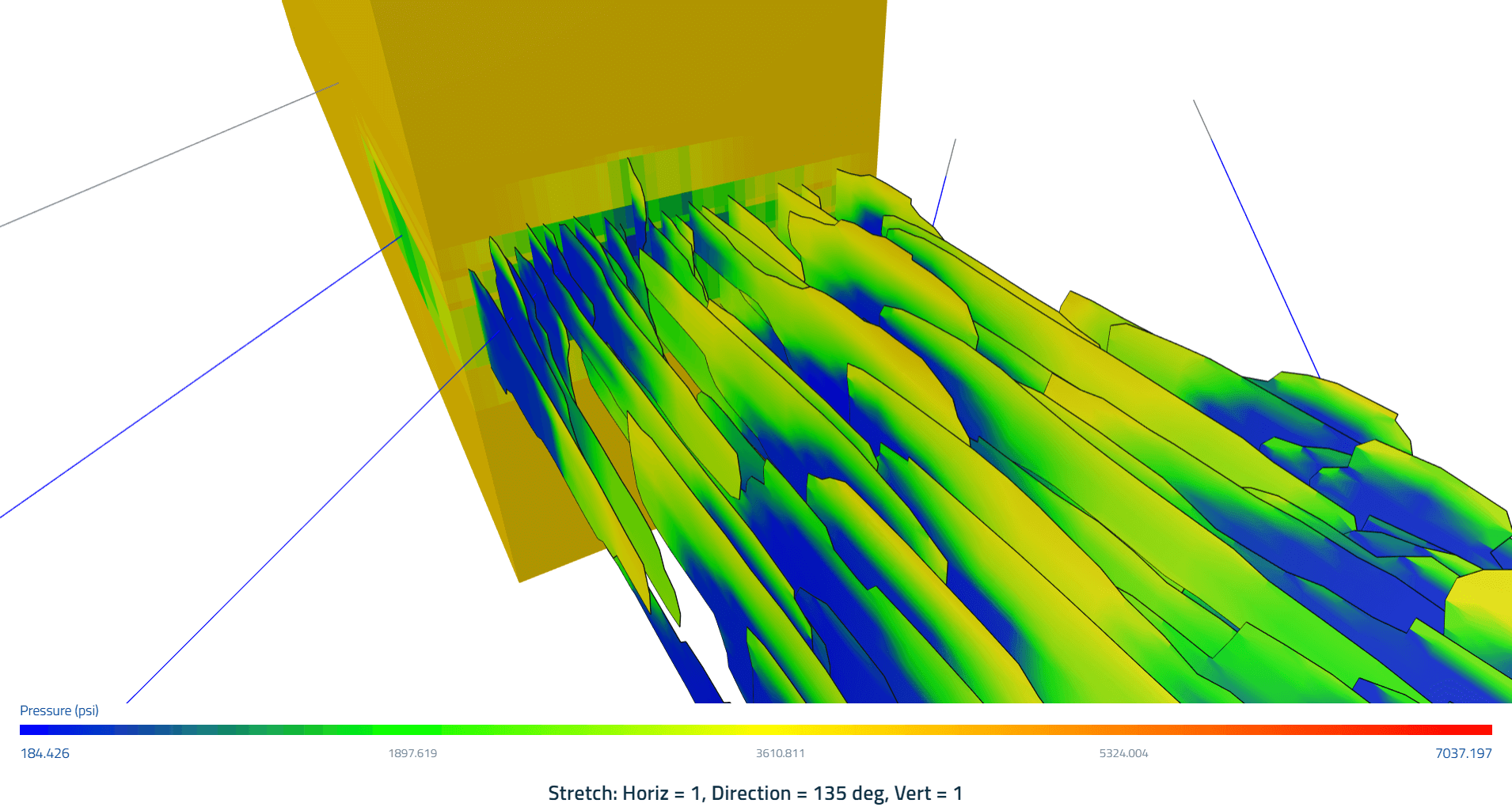
It's 6:42 a.m. in West Texas, and somebody is staring at a stress map.
The completions engineer has coffee in one hand and a stage spacing decision in the other. She's about to commit a few million dollars of pressure pumping to the ground. The map she is looking at - color-coded ribbons of fracture half-length, conductivity, drainage volume - did not come from a spreadsheet. It came from ResFrac, a piece of software designed in a townhouse in Palo Alto by a former Stanford petroleum engineer who decided, in 2015, that the industry had had enough rules of thumb.
This is what ResFrac does, quietly, every morning, in the offices of supermajors and the laptops of independents from the Marcellus to the Vaca Muerta: it simulates the cracking of rock and the multi-year drainage of the hydrocarbons that follow, in one continuous physics-based loop. No handoff between the frac model and the reservoir model. No "and then we hand it to the reservoir engineer." One engine. One simulation. The whole life of the well.
Better fracs. Better wells. Better returns. - ResFrac, tagline
A small company with an outsized footprint.
Mark McClure walked off the tenure track.
Three Stanford degrees - BS in chemical engineering, MS in petroleum, PhD in energy resources. An assistant professorship at UT Austin's Department of Petroleum and Geosystems Engineering. The standard fast lane for somebody who liked equations and rocks.
He left it. In 2015 he started ResFrac with a thesis that sounds simple and is not: the only way to actually understand an unconventional well is to model the fracture and the reservoir together. Most of the industry was modeling them separately, with different software, often by different people in different buildings.
Eleven years later, the engineers in those different buildings open the same tab.
One engine. A growing constellation of tools around it.
ResFrac (ResFracPro)
The fully coupled simulator. Multiphase fluid flow - black oil or compositional. 3D fracture mechanics with proppant transport. Poroelasticity, thermal effects, wellbore dynamics. Non-Newtonian fluid additives. One engine that follows a well from first crack to year ten.
ResApps
Browser-based engineering utilities. FracTest interprets diagnostic fracture injection tests. StageOpt sizes and spaces stages. IntTest knits the workflow together. The reservoir wizardry of ResFrac, served as a tab.
Enhanced Geothermal Systems
The same physics, redirected at hot rock. Used by next-generation geothermal developers - notably Fervo Energy - to design EGS wells that need fractures to be permeable for decades, not depleted in months.
Training & Applied Consulting
Online curriculum plus hands-on consulting. Because a coupled simulator without a calibrated operator is just an expensive aquarium.
Decisions, not dashboards.
An engineer running ResFrac can answer the questions that used to require six months and a pilot pad: how close can these wells sit before they steal from each other? How much proppant is actually being placed in the far field? What does my DFIT really tell me about minimum stress? Should I add another stage or skip it?
The answer, every time, is a number with a cost attached - which is the only kind of answer that travels well in an operator's morning meeting.
Where ResFrac Shows Up
Indicative share of platform use by application class, based on public case studies and company disclosures.
ResFrac has built something truly differentiated - a simulation platform grounded in first-principles physics that has earned the trust of the world's leading energy operators. - Matt McDonald, Banneker Partners
Banneker understands mission-critical software and has a proven track record of helping companies scale while staying true to the technical depth that customers depend on. - Mark McClure, Co-Founder & CEO, ResFrac
Eleven years, two investors, one stubborn idea.
Mark McClure founds ResFrac in Palo Alto. The bet: couple the frac and the reservoir, never decouple them.
The technical writeup that becomes the platform's calling card lands on arXiv, signaling academic-grade rigor in a commercial product.
Adoption climbs from a handful of curious operators to a roster of independents, supermajors and NOCs. Altira Group sits in the cap table.
JPT names ResFrac among the leading commercial hydraulic fracturing modeling platforms.
Banneker Partners announces a platform investment. Altira exits in full. Lightning Partners advises.
New website, refreshed logo - still three hydraulic fractures - and a new crack propagation algorithm called MuLTipEl.
Azure under the hood.
ResFrac is a Microsoft Azure shop in an industry famous for legacy Fortran. App Service, Functions, Batch, DevOps, Key Vault, Policy - and Azure OpenAI Service for the assisted history-matching workflows that are starting to creep into reservoir engineering. Python and PowerShell for glue. GitHub Actions for CI. Claude and Gemini in the developer toolkit.
The codebase is the moat. The cloud is the multiplier.
Engineering-led, remote-friendly, paper-publishing.
Three hubs - Palo Alto, Denver, Houston - and a remote workforce held together by Slack and a Deel-administered global payroll. The team publishes peer-reviewed papers as a matter of course. If the simulator says something surprising, the company would rather defend the math in a journal than soften the result.
Who else is in the room.
Schlumberger
Kinetix and Mangrove inside Petrel - the incumbent suite, deeply embedded in operator workflows.
Halliburton GOHFER
Long-standing fracture simulator with a loyal user base in the service company orbit.
CMG
Reservoir simulation specialist (IMEX, STARS, GEM). Strong on flow, lighter on integrated fracture mechanics.
ResFrac's pitch in one line: the others make you choose between the crack and the flow. ResFrac doesn't.
Things that don't fit in a pitch deck.
Where the trail continues.
6:51 a.m. The completions engineer commits.
The map on her screen has settled. The stage spacing is set. The proppant schedule is locked. The pumps will start at seven. None of this happened because somebody guessed - it happened because a small company in Palo Alto, run by a former professor with three Stanford degrees, built an engine that does not let you separate the crack from what the crack will drain.
Eleven years ago that engineer would have made the call on instinct. Now she makes it on math. The well still might surprise her. But the surprise will be smaller, and when it comes, ResFrac will be open in another tab, calibrating against the new data, ready for the next morning.
That's the change. A quiet one. Most of the people whose lives it touches will never know its name.