The first version of Remotebase was an email. Not a platform, not an algorithm and certainly not a grand pronouncement about the future of work. It was a hurried question sent from Pakistan to people in Silicon Valley: do you need a software engineer? The two men asking had already lost two major clients as COVID-19 arrived. A performance-tracking product they were building had failed to find traction. Cash would last perhaps 30 to 45 days. The ordinary response was layoffs. Qasim Asad Salam and Talha Masood chose the more inconvenient answer - sell the team before the clock sold it for them.
- Remotebase supplies vetted remote engineers and increasingly sells full ownership of technical problems through production.
- Its customers include startups and enterprises; named relationships include Fireflies.ai, Northwestern Mutual, Agentnoon, Qureos and Walnut.
- The company raised $1.4 million in 2021 and $2.1 million in 2022. It said it was cash-flow positive in early 2023.
- Current prices are quoted. The visible risk-reducer is a two-week trial without an upfront payment, subject to the engagement terms.
- The repeatable lesson is simple: preserve the scarce asset, sell manually, and build machinery only after strangers prove they want the result.
The business hiding inside the rescue
Salam and Masood met at Kickstart, a coworking space in Lahore, while each was working on a startup. They later ran a software house together. Salam went to the United States to find business, at one point living in a San Francisco garage and economising on three-dollar meals. Masood brought a different piece of evidence: in 2014 he had worked remotely from Pakistan for a New York company that later became worth a billion dollars. Location, he had learned, was a handicap mostly because employers treated it as one.
Their earlier startups failed first. Then two large software-house clients disappeared in the pandemic. What changed their minds was not a strategy retreat but demand: friends in the United States actually wanted the engineers offered in those frantic messages. The founders placed people by hand, recognised a pattern, and stopped behaving like a custom software shop. In April 2020, Remotebase began operating around the match itself.
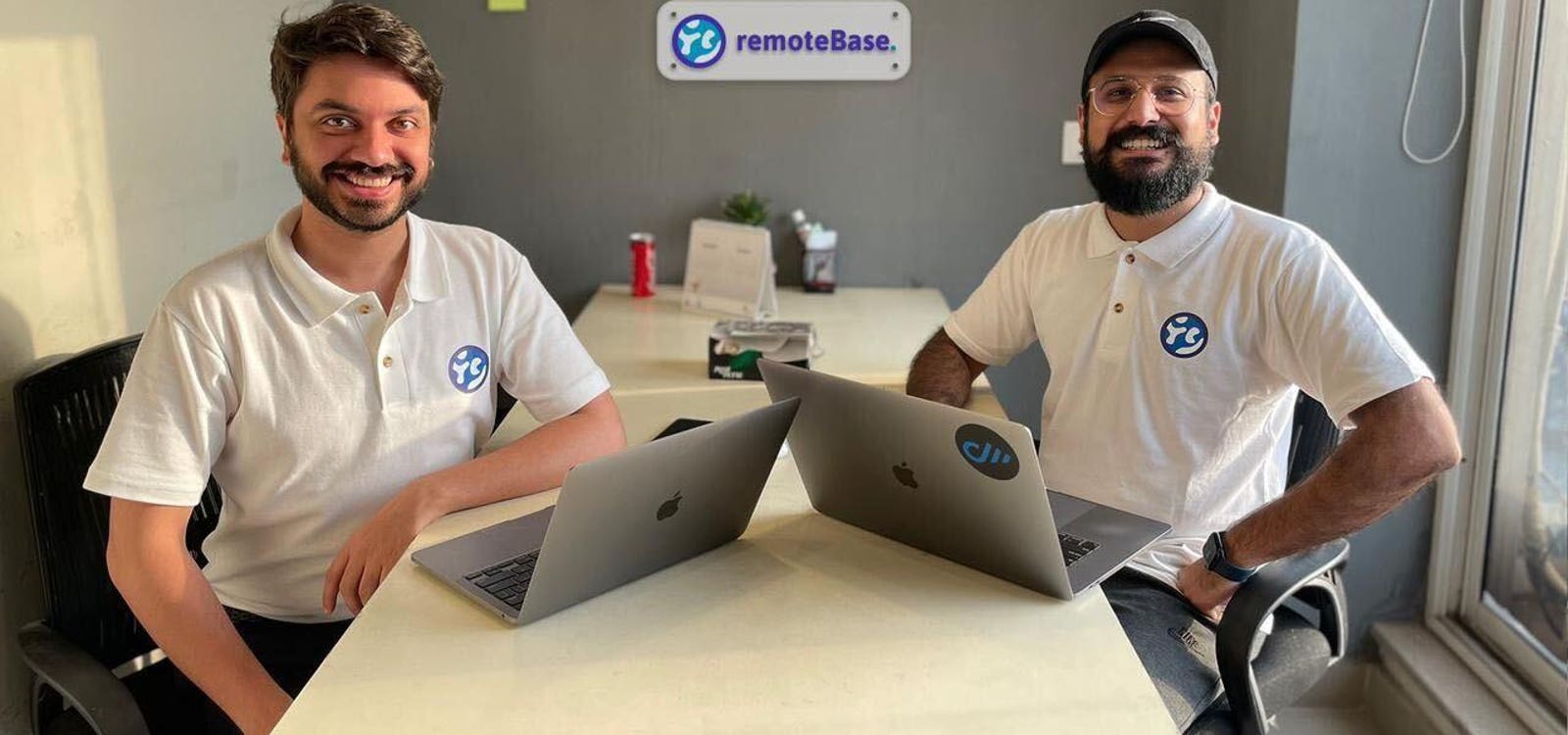
“We realised that we needed to pivot our businesses towards recruitment.”Qasim Asad Salam, co-founder and CEO
Manual placements become a company devoted to remote technical talent.
A $1.4 million seed round funds expansion; Hackfest draws more than 2,600 participants.
The 24-hour team pitch launches on Product Hunt; a $2.1 million pre-Series A follows.
The founders report 85,000 vetted engineers, 120-plus staff and positive cash flow.
The public proposition shifts toward forward-deployed engineers who own work through production.
Speed, with paperwork attached
The early headline was memorably blunt: build an engineering team within 24 hours. But speed is merely the visible part of a rather laborious machine. Candidates enter through domain tests, recorded HR questions, problem-solving exercises and human interviews. The company has assessed technical ability, communication and work habits, then maintained a smaller “hot” pool ready for placement. Clients interview the matches themselves. A four-hour time-zone overlap makes remote less remote. The two-week trial moves the final test from a résumé to actual work.
What does it cost? Today, the honest answer is a quotation. Remotebase asks for the stack, seniority and number of developers before producing a figure. Historical product listings described a fixed monthly cost, but did not publish one universal rate. In 2022 the founders announced a low-touch subscription named Talently, starting at $499 a month, which would let recruiters search skill-scored profiles directly. That was a distinct, historical offer, not a safe proxy for a current embedded engineer.
The advertised evaluation window before payment, designed to lower the cost of a bad match.
Current engagement pricing varies by skill, level, team size and scope.
From filling a seat to owning the problem
There is a second pivot hiding on the current homepage. Remotebase no longer leads only with hiring. It asks for a workflow, feature, system or bottleneck, then proposes a “forward-deployed engineer” who works inside the customer's environment through deployment. This is a meaningful change in grammar. Recruiters provide a person; consultancies provide a project; forward-deployed teams promise proximity and responsibility. Remotebase is trying to stand in the useful, untidy space between all three.
The customer stories explain the move. Fireflies.ai says that, around its $20 million Series A, almost half its technical team consisted of Remotebase people. Remotebase credits its work there with product and AI features, 70 percent fewer reported issues and 40 percent more engagement. At Northwestern Mutual, it describes a secure AI data platform and device integrations. Those performance numbers are company case-study claims rather than independent measurements, but they reveal what Remotebase now wants buyers to notice: what shipped after the match.
| Alternative | What it sells | Where Remotebase differs |
|---|---|---|
| Freelance marketplace | Search and access | Pre-assessment, matching, onboarding and ongoing support |
| Recruiting firm | A successful hire | A maintained talent pool, trial period and recurring engagement |
| Software consultancy | A scoped project | Named engineers embedded in the client's systems and team |
| Direct hiring | Long-term internal capacity | Faster start and less sourcing, with less direct institutional ownership |
A playbook worth stealing carefully
The Remotebase method is copyable, but not by copying the website. Its advantage came from a sequence of decisions made under pressure.
- Protect the scarce thing. The engineers were valuable even after their original client work vanished.
- Sell the outcome manually. Personal emails established demand before a marketplace absorbed time and cash.
- Turn judgment into a process. Tests, interviews and trial work made an informal recommendation repeatable.
- Remove the buyer's sharpest risk. A trial attacks the fear that an impressive interview will become a disappointing Monday.
- Follow the work after the sale. The move toward production ownership converts a replaceable introduction into a deeper operating relationship.
The fine print on distance
This model is best when work can be stated clearly, access can be granted safely, and a client has managers capable of reviewing decisions rather than merely counting tickets. It is weaker when national-security rules, data residency, export controls or employment law prevent cross-border access. It also struggles when knowledge is so tacit that an outside engineer spends months decoding the organisation, or when the buyer expects cheap labour but withholds the context required for ownership.
There is another tension. A network can grow faster than the number of people ready to start. Remotebase reported 85,000 vetted engineers in 2023 and now advertises more than 350,000. The meaningful number for any customer is smaller: candidates current in the exact stack, available now, compatible with the time zone and persuasive in a live interview. The 24-hour promise works only if that active layer remains dense.
Still, the company occupies a sensible place in the market. Toptal, Turing and Andela popularised curated global talent; Upwork made abundance searchable; consultancies sold accountability. Remotebase's proposition borrows from each and adds its own origin story: the employer began by taking responsibility for its engineers before asking clients to trust them. There are worse foundations for a company than refusing to treat people as spare parts.