In a breaking-news newsroom, yesterday can be surprisingly hard to find. Raw Story had more than 300,000 posts in its archive, a considerable store of reporting that became awkward to consult precisely when an editor most needed it. A new political development arrived. Somewhere in that back catalogue lay its history. Finding the right pieces took time the newsroom would rather spend publishing.
- RebelMouse combines a publishing CMS with hands-on design, SEO, and revenue services.
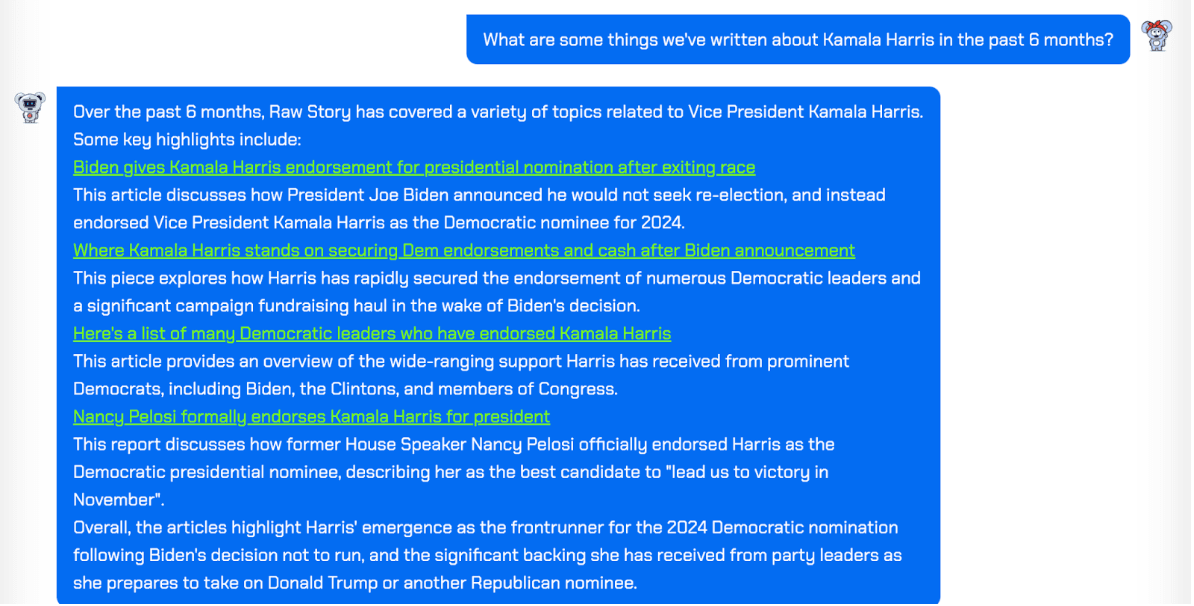
- Raw Story’s archive chatbot helps editors retrieve background, dates, authors, and links.
- When AI search returned poor matches, RebelMouse brought traditional search back into the mix.
The newsroom remembers
Raw Story founder John Byrne approached RebelMouse with a specific request: build an editorial assistant around the publication’s own work. The resulting chatbot could surface background, assemble timelines, and link to earlier coverage. Authors and publication dates were indexed too. An editor could ask about a particular journalist’s work or narrow the historical window, rather than invite a machine to rummage indiscriminately through two decades.
Executive editor Adam Nichols estimated that research and copyediting assistance saved five to six minutes per article. This was a newsroom estimate reported in RebelMouse’s case study, rather than an independently measured productivity trial. Even so, the unit is refreshingly ordinary. Minutes are something an editor can recognize, test, and spend.
“It is accurate and it is very easy to edit down.”
Adam Nichols · Executive editor, Raw Story
A publisher’s problem, inherited
RebelMouse’s interest in this bottleneck predates the chatbot. Founder Andrea Berry had led technology at The Huffington Post. After its acquisition by AOL, she inherited responsibility for 53 properties running dozens of content systems, according to the company’s account. The complaint was structural: publishing tools built around IT did not necessarily understand traffic and distribution.
Founded in 2012, RebelMouse initially gathered social content into a web presence. Its later enterprise CMS put editing, design, audience development, and monetization together. The customer roster now includes publishers such as IEEE Spectrum and Premier Guitar, alongside brand clients including Penske and Ricoh. The common requirement is a website with substantial publishing work to do.
The market kept providing reasons to adjust. In its account of 2018, RebelMouse described Facebook’s deprioritization of news as a reason to renew attention to search and site performance. A publisher could court a social feed, but it still needed somewhere useful for readers to land. Today, AI answers add another discovery channel to that calculation.

The search engine needed supervision
The revealing episode came when RebelMouse tested AI search. Users wanted exact matches; the system sometimes offered loosely related answers. Old material surfaced. Author searches could disappoint. In a January 2025 technical post, the team described moving away from its enthusiasm for an entirely AI search experience after examining data and user feedback.
The fixes were concrete. For a complaint about outdated, unrelated results, sorting prioritized similarity within a 60-day window. Single-word queries went to regular search; multiword queries could use AI. Typo correction and interpreting intent remained useful jobs for the model. The company’s recommendation became a mixture of methods chosen for the query.
That is a useful experiment for any content team to borrow. Try an exact name, a short query, and a question whose answer changed recently. Inspect the results before admiring the interface. An archive assistant will be less useful when the archive is thin, dates are unreliable, or reviewers accept background copy without opening its links. Retrieval still needs an editorial standard.
The redesign beneath the redesign
RebelMouse also addresses less conversational problems. Blueprints package the pages a publisher repeatedly needs: articles, authors, sections, tags, search, and even missing-page experiences. They combine configurable design with caching, technical SEO, recommendations, and ad placement. The appeal is reducing how much familiar publishing machinery must be invented again.
Premier Guitar’s relaunch moved from April planning to a live site in June, an eight-week project. RebelMouse’s case study reports gains in clicks, impressions, engaged time, and users arriving from AI. These measures describe different things; they cannot be added into a single score. Nor does a before-and-after comparison isolate the redesign from editorial output or changes in discovery.
Software with people attached
The commercial distinction is the service layer. WordPress, Drupal, and Adobe are alternative foundations; buyers can assemble specialists around them. RebelMouse supplies its own platform and an agency that works on migrations, technical SEO, editorial strategy, and advertising operations. Customers are buying a continuing relationship with the people operating and improving the machinery.
The price question requires a scoped proposal. Enterprise work depends on the site and services; Subscriptions also uses tailored pricing. A buyer should specify migration volume, custom templates, support, AI features, and ongoing optimization before comparing offers. The economical choice depends on which jobs the publisher can already handle internally.
In August 2026, Berry described conversational CMS workflows, a lower-budget AI website builder, and new subscription and engagement tools. Subscriptions can run on another CMS and supports PayPal and Stripe. The remote team supplies the human counterpart: HR head Milagros Linale’s June reflection on supporting employees across 28 countries emphasized everyday conversations and support.
RebelMouse’s practical proposition is to make publishing knowledge usable twice: first as work readers encounter, then as an archive editors and tools can consult. The lesson travels beyond its customers. Choose a recurring irritation, measure whether it shrinks, and let feedback revise the machinery. A search box that knows when to be literal has learned something valuable.
Open another tab
Explore the platform, Blueprints, Subscriptions, and the company blog.
Read the Raw Story account, hybrid-search explanation, Premier Guitar project, and 2026 product update.
Follow LinkedIn, X, Instagram, or Facebook. Watch the historical company video or browse product and strategy webinars.