The corporate risk business begins with a small comedy: every department believes it owns a different apocalypse. Cyber watches the intruders. Security watches the streets. Compliance watches regulators. Strategy watches elections, trade routes and presidents. Then one ship blocks a canal, one government changes a tariff, or one militia points at a pipeline, and everybody discovers they were studying the same problem from separate tabs.
RANE sells the tab that tries to connect them. The company gathers verified open-source signals, proprietary analysis, country ratings, forecasts, events and expert judgment across four categories - geopolitics, physical security, cyber, and legal or compliance risk. Customers search it, receive briefs and alerts, inspect maps, call analysts, commission assessments or pipe the material into their own systems through an API.
This is not a crystal ball. It is a filter with institutional memory. RANE's job is to tell a compliance officer in New York why an election in West Africa could matter to a supplier, a facility or a sanctions policy before the connection becomes painfully obvious.
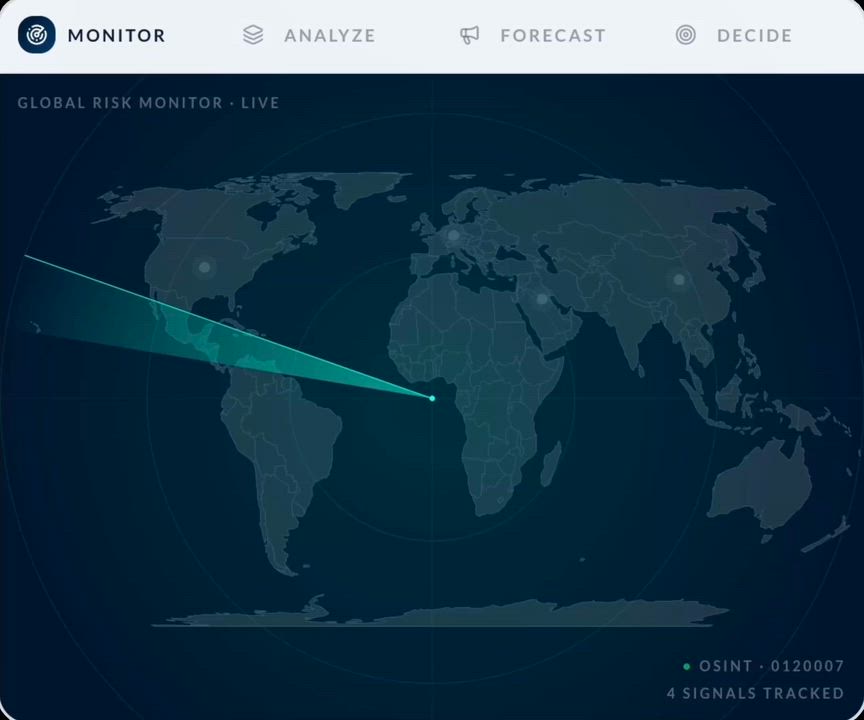
A network before it was a dashboard
Founder David Lawrence knew the inside of this problem. Before RANE, he spent roughly two decades at Goldman Sachs, where he created and led the firm's Business Intelligence Group. He and a group of co-founders launched Risk Assistance Network + Exchange around 2013. The spelled-out name matters: the first proposition was access to vetted expertise, not another blinking console.
An old 2016 cyber-industry directory described annual memberships around $120,000, with subscribers tapping a network of experts. That number is historical, not a current quote, but it captures the original economics: RANE was selling a fraction of an elite in-house intelligence operation. It was useful, high-touch and difficult to scale cleanly.
What failed first was the industry's basic assumption that more feeds meant more safety. Signals multiplied faster than the humans assigned to interpret them. A threat alert might be accurate and still be useless if nobody could connect it to a plant, a policy or a decision deadline. RANE gradually changed the shape of the product: a network became a research service; the research service became a platform; the platform began arriving through mobile apps and APIs.
“Corporations are being called upon to manage risks that they were never intended to manage.”David Lawrence, founder
Buying the forecast factory
The decisive turn came in February 2020, when RANE acquired Stratfor with an investment from Teakwood Capital. Stratfor brought more than two decades of geopolitical analysis, a substantial archive and a recognizable habit of making explicit forecasts from history, politics and geography. RANE had not merely added content. It had bought a methodology, a newsroom and a reputation in one transaction.
That deal changed the center of gravity. The early company connected clients to outside expertise. The expanded company could own the analysis, standardize it, link it to other risk categories and sell it repeatedly. It later launched the Stratfor Center for Applied Geopolitics, while the consumer-facing Worldview product kept an individual subscription door open.
The acquisition price was not disclosed. Public company databases list later debt financing from SG Credit Partners in 2024, also without an amount. Supplied company data puts total funding at $14.7 million and records a $2.7 million seed round in 2017, but RANE has not made a detailed cap table or valuation public. This is a private information company that keeps its own financial information rather private. Fair enough.
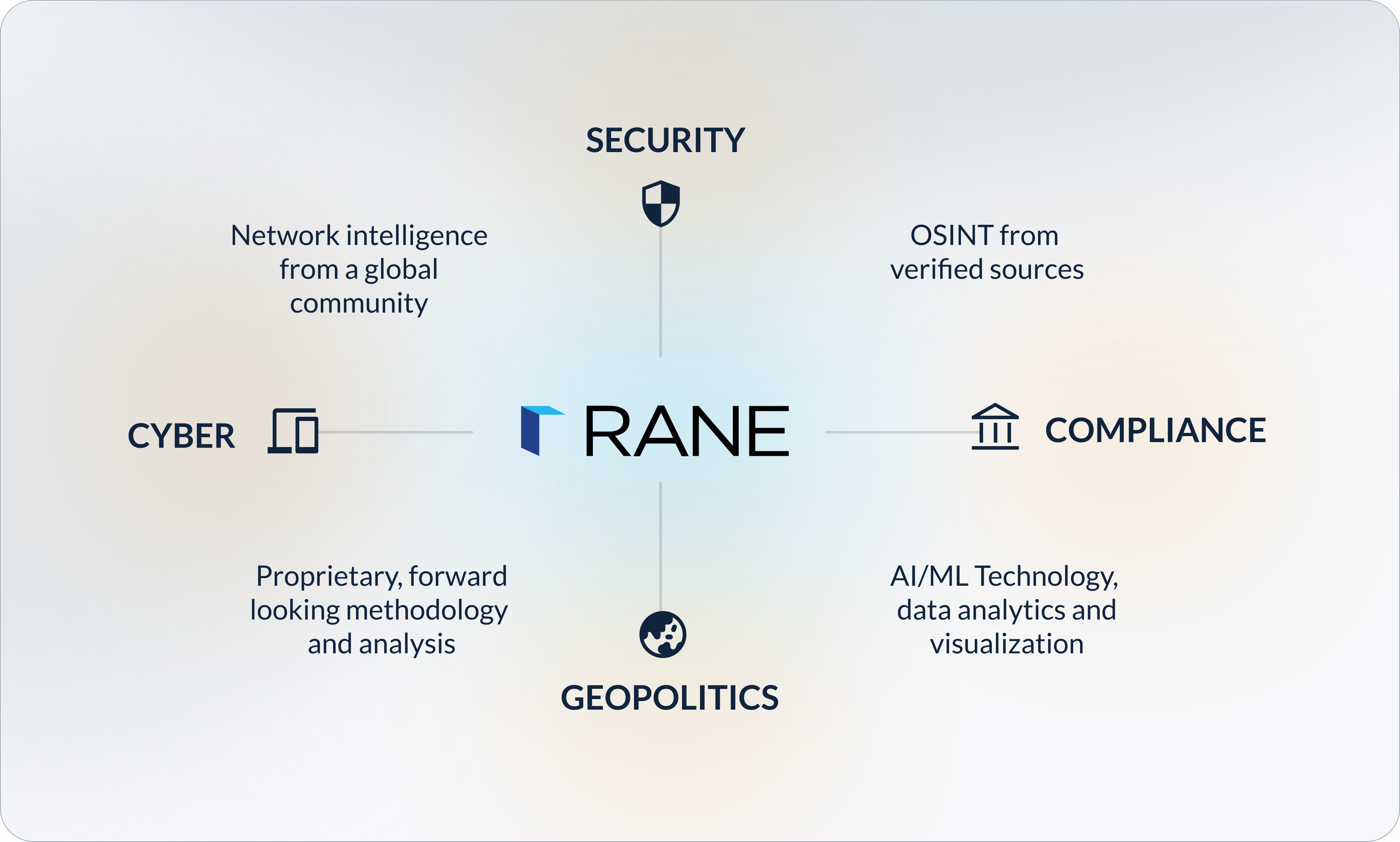
From signal to boardroom sentence
RANE describes its architecture as a sequence: monitor, analyze, forecast, impact, embed, decide. The verbs are more revealing than the feature list. First comes curated OSINT and risk feeds. Then analysts explain why an event matters. Forecasts add scenarios and probability. Industry and company context translate the event into exposure. APIs or platform tools move the conclusion into a workflow. Finally, an executive gets a short brief that can support a decision.
The Core Intelligence platform includes unified search, relationship maps, country-risk data, events, downloadable graphics and mobile briefs. Geopolitical Intelligence adds annual and quarterly forecasts, key forecast questions and scenario tracking. Threat Intelligence offers incident monitoring, maps and geofencing. Services cover due diligence, risk screening, assessments, training and dedicated analyst support.
In 2025, RANE added Smart Report, which uses AI to summarize search results drawn from verified OSINT and proprietary analysis. The order is sensible: establish sources, taxonomy and analysis first; place the summarizer on top. AI is the clerk here, not the oracle.
Worldview Basic for limited geopolitical reports, briefs, maps and podcasts.
Worldview Essential for unlimited analysis and forecast summaries.
Teams, APIs, analyst access, account support and client-specific intelligence.
Not news, not a guard force, not quite consulting
RANE occupies the space between a general news subscription and a standing internal intelligence team. Eurasia Group, Economist Intelligence Unit, Oxford Analytica and Control Risks compete for geopolitical and strategic work. Dataminr, Factal, Everbridge and Crisis24 compete around alerts, crisis information and security operations. Large consultancies sell bespoke answers. An experienced in-house analyst offers company-specific memory.
RANE's difference is breadth with a common spine. A user can move from a cyber signal to a sanctions issue, a protest threat and a country forecast without crossing four vendors. Distribution matters too: the intelligence can appear in RANE's platform, on mobile, through Bloomberg Terminal, inside Silobreaker or in a customer's own software.
The customer list is described by function rather than logo parade: security leaders protecting people and sites, compliance teams watching sanctions and regulation, supply-chain teams testing weak links, government-affairs teams reading policy, and strategy groups weighing markets or acquisitions. RANE says more than 400 organizations use its work across corporate, government and academic settings. A 2021 company post cited a broader network reach of 1.5 million members, a different and much looser measure than paying enterprise customers.
The company presents expertise as part of the product, not decoration around it. CEO Steve Roycroft previously ran information and workflow businesses at Thomson Reuters and inVentiv Health. Lawrence supplies the investigative and legal lineage. Analysts bring regional, cyber and security specialties, while the service side can conduct a targeted assessment or briefing when a subscription answer is too generic. That mix makes RANE look less like a conventional SaaS company than a newsroom, consultancy and software vendor sharing one invoice.
Its internal culture follows the same hybrid. RANE's careers material lists client focus, collaboration, curiosity and integrity as values, and advertises remote work, flexibility and autonomy. It also asks candidates to be comfortable with ambiguity and a start-up atmosphere. This is the labor bargain behind the polished executive brief: specialists spread across locations, working to a publishing clock while clients need answers on their own clock. The approach scales better than a purely bespoke consultancy, but every new topic still demands human judgment somewhere in the chain.
Build the editorial system before the AI layer
Most companies cannot copy RANE's analyst bench or acquire a forecasting institution. They can copy the operating logic. Start by naming a small set of risk categories in language every department accepts. Separate raw signals from analysis. Force every important item to answer three questions: Why does this matter to us? What happens next? Which decision changes if the forecast is right?
- Create one shared taxonomy for countries, topics, assets and business units.
- Give forecasts a probability, a time horizon and a visible owner.
- Publish on a fixed cadence, but reserve alerts for decisions that cannot wait.
- Write the one-page executive brief before building another dashboard.
- Send conclusions into tools people already use, then measure what action followed.
That last step is the quiet lesson in RANE's API and partnership strategy. Intelligence loses value each time the reader must remember to visit a separate portal. Bloomberg and Silobreaker are not merely distribution badges; they are admissions that workflow beats destination.
Where it works
Organizations with cross-border operations, regulated markets, exposed suppliers or traveling staff - plus a named team able to turn analysis into policy, purchasing or security action.
Where it breaks
Small domestic businesses with little external exposure, teams seeking raw cyber telemetry, or crises that require guards, sensors and incident command rather than strategic context.
A forecast is only useful if someone can move
RANE cannot make an uncertain world behave. Forecasts can be wrong, open-source signals can arrive late and a beautifully tagged risk is still a risk. The platform also asks something of its buyer: enough exposure to justify the expense, enough internal discipline to define priorities, and enough authority to act before certainty arrives.
Under those conditions, RANE's value is not omniscience. It is compression. A week of alerts becomes a paragraph. A regional conflict becomes three operating scenarios. A board receives a decision instead of a reading list. For a risk team, that may be the most practical forecast of all: fewer tabs, sharper questions, and one person willing to say what the company should do next.