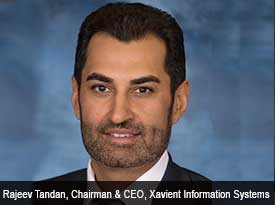
Success presented Rajeev Tandon with a small problem: every time he approached it, he changed its address. At 20, the ambition was to have 100 people working for him. At 25, it was to run a million-dollar company. By 2016, with Xavient established in enterprise software services, he was still questioning the premise of having arrived. “What does made it mean?” he asked.
It is a useful question to put to someone whose company would soon attract an international buyer. A sale gives a business a price, a date and a place in somebody else’s financial statements. Satisfaction is less cooperative. Tandon’s career has continued beyond Xavient, into Daten Technology Solutions, where he is founder, chairman and CEO. The milestone acquired a closing date. The founder had another company to build.
A family business with software waiting inside
Tandon was born in Cupertino, California, and worked in the family business, Tandon Corporation. His father, Jugi Tandon, built a career in computer storage. For Rajeev, the industry was close enough to observe before it became a career choice. The family connection gave him an unusually direct view of technology as a business: equipment had to be designed, manufactured and sold, and customers had to keep coming back.
His own work included executive positions in hardware. At Celetronix, he was president of the computer hardware division and co-founding CEO of its memory division. Those responsibilities put him inside the practical economy of physical products, where production and customer requirements meet. The eventual software founder had already worked on the side of the industry that shipped things you could pick up.
Xavient’s beginning was correspondingly practical. The family’s set-top-box operation was making equipment for EchoStar and needed software work. Rajeev assembled a small group of software engineers to help. Here was a customer requirement, engineers who could meet it, and the possibility of more work beyond the immediate assignment. A new business could start with an existing problem.
Founded in 2002, Xavient continued after the hardware company’s sale to Jabil. The software work had developed a life of its own. That separation is the hinge in Tandon’s story: an activity inside a manufacturing business became the basis of a company serving other enterprises. His father later described the venture with obvious pleasure. The family had produced another founder, working in a different part of the same industry.
The customer came back
A software services company has an unglamorous test of its worth: does the customer renew? In August 2014, DISH announced a multi-year agreement with Xavient after a relationship stretching back roughly a decade. The work covered a range of IT services, with delivery organised to support the television company around the clock. For Tandon, the existing relationship was becoming another commitment.
That matters because a long-running customer brings knowledge that is difficult to acquire in a sales meeting. Engineers learn how systems behave, where the dependencies sit and what a change might disturb. A renewal gives that accumulated familiarity another commercial purpose. It also places a continuing obligation on the supplier. Yesterday’s competent delivery is useful evidence; tomorrow’s service still has to work.
Xavient’s communications background also shaped its hiring. In 2013, Tandon brought in Robert Hallahan as vice president of solution architecture, with responsibility for major telecom engagements and integration work. The appointment reinforced an existing specialism. As customer projects grew more involved, the company was adding someone to lead the architecture behind them. An expanding services business needs people who can make its promises technically plausible.
A conceptual view of enterprise integration. The screen gets noticed. The connections earn their keep.
Growth changes the job
By the mid-2010s, Tandon was managing a company with work on both sides of the Pacific. Xavient’s U.S. presence and Indian engineering operations made geography part of its operating model. A customer engagement could require local conversations and a much broader delivery team. The founder’s task had widened from assembling engineers for a particular need to maintaining an organisation that could take on many such needs.
There is a particular discipline in that kind of growth. Adding people expands capacity, but it also increases the number of decisions that must travel reliably through the company. A founder can personally understand an early assignment. At greater scale, colleagues need enough authority and context to make decisions without a founder standing beside them. Organisation becomes part of the product the customer buys.
In April 2018, after the controlling investment by TELUS International, Xavient announced plans to recruit 250 employees in California and the northeastern United States. Locations included San Diego, Philadelphia, New Jersey and Delaware. Tandon connected the recruitment to client partnerships and longer-term technology careers. The deal had closed, yet the immediate agenda still included the decidedly familiar business of hiring people to do the work.
What the buyer was buying
TELUS International announced its agreement to acquire Xavient on October 30, 2017. The initial stake was 65 percent, with provisions for acquiring the balance by the end of 2020. At announcement, the estimated total consideration, including the remaining interest, was approximately US$250 million and depended on performance-related measures. The number described the proposed whole transaction, with conditions attached.
The strategic attraction was specific. Xavient offered capabilities in cloud services, user experience, big data, connected devices, DevOps and software delivery. It also gave TELUS International its first operations in India. Tandon had built something that could extend both the buyer’s technical offering and its delivery geography. An engineering organisation assembled around customer requirements had become a way for another organisation to expand what it could offer.
The controlling acquisition closed on February 6, 2018. About 1,800 Xavient employees joined TELUS International, whose workforce then exceeded 30,000. The business took the name Xavient Digital - powered by TELUS International. Tandon remained identified as founder and CEO at closing, and spoke about bringing together cultures focused on developing employees and serving customers. Ownership changed while the delivery responsibilities continued.
The earlier US$250 million figure was an estimate for the full transaction.
The remaining interest was acquired in April 2020. TELUS International subsequently reported total cash and share consideration of US$202.4 million, including shares valued at US$15 million. The completed transaction therefore has a different number from the original estimate. Neither number supplies a personal balance sheet for Tandon. They describe a corporate acquisition, with more than one stage and more than one form of payment.
The finish line was already moving
In May 2018, Tandon explained his view of digital change in terms that also illuminate the business he had built. Customer expectations keep shifting. Companies need to connect technology with operations and service, and they cannot treat the work as a project that ends permanently at launch. He argued for repeated adaptation, with technology chosen and integrated around what a business and its customers actually need.
He also made room for modest beginnings. A company could start by adding a chatbot or an analytics capability to existing operations. Employee resistance, training and willingness to experiment belonged in the discussion alongside the software. The point was operational: buying technology does not by itself teach an organisation to use it well. A new tool can arrive quickly; changing how people work takes attention.
“So the bar keeps changing.”
Rajeev Tandon, 2016
Read beside his earlier question about having “made it,” this becomes a recurring idea. The organisation is expected to adapt, and the founder’s own measure of progress has adapted too. There is a commercial advantage to remaining interested in the next requirement. There is also a personal inconvenience: success has a habit of turning into the starting point for the next assignment.
Another company, familiar ground
Daten Technology Solutions brings Tandon back to engineering and software services for large enterprises. Its leadership includes people with Xavient experience: chief operating officer Pradeep Philip and communications and media technology executive Arup Chakraborty both worked there. The continuity is tangible. A later venture can carry forward knowledge through colleagues as well as through its founder.
His connection with the University of Southern California has continued too. Tandon earned a bachelor’s degree there and serves on the Board of Councilors at USC Dornsife. That places an educational institution alongside the companies in his working life. His career reaches from the family’s storage business to software delivery, acquisition and another leadership team, with relationships persisting across the changes.
There is even another generation in the picture. His son Rashaun founded Dwell, a property operations software company. Its stated focus is the coordination between tenants, landlords and vendors: requests that need to become organised work. The setting is different from satellite television, but the family resemblance is easy to appreciate. There are people trying to get something done, and systems that could make the process less troublesome.
Tandon’s story began close to hardware, where a product occupies a definite amount of space. Software services gave him a business whose boundaries could keep expanding with the customer’s needs. Xavient reached a buyer. Daten has him building again. His old question about having arrived remains a good one. In this career, arrival seems to come with another set of responsibilities.
Follow the next chapter
Company, public profile and further reading.