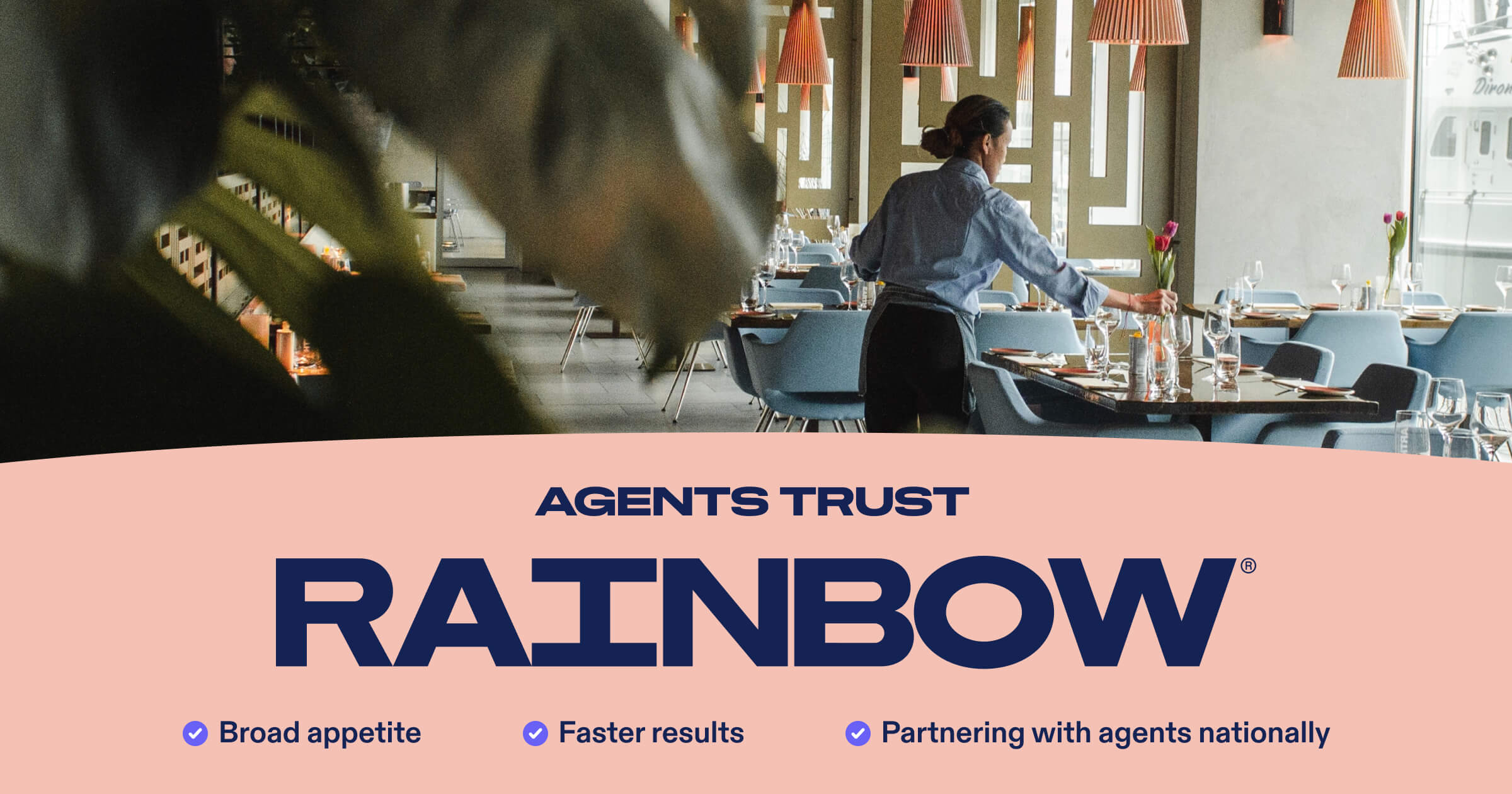
01 - Who they are, right now
The agents are awake before the brunch crowd.
It is a Tuesday morning in San Francisco, and somewhere in an independent insurance agency in Sacramento, a producer is quoting a 22-seat trattoria. Liquor license, brick pizza oven, lease that goes through 2029. The agent types it into Rainbow's portal. The bind happens before the espresso machine warms up. This is the unglamorous, unromantic, very lucrative middle of America that Rainbow has chosen as its beat.
Rainbow is not a household name and is not trying to be. It is a managing general underwriter - an MGU, in the trade - which means it builds insurance programs, prices them, and uses partner carriers to hold the paper. Its first program covers restaurants. Its second covers salons and gyms. Its long-term ambition is broader, but the company has been admirably stubborn about not getting ahead of itself.
It is not a tech company that does insurance. It is an insurance company that happens to write good software.
- The shortest possible Rainbow elevator pitch
About 170 people now work there. Headquarters is San Francisco. Phones answer with a human. The website, userainbow.com, is bright and slightly cheeky, which is more than you can say for most carrier homepages.
02 - The problem they saw
Restaurants are catastrophic.
Not morally - actuarially. Slip-and-falls in the dining room, grease fires in the back, a busboy who pours one drink too many, a brunch line that spills onto a public sidewalk. From a traditional underwriter's spreadsheet, a single-location restaurant looks like a stack of small disasters waiting to happen, priced on a template borrowed from a generic small business owner's policy.
For decades, that template was good enough. Then it wasn't. Inflation, climate, social-inflation jury verdicts, reinsurance pulling back from California wildfire risk - all of it converged. Generalist carriers either jacked up premiums, narrowed coverage, or quietly walked away from whole classes. Restaurants ended up paying more for less, often through a non-admitted surplus market.
Caption: An industry so chronically mispriced that even the people pricing it admit, in private, that the price is wrong.
That market dislocation is the door Rainbow walked through. Its founders made a simple observation: if a hot-dog cart, a fine-dining steakhouse, and a midnight ramen shop are all sharing the same generic BOP, none of them is being priced fairly. Specialization is supposed to be insurance's whole job. Somewhere along the way the industry forgot.
If you cannot tell the difference between a 90-cover bistro and a single-location ghost kitchen, you are not underwriting. You are guessing.
- Argument the founders kept making, to anyone who would listen
03 - The founders' bet
Three people, one narrow door.
Rainbow was founded in 2022 by Bobby Touran, Shalom Yiblet and Jamie Hankinson. Touran runs the company; Yiblet leads engineering; Hankinson leads product. The team is, by the standards of insurtech, refreshingly unsentimental. They did not raise on a manifesto. They raised on a class of business - restaurants - and a plan to write it well enough that agents would notice.
The bet was vertical. Pick one hard, ugly, real-economy class. Learn it cold. Build the underwriting math, the agent portal, the claims process, and the regulatory paperwork around it specifically. Resist the temptation, very strong in this category, to immediately raise a giant round and announce a platform for everything. The seed round, twelve million dollars in January 2024, came from Altai Ventures, Arch Capital Group, Buckley Ventures, Caffeinated Capital, 8VC, Habitat Partners and Zigg Capital. Zigg led the Series A a year later, eight million more, bringing the total to twenty.
Caption: Twenty million dollars sounds like a lot, until you remember insurance balance sheets are measured in something closer to billions.
That is small for an insurance company by design. Rainbow is not the insurer of record. It uses carrier paper - notably, capacity supplied through Accelerant Risk Exchange and partners like Arch - which means the cost of starting up was technology, talent, and underwriting authority, not regulatory capital.
04 - The product
An insurance company that ships software.
Walk through what Rainbow actually sells and the differentiation starts to feel less abstract.
Restaurant BOP
Admitted Business Owner's Policy bundling property, general liability, liquor liability and excess - tailored to casual dining, fine dining and QSR.
Beauty & Wellness
Tailored coverage for salons, nail studios, gyms and similar Main Street operators.
Agent Portal
Online instant quote-to-bind, with transparent reasoning behind each underwriting decision. Agents see why a risk priced where it priced.
Pay-as-you-go Premium
Premiums that flex with actual restaurant sales. A slow February costs less than a packed July.
That last one is the trick people in the industry keep mentioning. Pay-as-you-go is standard in workers' comp. In a restaurant BOP it is novel, and slightly heretical: it requires Rainbow to actually understand a restaurant's revenue rhythm and adjust pricing instead of guessing once a year and hoping. That is harder than it sounds. It is also, when it works, a much fairer deal for the operator.
A premium that knows the difference between a Tuesday in February and a Saturday in July is not just kinder. It is more accurate.
- The case for pay-as-you-go, as Rainbow tells it
Midpoint - Receipts
A short, factual timeline.
- 2022
Rainbow is founded in San Francisco by Bobby Touran, Shalom Yiblet and Jamie Hankinson.
- January 2024
Closes a $12M seed round; investor syndicate includes 8VC, Arch Capital, Caffeinated, Zigg and others.
- April 2024
Launches its admitted restaurant insurance program in California.
- November 2024
Expands restaurant program to New Jersey, Iowa and Virginia.
- January 2025
Announces $8M Series A led by Zigg Capital; total raised reaches $20M.
- July 2025
Restaurant program lights up in New York with select agent partners.
05 - The proof, in bars
How fast a vertical bet can spread.
Insurtech investors love to see two things on the same chart: capital in, and footprint out. Rainbow has both. The capital arrived in two doses. The footprint expanded state by state, deliberately - not because Rainbow could not move faster, but because each new state means a new filing, new rate, new appetite memo, new agent training.
States live + capital raised, by quarter
1 stateQ2 24
5 statesQ3 24
8 statesQ4 24
20 statesQ1 25
26 statesQ2 25
30+ statesQ3 25
Approximate program footprint - Rainbow restaurant BOP, by quarter. Sources: company press releases and Insurance Business America.
06 - The mission
Specialization, reissued.
The mission statement on Rainbow's site is short and almost suspiciously calm: deliver specialized, technology-enabled insurance to small businesses that legacy carriers under-serve. No moonshot. No "reimagine." Just the trade.
What that means in practice is that Rainbow's underwriters are expected to know that a Sichuan restaurant with an open-flame wok has a different fire profile than a salad concept with no fryer. That a salon with chair rentals is a different employment-practices risk than a salon that employs every stylist W-2. That a gym with free weights and no staff at 10pm is - obviously, in hindsight - a different liability story than one with a front desk and personal trainers.
Caption: Most of insurance is just paying attention to the boring details. Rainbow pays attention to slightly different boring details than everyone else.
The distribution story matters too. Rainbow sells exclusively through independent agents. There is no shiny direct-to-restaurant consumer app. That choice annoys the part of Silicon Valley that wants every insurance startup to be Lemonade. It is also, by the math of how small business insurance actually moves, correct.
If you want to write a real book of small business, you do it through agents. Anyone telling you otherwise is selling something else.
- A truism Rainbow has very carefully built around
07 - Why it matters tomorrow
The next ten years of Main Street.
Small business insurance is, in dollar terms, one of the largest under-digitized markets in financial services. Most of it still runs on PDFs, faxes, and phone calls between agents who have known each other for twenty years. That is not going away. But the pricing models behind those phone calls are due for a real upgrade, and so is the experience of binding a policy on a Tuesday at 9:14am.
Rainbow's bet is that the next decade of small business insurance gets won by carriers and MGUs that pick a vertical and go deep, rather than chasing every class. That is a hopeful bet for restaurants and salons - businesses that have, for years, paid the price of being lumped into a generic risk pool with every dry cleaner and bookstore in the country.
It is also, in a quiet way, a bet about the country itself. Restaurants employ more than 15 million Americans. Salons employ another 700,000. If the cost of insuring them keeps climbing faster than their margins, fewer of them open. So the work Rainbow is doing - dull, technical, regulatory, important - is not really about a software portal. It is about whether the people who run the businesses that make a neighborhood feel like a neighborhood can afford to stay open.
The chef does not know who underwrites her policy. She does notice when her premium does not match her sales.
- The Rainbow theory of impact, distilled
Back to that Tuesday morning. The agent in Sacramento has bound the trattoria. Somewhere in the back of Rainbow's stack, a model has just learned a little more about how Italian restaurants in zip code 95814 actually behave. The next quote will be slightly fairer. The one after that, slightly fairer still. That is the boring, accumulating, agent-facing revolution Rainbow has chosen to build - one bind at a time, before the espresso machine has even warmed up.
Read & watch
If you want to go deeper.