In 2006, Rafał Strzelecki was explaining an unusually flexible job vacancy. A company could outsource its books, its payroll, even its finance director. “You can even hire a finance director for a specified period,” he said. The executive office, apparently, could be rented along with the expertise. Twenty years later, the co-founder of CashDirector is still working on the same question: how much of a large company’s financial intelligence can fit inside a small one?
His answer has passed through an accounting business, a sale to an international services group, and software delivered through banks. Along the way, the finance director has become virtual, invoices have become data, and Strzelecki has kept a research and development role alongside the chief executive’s job. There is something pleasingly persistent about the undertaking. The technology changes. The small-business owner still needs to know what happens to the money next.
The executive with a time limit
Strzelecki’s preparation crossed two kinds of office. He studied computing at Wrocław University of Science and Technology and completed an executive MBA at Université du Québec à Montréal. His career included IT director roles at Ruch and Ciech. Those positions placed him among corporate systems and the practical work of making information usable inside an organization. Later, accounting outsourcing brought him closer to the people responsible for producing that information.
At Extor, he worked alongside Patrycja Strzelecka, his wife and business partner. The distinction matters because the company’s history has two protagonists. When TMF Group announced its acquisition in May 2016, it identified Patrycja as Extor’s CEO. The business had 140 employees, providing accounting, tax compliance, payroll and human resources administration. Established companies and businesses entering Poland were among its clients. This was an operating service business with people doing the work.
The sale gave their earlier venture a new owner. CashDirector, however, was already under way. Its founding dates to 2012, initially under the SuperKsięgowa brand. The two businesses overlapped before Extor changed hands. That chronology gives Strzelecki’s next chapter a different character from the familiar exit-and-reinvention story: the software project had begun while the older enterprise was still teaching its founders about accounting at scale.
“You can even hire a finance director for a specified period.”
Rafał Strzelecki, 2006 · translated from Polish
In a 2025 interview, Patrycja described their decision to start the accounting company together over several evenings. She also described putting proceeds from its eventual sale into CashDirector. The account supplies a domestic scale to a corporate history: two people considering a business, then building one, then committing money from that business to the next. The partnership continued even as their product moved from professional services toward software.
A superhero name for ordinary paperwork
SuperKsięgowa roughly translates as Super Accountant. It is an exuberant name for a product concerned with invoices, taxes and cash requirements. Strzelecki’s description of the project on his professional profile was already broader than bookkeeping: it combined accounting knowledge with artificial intelligence and aimed to help small companies run their businesses. He dated that project to October 2012. The promised audience was the entrepreneur with decisions to make, as well as records to keep.
Another project on his profile, costKiller, appeared in July 2014. Its subject was less theatrical than its name: controlling operating costs by joining document circulation, budgets and accounting. Purchase orders could help control expenditure before the money was committed. Both projects reveal the same product interest. Strzelecki wanted financial information to arrive early enough to influence an action. A beautifully organized record of an avoidable expense has limited consoling power.
That is a useful way to read his subsequent career. Accounting is full of moments when timing changes the usefulness of a fact. A document can explain what happened. A current view of obligations can help someone decide what to do. Strzelecki’s projects repeatedly move toward that second use. The ambition is managerial: give a smaller business access to the sort of information and controls its larger competitors can afford.
- 2006Extor partner discusses outsourced finance directors.
- 2012SuperKsięgowa and the CashDirector chapter begin.
- 2016TMF Group acquires Extor.
- 2026R&D and accounting practice meet in the AI discussion.
He put the bank in the middle
CashDirector’s route to the customer made another deliberate connection. Its virtual finance director could be distributed through financial institutions. The small company would encounter accounting tools through its bank, while CashDirector supplied the underlying platform. For a founder with an IT background and experience selling accounting services, the arrangement brought two familiar disciplines together. It also meant that another organization’s customer relationship became central to the product’s reach.
At FinovateFall in 2018, CashDirector reported 55,000 registered small-business users and two large banks signed. Its reported annual recurring revenue was $1 million. These are figures from that presentation, rather than a present-day tally. Patrycja Strzelecka and advisory board director Geoffrey Nicholson presented the demonstration; Rafał was listed as CEO. The division is revealing in a straightforward way: the founder’s work reached the stage through colleagues as well as through him.
The platform’s description joined real-time accounting with cash-flow management, loan origination and preliminary lending assessment. An invoice could serve the owner, the accountant and the bank, each for a different purpose. As an editorial reading of the model, this is where Strzelecki’s problem becomes organizational as much as technical. Information must travel between institutions whose jobs overlap but whose priorities differ. Software is part of the arrangement; cooperation supplies the rest.

The network around the project widened. CashDirector participated in international accelerator programs, including Barclays Techstars. EIT Digital identified it among the finalists of its 2019 Challenge and then supported its fundraising. In 2020, EEC Magenta announced a PLN 12 million investment. Investor Voytek Siewierski described knowing Strzelecki from the United States and emphasized his energy, determination and responsibility for results. That is a colleague’s assessment of his temperament, with a long acquaintance behind it.
EIT Digital’s following annual report supplied a picture of the work behind expansion. It recorded entry into France, Italy and Germany, contracts with three additional banking partners and cooperation agreements with two thousand accounting offices. These were organizational milestones rather than a personal victory lap. They underline what Strzelecki’s route demanded: a technology company had to build working relationships with both financial institutions and professional practices. Geography was only one part of the distance to cover.
Three firms, five invoices, and a useful objection
For all the ambition surrounding automation, one of Strzelecki’s more memorable public interventions was a qualification. At an accounting congress in Kielce in October 2021, he distinguished between a very small workload and a much larger client operation. Automation made a different proposition when an office handled substantial numbers of clients and invoices. The remarks brought an ordinary question of scale into a discussion that could easily have floated away on technological enthusiasm.
He contrasted “three companies with five invoices” with “200 clients with 300 invoices,” speaking in Polish. The point was that the workload mattered when deciding whether a tool would help. It was a useful interruption from someone selling automation: first look at the work. The owner of a small practice has reason to appreciate that order of operations. A new system is another thing to learn before it becomes time saved.
Invoices, costs and decisions
Records, interpretation and advice
Payments, accounts and financing
His longer-running argument concerned the accountant’s job after routine work was automated. In 2021 he urged accounting offices serving smaller businesses to make room for financial guidance. The proposal fits his earlier interest in outsourced finance directors: some of the expertise already exists in the accountant’s relationship with the client. Technology could help make that relationship more useful. The human task becomes explaining what the figures mean and helping the owner respond.
The research chief returns to the conversation
By September 2024, he was also putting the latest AI excitement into a longer history. Speaking during another accounting congress, he described a widening of access to technologies that specialists had used for years. The comment suits a founder whose own product descriptions mentioned AI back in the SuperKsięgowa chapter. His point gives the fashionable terminology a practical test: how does wider availability change the work people can actually do?
Strzelecki’s current company biography identifies him as CEO, head of R&D and co-founder, responsible for strategy and AI applications in financial management and accounting systems. The combination is distinctive. He retains a formal connection to the work inside the product while leading the organization around it. His computing education and executive MBA sit together in that remit, alongside the experience of running businesses that depend on accurate financial information.
In June 2026, he and Patrycja appeared in an OSCBR discussion about AI and accounting. Their contribution drew a practical distinction between Poland’s electronic-invoicing system, KSeF, and artificial intelligence. KSeF organizes the exchange of structured documents. Analysis and interpretation are further tasks. The distinction is particularly apt for Strzelecki: orderly inputs are a prerequisite for many of the decisions he wants software to support. Even an ambitious machine needs its paperwork in order.
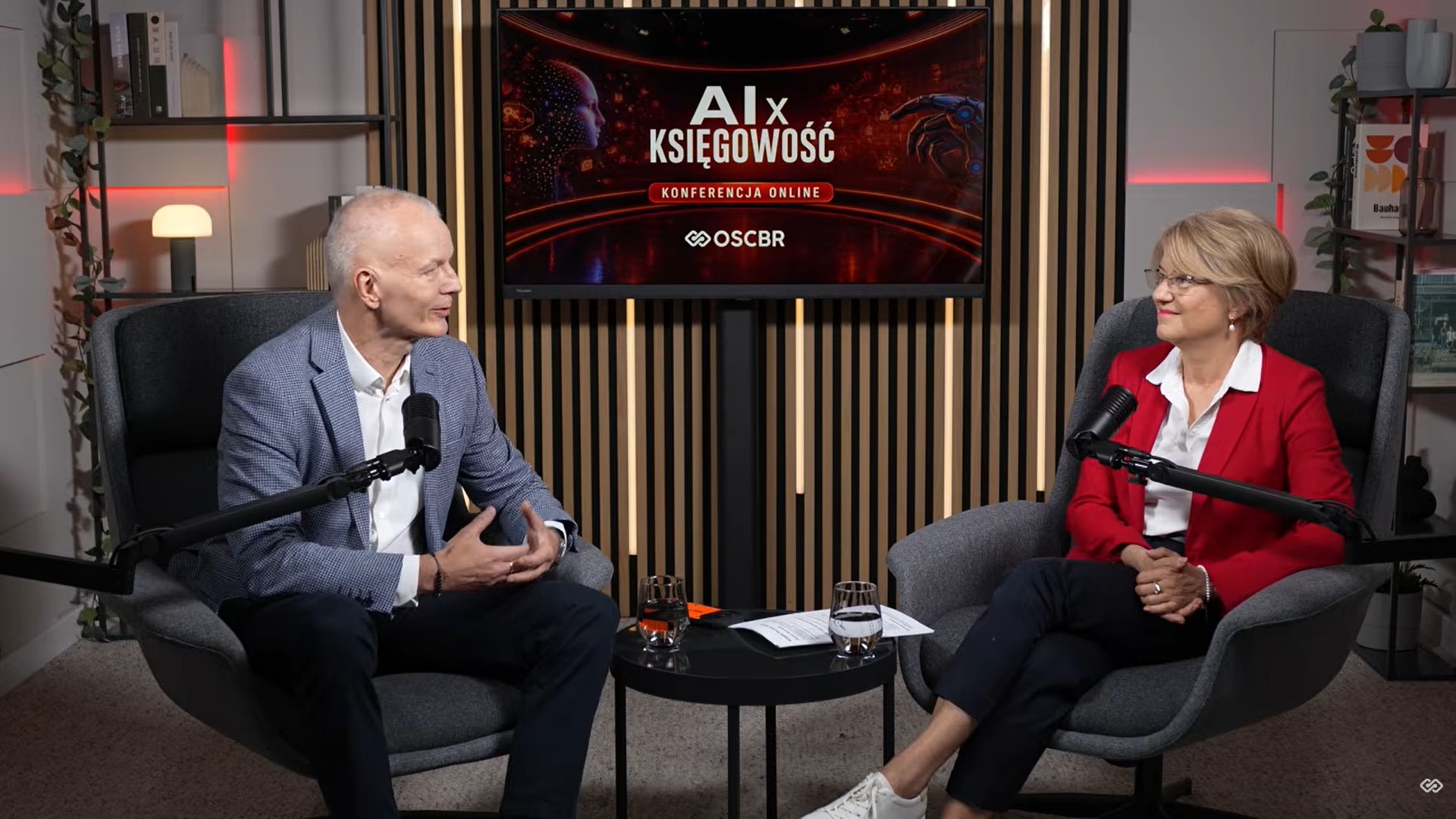
The company now reports connections with seven Polish banks and service to more than 300,000 entrepreneurs. Its biography credits Strzelecki with initiating the OSCBR accounting-office network, which it lists at 3,500 affiliated practices. Those organizational figures describe the setting of his work. The person inside it remains concerned with a more intimate transaction: an accountant helping an owner understand a business. The network gives that exchange a larger stage.
His public work returns to the same aspiration across different versions of the technology: financial tools and advice associated with large companies should become accessible to smaller ones. In 2006, that could mean hiring a finance director for a while. Today, it can mean connecting the bank account, the accounting system and the professional who explains the numbers. Strzelecki has spent years rearranging that relationship. The executive office may be virtual; the next bill remains quite real.
Continue the conversation
- Rafał Strzelecki on LinkedIn ↗Professional profile
- Meet the CashDirector founders ↗Company biography
- His 2006 discussion of accounting outsourcing ↗The early finance-director proposition; Polish
- Extor’s 2016 acquisition announcement ↗TMF Group announcement
- AI x Księgowość, June 2026 ↗Discussion recap with Rafał and Patrycja; Polish
- Watch the CashDirector Finovate demo ↗2018 presentation by Patrycja Strzelecka and Geoffrey Nicholson
- CashDirector on YouTube ↗Company videos
- CashDirector company blog ↗Accounting and business updates; Polish
- Patrycja Strzelecka’s business-history interview ↗Biznes Klasa, 2025; Polish