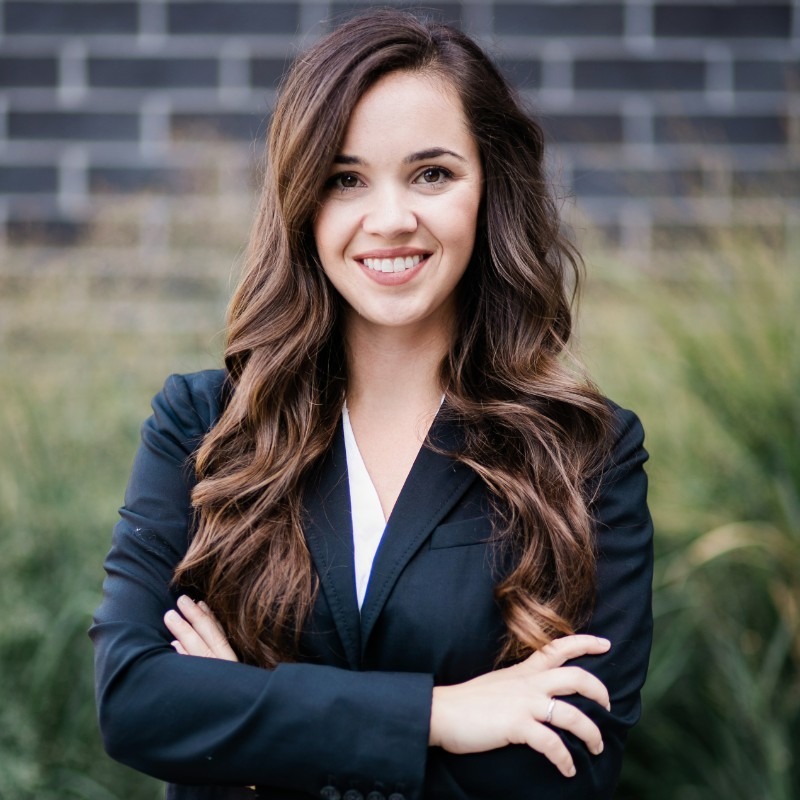
There is a specific Tuesday in 2017 when Rachel Soper Sanders was in a 900-square-foot office, hand-cutting stickers and writing notes to customers by hand. She had an MBA from Harvard. She had just spent years closing billion-dollar healthcare transactions for one of the country's top investment banks. And there she was - cutting stickers. She will tell you that was one of the most important weeks of her career.
That moment captures everything about how Rachel operates. She does not outsource understanding. She learns the whole machine before she lets anyone else touch it - and then she scales.
Today, Rachel Soper Sanders runs two parallel lives that most people would struggle to keep in the same sentence. She is the CEO and co-founder of Rootine, a precision nutrition company that personalizes cellular health down to your DNA profile. And she is a Venture Partner at 2048 Ventures, a $67 million fund based in New York, where she writes checks between $500K and $2 million into the next wave of health-tech founders.
Founders are firefighters - need to be flexible, wear many hats, and be willing to dig into even the most tedious of tasks.- Rachel Soper Sanders
Wall Street to Wellness: The Pivot That Wasn't a Pivot
Rachel grew up in Nashville, Tennessee. She graduated Cum Laude in Economics from Vanderbilt University in 2011, then spent four years at Raymond James Financial's Healthcare Investment Banking division - first as analyst, then associate. By the time she arrived at Harvard Business School in 2013, she had advised on M&A and public financing transactions collectively valued at over $5 billion.
That kind of Wall Street experience gives you a very specific lens: you learn to see every company as a machine, every founder as either a problem or a solution, and every market as either growing or dying. What you do not learn - at least not from a spreadsheet - is how to optimize the actual human running the machine.
That gap opened up after Harvard. Rachel was founding her first company - Patch Health, a practice management platform for physical therapy clinics, launched in 2017 - while simultaneously fighting what she could only describe as decision fatigue and burnout. She tried the standard playbook: supplements from the grocery store shelf. Generic vitamins. One-size-fits-all advice from the internet.
None of it was working. Because none of it was hers.
Investment Banker
4 years at Raymond James closing $5B+ in healthcare M&A. Learning the industry from the outside in.
Founder + VC
Building precision nutrition at Rootine. Backing the next generation of health founders at 2048 Ventures.
Co-founding Rootine: The Atlantic-Wide Partnership
Around the same time Rachel was battling burnout in Nashville, Dr. Daniel Wallerstorfer was doing something remarkably similar on the other side of the Atlantic. A Ph.D. biotechnician and nutrigenetic expert, Dr. Wallerstorfer was building Novogenia, Europe's leading genetics lab, while trying to optimize his own health through data.
Two people. Two continents. One shared conclusion: the supplement industry was broken, unregulated, and fundamentally lazy. It sold the same product to every human body, regardless of genetics, blood markers, lifestyle, or stress levels. The CDC data backed them up: 80% of Americans lack adequate daily micronutrients.
They met. They launched Rootine in 2018. The model was simple in concept and complex in execution: take a customer's DNA data, blood test results, and lifestyle factors, run them through a proprietary genomic algorithm, and produce a precision micronutrient supplement - custom-mixed, slow-release microbeads, delivered monthly.
Within a year of launch, they had raised a $3 million seed round. Within a few years, 85% of their members were reporting measurable improvements in energy, stress, focus, and sleep within three months of starting Rootine.
The Rootine Model at a Glance
The Operator's Mindset
Eight weeks after having her first daughter in January 2020, Rachel was giving press interviews about maintaining her health routine. She had switched from coffee to tea. She was doing squats and lunges while carrying the baby during calls. She was tracking her water intake with a 1-liter bottle, hitting 3-4 liters a day. She was nursing a newborn and running a fast-growing startup and she wanted to talk about oatmeal with berries.
This is not performance wellness. This is what it looks like when health is infrastructure, not accessory. Rachel is genuinely dogmatic about her own data - not as a brand move, but because Rootine only works if the person building it actually lives it.
The Daily Operating System
Venture Capital and the Health-Tech Thesis
When 2048 Ventures brought Rachel on as a Venture Partner, they were not hiring a celebrity check-signer. They were hiring someone who had lived the full stack: Wall Street, product strategy at a digital health company that sold for $1 billion, two company foundations, a seed raise, a Series A. Someone who understood both the deal memo and the sticker-cutting.
Her investment range at 2048 - $500K to $2 million, with a sweet spot around $1.3 million - puts her at the precise moment when a health-tech startup needs someone who knows both the capital markets and the consumer psychology. Her sectors span digital health, biotech, AI, fintech, AR/VR, and e-commerce.
Her thesis is direct: consumer health brands who can bridge the digital and physical world through products and services informed by personal data are more poised to win. She is not guessing at that. She built the case study herself.
Consumer health brands who can bridge the digital and physical world through products and services informed by personal data are more poised to win.- Rachel Soper Sanders
Web3, NFTs, and the Precision Health Club
In December 2021, Rachel launched Apex Optimizers - described, with full self-awareness, as the first collaborative NFT project focused on health and human performance optimization. Partners included Eight Sleep, Hydrant, Levels, and OneSkin. Athletes involved included Justin Gatlin. Collaborators included Anthony Pompliano and Steve Aoki.
The real-world benefits for token holders were not digital art bragging rights. They were product drops, brand discounts, access to pro athletes and health experts, and membership in the Precision Health Club. Eight percent of sale profits went to community-selected health charities.
Her view: regardless of where people spend their time - digital or physical - they still want to feel and perform their best daily. The Apex Optimizers project was a bet on that. The technology might shift. The desire for performance will not.
The Media Footprint
Rachel hosts the Smart Health with Rachel Sanders podcast, now available on iHeart Radio and Apple Podcasts. The show covers precision health, entrepreneurship, and wellness - the intersection she has lived professionally for over a decade.
Her Instagram account, @rachelsopsanders, sits at 182,000 followers. In a single recent month, she crossed 18 million views across social platforms. The content covers wellness and productivity, but it is not the generic influencer format. It is a working founder talking to people who actually want to optimize, not just aspire.
She has been featured in Business Insider, Entrepreneur, TechCrunch, Forbes, Thrive Global, Nashville Post, and BusinessWire. She has written for Levels. She has appeared on the Fitt Insider podcast and the Stand Up Comedy Podcast Network's health series, which suggests a range of comfort with different audiences and formats.
Decision fatigue and burnout are real. You don't really understand until you experience life as a startup founder.
Prioritizing my health and wellbeing, as well as spending time with my family, makes me a better founder.
Career in Full
Key Achievements
Co-founded Rootine, raising $3M seed and $10M Series A in precision nutrition
Advised on $5B+ in healthcare M&A deals at Raymond James Financial
Venture Partner at 2048 Ventures' $67M fund; investing $500K-$2M per deal
Founded Apex Optimizers - first health-focused collaborative NFT project
182K Instagram followers + 18M+ monthly social views
Featured in Forbes, Business Insider, Entrepreneur, TechCrunch, Thrive Global
Field Notes
- Born November 8 in Nashville, Tennessee. Currently based in New York, NY.
- 5 feet 1 inch tall. Very small person. Very large footprint.
- Drinks 3-4 liters of water daily, tracked with a 1-liter bottle like a scientist tracking an experiment.
- Has two daughters and a dog. Both mentioned with equal pride.
- Switched from coffee to tea postpartum - kept the habit permanently.
- Weekend pancakes exist in her world. Data-driven health does not mean joyless.
- Rootine vitamins can be mixed directly into smoothies and oatmeal.
- Apex Optimizers partnered with NFL player Brian Burns and Olympic sprinter Justin Gatlin.
- Her first company pivot came after personally living the burnout she is now trying to solve at scale.