Consider the quantum amplifier. Its job is to make a faint signal readable. For QuantaSense, a University of Calgary spin-out, that means developing equipment for the difficult business of measuring quantum systems. A better readout matters to a computing company trying to scale superconducting qubits. But an amplifier does not write its own business plan, negotiate a pilot or introduce itself to investors. Somewhere between the laboratory and the purchasing department, another kind of amplification is required.
- QAI Ventures combines investment with accelerators and venture building.
- Founders get technical mentorship, infrastructure access and introductions to industry.
- Its advertised global accelerator funding is up to $200K through a convertible note.
QuantaSense was one of five companies in QAI Ventures’ first Canadian graduating cohort. The others included quantum microscopes, microwave sensing and trapped-ion computing. This is an instructive collection. Quantum is often discussed as though it were one product awaiting one spectacular unveiling. Here, it looks more like a supply chain: instruments, components, software and businesses with different buyers and different clocks.
The experiment after the experiment
QAI Ventures occupies the space where those clocks must be reconciled. Founded in Switzerland in 2023, it is a venture capital firm with accelerator and company-building programs. Its scope includes quantum computing, sensing and communications, alongside advanced AI and the technologies that enable next-generation computing. The central proposition is practical: put investment, technical help and commercial relationships within reach of the same founder.
Its roots are in the privately funded uptownBasel initiative. The Swiss accelerator works from that innovation campus, close to the QuantumBasel ecosystem. This matters because a founder’s missing resource may be a machine, a laboratory connection or someone capable of distinguishing a plausible demonstration from an impressive slide. Office space is pleasant. Access to the right experiment is more consequential.
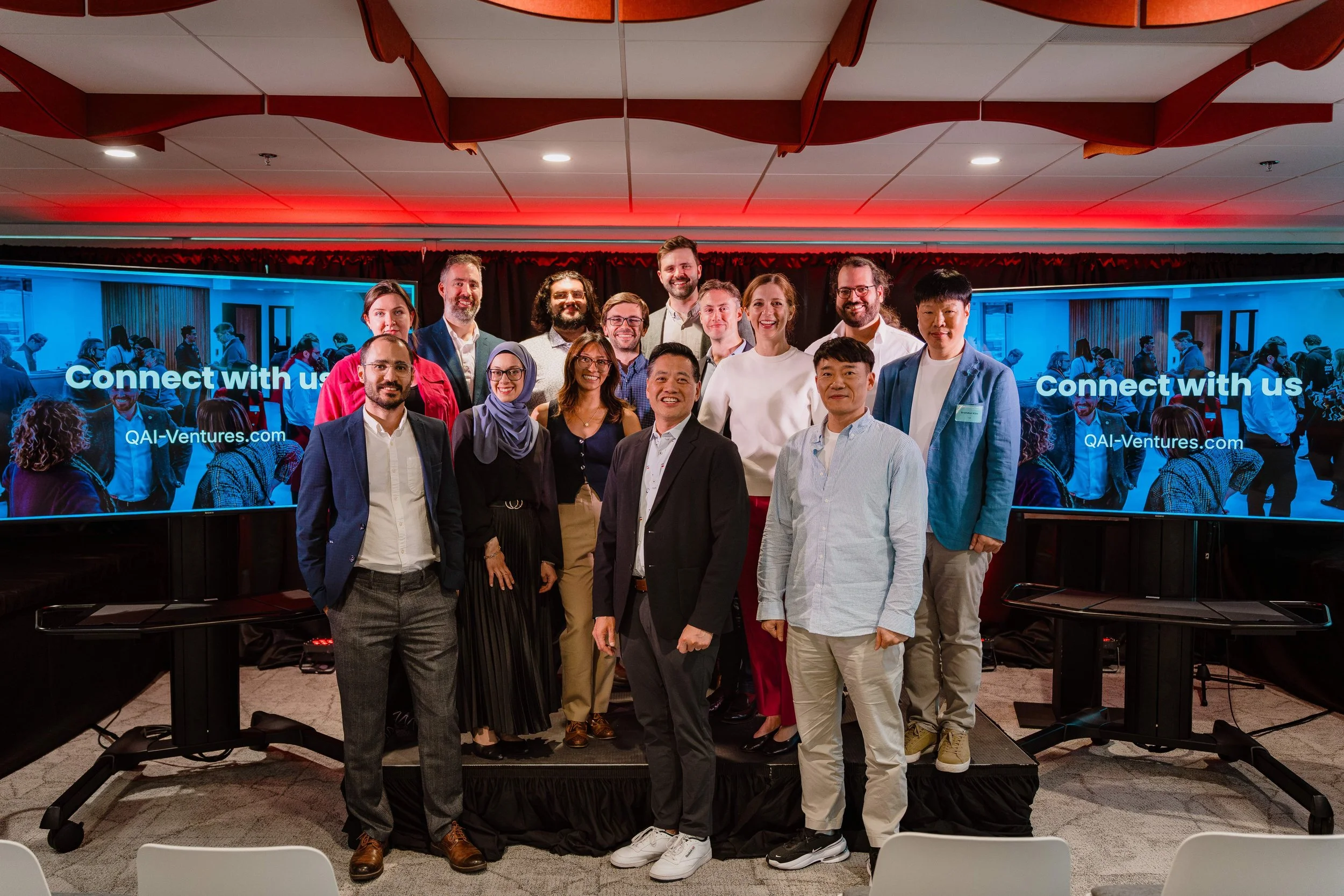
The business has three constituencies. Founders need money and help becoming companies. Corporate partners need useful applications, or a team built around an unsolved problem. Investors need a way to select technically difficult businesses. QAI’s platform puts these groups in conversation. The hoped-for result is a pilot or an investable company; an introduction alone is merely an introduction.
A cheque with a conversion clause
The global accelerator page advertises up to $200,000 through a convertible note. Strong performers may receive follow-on equity investment of up to $2 million. Weekly mentoring, masterclasses, hardware access and industry introductions accompany the capital. Topics include intellectual property, fundraising and explaining technical work to people who do not share the founder’s vocabulary.
For a founder, the financial distinction matters. A convertible note can become ownership under its terms. Optional follow-on funding remains optional. The sensible comparison is the usable cash, the contractual conversion terms and the resources a team will actually use. A generous list of benefits is worth less if the available hardware cannot answer your particular research question.
Convertible note
Equity investment
Series A-C
The growth-stage offer extends the relationship into Series A through C, advertising investments up to $12 million per company. That changes the selection question. The growth fund looks for proven technology, commercial traction and visibility into revenue. The early program helps establish those things. Fund capital and portfolio fundraising belong on different ledgers from QAI Ventures’ own corporate revenue.
Borrow the machine. Meet its people.
In August 2023, QAI partnered with neutral-atom quantum-computer maker QuEra. The arrangement included access to its machines, training and consulting with scientists about whether a proposed problem suited the hardware. That last provision is revealing. Compute time is more useful when someone can tell you which experiment deserves it.
The original Swiss cohort began the previous month with Anaqor, Kipu Quantum, Miraex, Moonlight AI and qdc. The announcement described CHF 100,000 for each company plus services. Today’s global offer uses different numbers and instruments. These are dated program descriptions, and treating them as interchangeable would obscure the deal a founder must evaluate now.
“The most impressive part of the QAI Ventures program has to be the mentors.”César A. Rodríguez Rosario, Commutator Studios
The mentor testimonial hints at QAI’s competitive position. A generalist investor can supply capital. A university commercialization office can help with research IP. A hardware company can supply access to its system. QAI attempts to coordinate several of those functions. Its advantage depends on whether that coordination saves a founder time and produces useful decisions.
Three hubs, three routes to a buyer
Calgary adds a local partner: Quantum City at the University of Calgary. The relationship connects companies to research infrastructure, mentors and industrial networks. QAI established its Asia-Pacific headquarters in Singapore in September 2025; its first accelerator cohort there launched in July 2026 with Enterprise Singapore’s support.
Four companies were selected from 63 applications across 12 countries. The launch announcement described SGD 300,000 investment packages and mandatory masterclass weeks. Between those weeks, founders receive individual coaching. The promise is a route into Asia-Pacific with people who know the local institutions, rather than international expansion conducted entirely through a browser tab.

Start with the missing piece
For researchers who have IP but no company, QAI’s venture-building offer starts earlier: commercial validation, team formation, licensing and prototype development. Corporates can bring an unsolved challenge. Entrepreneurs can seek a technical co-founder. The transferable lesson is to identify the missing piece precisely. “We need an ecosystem” is a wish. “We need a partner to test this readout” can become a task.
The fit has limits. Accelerator applicants generally need a proof of concept or MVP and a committed team. A company without a relevant technical problem, or unable to attend required sessions, should assess that mismatch before applying. Mentorship can sharpen a commercial argument; it cannot make an unsuitable technology meet a buyer’s requirements.
In August 2026, QAI added another route into its network: a partnership with iAccess Partners offering qualified or professional investors fund access from $25,000 through existing securities accounts. Across founders and investors, the recurring idea is access with specific conditions. The interesting question for any participant is concrete: which obstacle will this relationship remove next?